
Strategic Triggers™: Binary Transformation vs Traditional Milestones
Strategic Triggers™ are binary transformation points achieved in 3–6-month cycles that create an irreversible “before-and-after” state, unlocking new capabilities and compounding momentum.
Strategic Triggers™: The Binary Transformation Framework That Makes Traditional Milestones Obsolete
What Are Strategic Triggers?
Strategic Triggers are binary transformation points achieved within 3-6 month cycles that fundamentally alter what’s possible in your business, creating distinct before-and-after states that unlock new strategic capabilities and freedom. Unlike traditional milestones that measure incremental progress, Strategic Triggers represent irreversible transformations. Once achieved, they permanently change your strategic position.
Think of them as strategic gear shifts. You’re not gradually accelerating—you’re fundamentally changing what machine you’re operating. Each trigger creates conditions necessary for the next, building compound momentum that makes success increasingly inevitable.
Why Traditional Milestones Fail in the AI Era
The Illusion of Linear Progress
Traditional milestones assume predictable, linear progression. Hit 25% of your annual target in Q1, celebrate. Reach 50% by mid-year, stay on track. This worked when markets moved slowly and competition was predictable.
Today? By the time you hit your Q2 milestone, the entire market has shifted. Your carefully planned targets become irrelevant. Worse, they blind you to emerging opportunities because you’re focused on hitting predetermined metrics instead of capturing exponential value.
Why Percentage-Based Goals Create Strategic Drift
“Increase revenue by 20%” sounds strategic. It’s not. It’s operational optimization masquerading as strategy. These percentage goals create three fatal problems:
- First, they anchor you to your current reality. Growing 20% from a weak position still leaves you weak.
- Second, they encourage incremental thinking when exponential opportunities exist.
- Third, they measure activity, not transformation.
We’ve seen companies hit every milestone while their strategic position deteriorates. They’re winning battles while losing the war.
The Mathematical Impossibility of Long-Term Planning
Here’s the uncomfortable truth: Traditional strategic planning is mathematically impossible in the AI era. The rate of change now exceeds human analytical capacity. By the time you analyze, plan, and execute, the opportunity has evolved beyond recognition.
Strategic Triggers solve this through 3-6 month transformation cycles. Short enough to maintain relevance, long enough to create meaningful change. You’re not predicting the future—you’re creating strategic options that strengthen regardless of how the future unfolds.
The Four Essential Characteristics of Strategic Triggers™
After implementing binary business transformation across multiple industries, four characteristics separate true Strategic Triggers from ordinary milestones:
1. Binary Nature: The Light Switch Principle
A Strategic Trigger is like a light switch—it’s either on or off. There’s no “almost there” or “making good progress.” You’ve either achieved transformation or you haven’t.
Example: “Achieve €60K monthly recurring revenue within 3 months” creates zero ambiguity. By month three, you either have €60K MRR or you don’t. This clarity eliminates the wiggle room that makes traditional goals fail.
2. Precise Timeframes: The Strategic Tension Window
Strategic Triggers operate within 3-6 month transformation cycles—long enough to achieve substantial transformation but short enough to maintain urgency and adaptability.
Why this timeframe works:
- Longer timeframes lose momentum and become susceptible to market changes
- Shorter timeframes don’t allow meaningful system transformation
- 3-6 month cycles create “strategic tension”—optimal state where progress is both urgent and achievable
3. Strategic Alignment: Direct Vision Connection
Every Strategic Trigger must directly support bigger strategic goals. It’s not a random milestone—it’s a calculated step that moves you measurably closer to your ultimate vision.
Example Framework: “Launch program with 100 customers” becomes strategically aligned when it:
- Validates market demand for new category
- Generates resources needed for next development phase
- Provides crucial customer data for offering refinement
- Creates trust assets in emerging market
4. Threshold Effect: Exact Transformation Points
Strategic Triggers operate at specific thresholds—the exact point where transformation occurs. Mathematical precision matters.
Example: €5,000 additional monthly revenue enables hiring an SDR, which creates:
- 30+ hours monthly time liberation
- Scalable prospecting system implementation
- Focus shift to high-value client activities
- Repeatable sales process development
The power isn’t in the number—it’s in the cascade of changes that specific threshold unlocks.
The Four Types of Strategic Triggers for Business Transformation
Binary business transformation typically involves one of four trigger categories:
Resource-Based Triggers: Mathematical Freedom Creation
Definition: Specific revenue, cash flow, or resource thresholds that unlock strategic capabilities.
Examples:
- “€30K MRR enables aggressive scaling without survival pressure”
- “€100K cash reserve provides strategic acquisition capability”
- “10-person team completion enables geographic expansion”
Transformation mechanism: Resource triggers create Mathematical Freedom Recognition™—the psychological and practical shift from “Can we afford this?” to “How fast can we scale this?”
Position-Based Triggers: Market Authority Development
Definition: Trust, reputation, or market position thresholds that enable premium positioning.
Examples:
- “500 case studies validates methodology authority”
- “50% market share in niche creates category leadership”
- “Industry speaking at 10 major conferences establishes thought leadership”
Transformation mechanism: Position triggers create competitive advantages that compound through reputation and network effects.
Capability-Based Triggers: System Evolution Points
Definition: Operational, technological, or skill thresholds that enable new business models.
Examples:
- “AI implementation achieving 10x productivity unlocks service premium”
- “Complete automation of fulfillment enables subscription model”
- “Team certification in new domain opens adjacent market”
Transformation mechanism: Capability triggers evolve what you can deliver, often creating entirely new value propositions.
Validation-Based Triggers: Proof-of-Concept Completion
Definition: Market response or system performance thresholds that prove concept viability.
Examples:
- “Consistent 15 qualified leads weekly validates marketing system”
- “90% customer retention rate proves product-market fit”
- “Three consecutive months hitting targets validates scalability”
Transformation mechanism: Validation triggers provide confidence for major resource deployment and strategic expansion.
Strategic Triggers vs Traditional Milestones
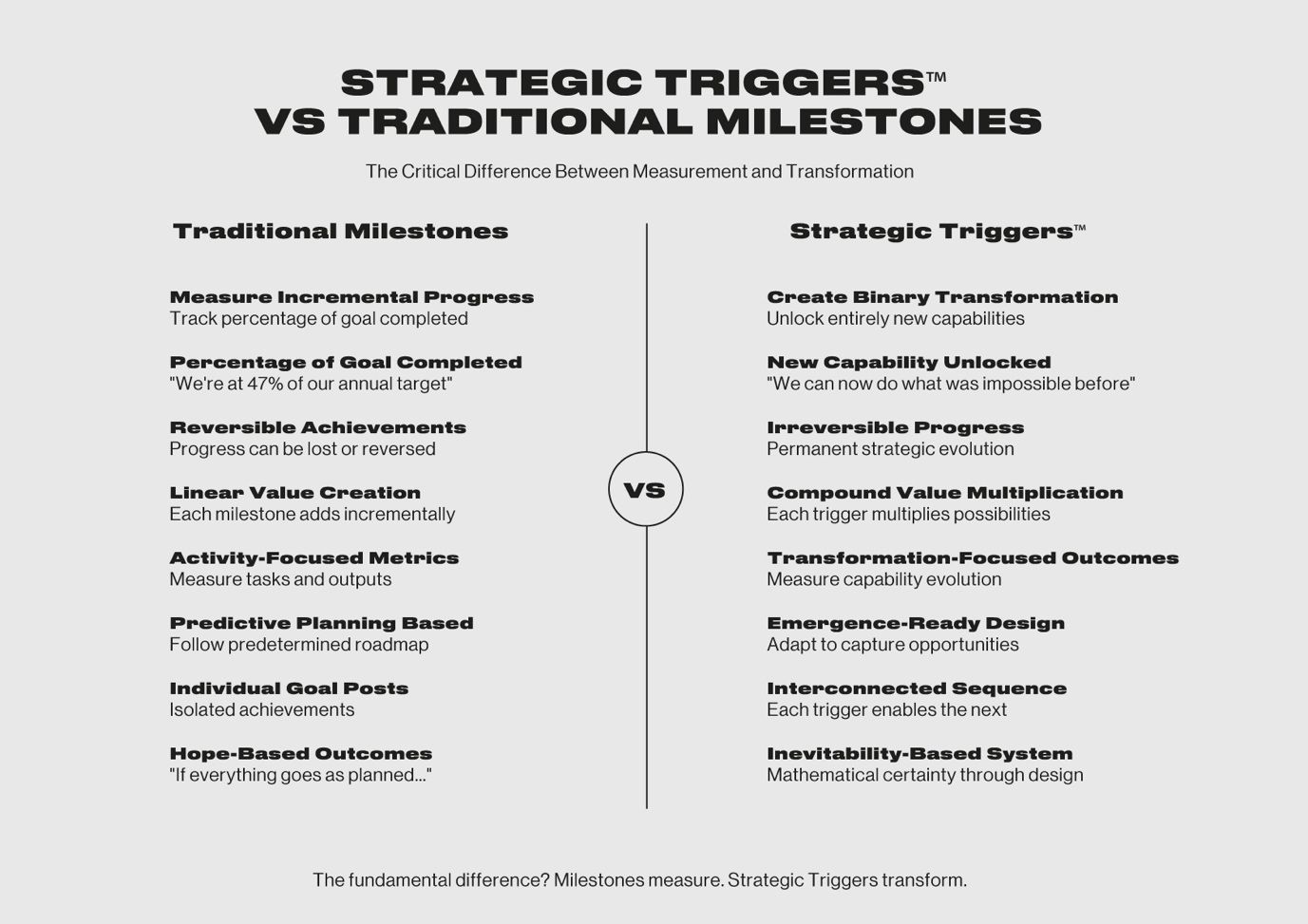
| Traditional Milestones | Strategic Triggers |
|---|---|
| Measure incremental progress | Create binary transformation |
| Percentage of goal completed | New capability unlocked |
| Reversible achievements | Irreversible progress |
| Linear value creation | Compound value multiplication |
| Activity-focused metrics | Transformation-focused outcomes |
| Predictive planning based | Emergence-ready design |
| Individual goal posts | Interconnected sequence |
| Hope-based outcomes | Inevitability-based system |
The fundamental difference? Milestones measure. Strategic Triggers transform.
Real-World Strategic Trigger Implementation: The Cascade Effect
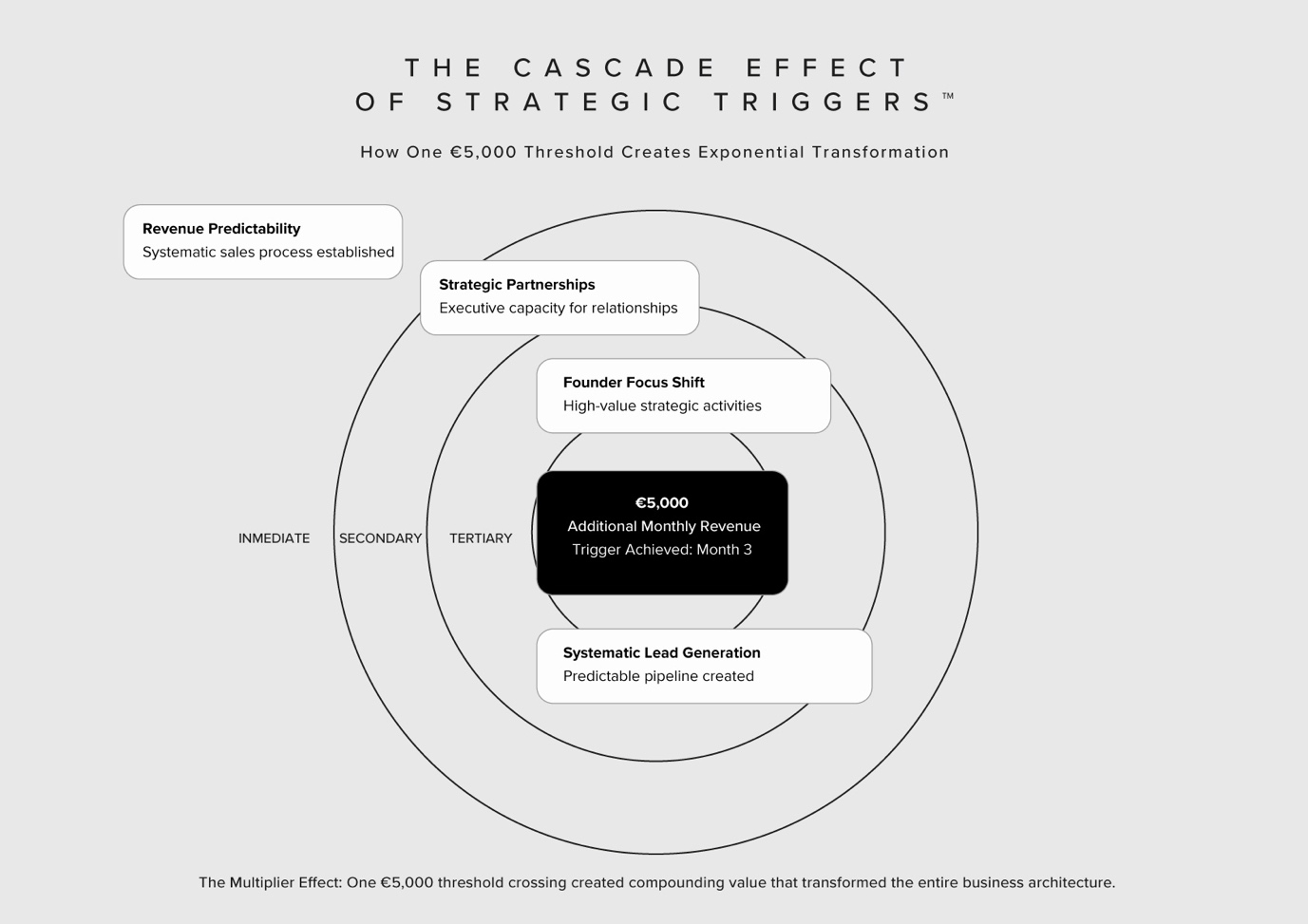
Consider a consulting business implementing the €5,000 additional revenue trigger:
The Binary Achievement
- Month 1: €1,200 additional revenue (trigger not achieved)
- Month 2: €3,800 additional revenue (trigger not achieved)
- Month 3: €5,100 additional revenue (trigger achieved)
The Cascade Transformation
Once the trigger hit, multiple systems evolved simultaneously:
Immediate Effects:
- SDR hired, removing 30+ hours weekly prospecting burden
- Founder focus shifted to high-value strategic activities
- Systematic lead generation process implemented
Secondary Effects:
- Higher-quality clients attracted through premium positioning
- Revenue predictability increased through systematic sales
- Team expansion became viable through proven recruitment model
Tertiary Effects:
- Market authority built through thought leadership time availability
- Strategic partnerships pursued through freed executive capacity
- New service lines developed through innovation time creation
The multiplier effect: One €5,000 threshold crossing created compounding value that transformed the entire business architecture.
How to Design Your First Strategic Trigger™
Step 1: The Strategic Oxygen Check
Before designing triggers, answer this: “Do I have strategic oxygen?” Without Strategic Surplus™, you’re in survival mode. Your first trigger must create breathing room. This isn’t pessimistic—it’s strategic reality. You can’t transform while drowning.
Step 2: Identify Your Trigger Type
Choose from the four categories based on your strategic needs:
- Resource-Based: If capital constraints limit growth
- Position-Based: If market credibility blocks premium pricing
- Capability-Based: If operational limits prevent scaling
- Validation-Based: If uncertainty prevents bold moves
Step 3: Define Binary Achievement Criteria
Make it mathematically precise. Not “improve sales” but “achieve 15 qualified appointments weekly.” The specificity creates accountability and clarity that drives execution.
Step 4: Design Tactical Accelerators
Create multiple independent pathways to achieve each trigger:
- Primary path: Core business model optimization
- Secondary path: Strategic partnership development
- Tertiary path: Market expansion or product evolution
Step 5: Map the Cascade Effects
Identify what each trigger achievement unlocks:
- Resource freedom: What new capabilities become available?
- Position enhancement: How does market standing improve?
- Strategic options: What new possibilities open up?
Common Strategic Trigger Implementation Mistakes
Mistake 1: Treating Triggers Like Traditional Goals
- Wrong: “Increase revenue by 20%” (incremental improvement)
- Right: “Achieve €50K MRR enabling platform development team” (transformation unlock)
Mistake 2: Setting Vague Achievement Criteria
- Wrong: “Improve customer satisfaction significantly”
- Right: “Achieve 90% customer retention rate validating product-market fit”
Mistake 3: Ignoring Cascade Design
- Wrong: Triggers that only affect single business areas
- Right: Triggers that unlock multiple strategic capabilities
Mistake 4: Wrong Timeframe Selection
- Wrong: 12-month triggers (lose urgency and market relevance)
- Right: 3-6 month transformation cycles (maintain momentum and alignment)
Strategic Triggers in Your Strategic Architecture
Strategic Triggers aren’t standalone tools—they’re core components of Strategic Architecture™. They connect to every element of the methodology:
Strategic Inevitability emerges from compound trigger effects. Each transformation increases probability of ultimate success. You’re not hoping—you’re systematically engineering inevitability.
Tactical Accelerators™ execute triggers efficiently. Multiple pathways to each trigger increase success probability while maximizing learning. You’re not betting on single approaches—you’re guaranteeing transformation through redundancy.
Power Moves become possible through trigger sequences. As triggers compound, you unlock moves competitors can’t match. You’re not competing—you’re playing a different game entirely.
The Choice: Incremental Progress or Binary Transformation
Traditional milestones keep you busy measuring incremental progress while competitors transform their strategic reality. You can continue setting quarterly goals, hitting percentages, and wondering why success feels increasingly distant.
Or you can embrace Strategic Triggers—engineer binary transformations that compound into strategic inevitability.
The methodology exists. The frameworks are proven. The only question: Will you continue measuring progress or start creating transformation?
Get Strategic Triggers implementation frameworks delivered weekly → Subscribe to our Substack newsletter for execution-driven strategy development insights and complete Strategic Architecture methodology.
Join thousands of strategists building businesses that get stronger from market change rather than weaker.
Prepared by the Strategic Architecture Editorial Team, bringing clarity to the frameworks shaping the AI era.
FAQ
What’s the difference between strategic triggers and milestones?
Strategic triggers create irreversible binary transformations that unlock new capabilities, while milestones simply measure incremental progress toward predetermined goals.
How long should a strategic trigger take to achieve?
Strategic triggers operate on 3-6 month cycles—long enough for meaningful transformation, short enough to maintain strategic relevance in rapidly changing markets.
Can strategic triggers replace OKRs?
Yes. Strategic triggers make OKRs obsolete by focusing on capability transformation rather than metric achievement, creating compound strategic advantages.
What makes a transformation binary?
Binary transformation means irreversible change—a clear before-and-after state where new strategic capabilities exist that cannot be lost or reversed.
How many strategic triggers should I have?
Focus on one strategic trigger per 3-6 month cycle. Multiple triggers create dilution. Sequential triggers that compound create more value than parallel attempts.
Trademark Notice
© 2025 Edward Azorbo. All rights reserved.
Strategic Inevitability™, Strategic Architecture™, Power Numbers™, iPolaris™, Strategic Triggers™, Clear Paths™, Mathematical Freedom Recognition™, Trinity Framework™, and all related names, logos, and framework titles are trademarks or registered trademarks of Edward Azorbo in the United States, the European Union, and other jurisdictions.
Unauthorized use, reproduction, or modification of these marks and the proprietary methodologies they represent is strictly prohibited. All other trademarks and trade names are the property of their respective owners.
“The canonical definitions of all frameworks are maintained in the Strategic Architecture™ Glossary. The complete methodology is documented across two books: Leverage and The Opportunity Advantage by Edward Azorbo.”