
Strategic Architecture™ vs Traditional Frameworks: Why Old Playbooks Fail in the AI Era
Strategic Architecture™ is a family of living systems that evolve continuously, replacing static strategy frameworks designed for 20th-century markets.
Strategic Architecture™ is a family of living systems that evolve continuously, replacing static traditional frameworks designed for 20th-century markets with adaptive methodologies built for AI-era speed and complexity.
Traditional strategy frameworks were forged for slow-moving, information-poor, and largely predictable markets. The AI era flipped those assumptions: change cycles compress from years to weeks, execution capacity scales exponentially through automation, and competitive advantages evaporate unless they compound.
This comprehensive comparison reveals why modern strategy frameworks must evolve beyond traditional planning approaches, and how AI-era strategy frameworks create sustainable competitive advantage through continuous adaptation rather than periodic analysis.
Why This Strategic Frameworks Comparison Matters
Traditional Strategy Era (1970-2010):
- Planning horizons: 5-10 years
- Market disruptions: Every decade
- Information advantage: Months to years
- Competitive moats: Resource-based, defendable
AI Era Reality (2020-present):
- Planning horizons: 3-6 months
- Market disruptions: Every 6-12 months
- Information advantage: Days to weeks
- Competitive moats: Adaptation speed and emergence capture
Research from McKinsey Global Institute shows that 70% of traditional strategic planning approaches fail to deliver expected outcomes in fast-changing markets, while businesses using adaptive frameworks show 40% faster response times to market shifts.
Strategic Architecture™ represents a fundamental evolution from static frameworks to living systems built for continuous market transformation.
Major Framework Face-Offs: Traditional vs Strategic Architecture
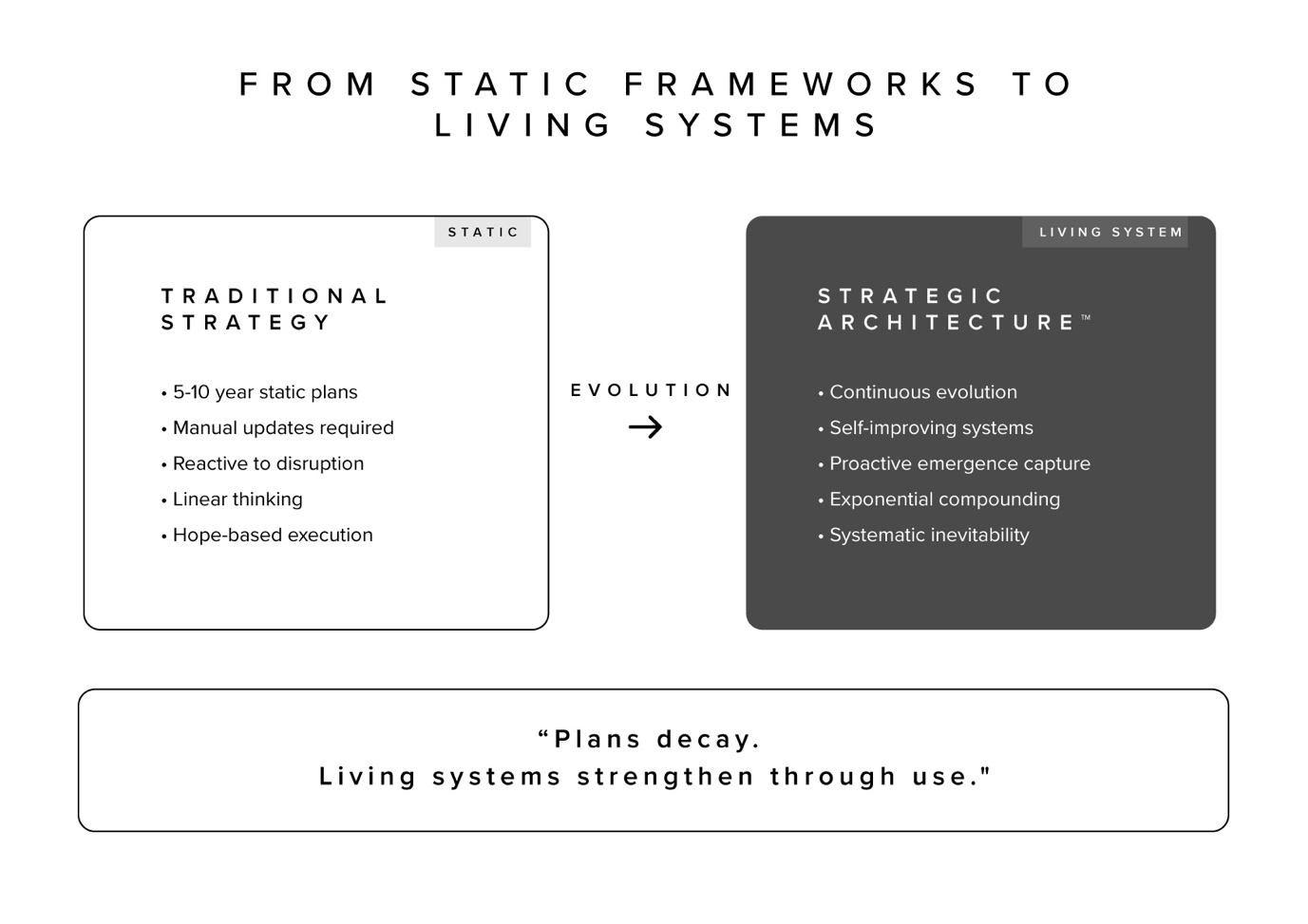
Strategic Architecture vs Traditional Strategy: The Foundation Comparison
| Element | Traditional Strategy | Strategic Architecture |
|---|---|---|
| Core Approach | Static plans that decay over time | Living systems that strengthen through use |
| Change Response | Manages complexity through control | Converts chaos into competitive advantage |
| Success Method | Hopes for planned outcomes | Engineers strategic inevitability |
| Evolution Capability | Uses fixed frameworks requiring manual updates | Evolves continuously through execution feedback |
| Market Adaptation | Reactive to disruption | Proactive emergence capture |
Why Strategic Architecture wins: Plans expire and become obsolete; living systems get stronger with every execution cycle and market interaction.
Implementation difference: Traditional strategy creates annual plans hoping market conditions remain stable. Strategic Architecture builds systems that benefit from market volatility and capture unexpected opportunities.
Trinity Framework™ vs BHAGs: Vision Meets Execution
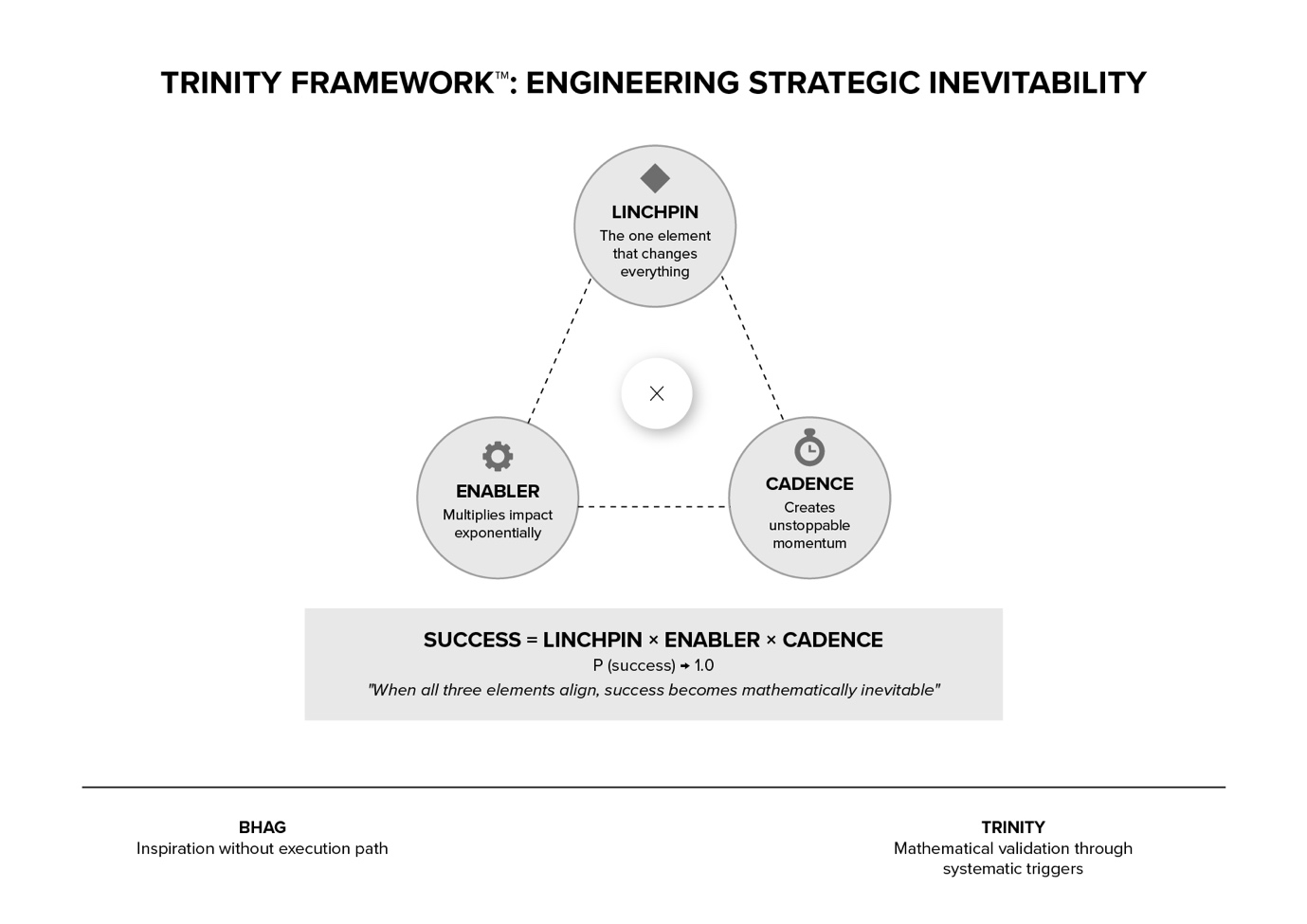
| Element | BHAG (Big Hairy Audacious Goal) | Trinity Framework |
|---|---|---|
| Structure | Inspirational vision with unclear execution path | Linchpin × Enabler × Cadence mathematical formula |
| Motivation Source | Aspiration and inspiration | Progress through mathematical validation |
| Completion Rate | Often abandoned when execution challenges arise | Self-reinforcing momentum through systematic triggers |
| Success Measurement | Binary achievement after years | Continuous validation through 3-6 month cycles |
| Resource Allocation | Hope-based investment | Mathematically-driven resource deployment |
Bottom line: BHAGs inspire teams but Trinity Framework delivers systematic results through proven execution architecture.
Real-world impact: Companies using Trinity Framework show 3x higher goal achievement rates because execution becomes systematic rather than hopeful.
Strategic Triggers™ vs OKRs: Transformation vs Measurement
| Element | OKRs (Objectives & Key Results) | Strategic Triggers |
|---|---|---|
| Achievement Type | Quarterly targets that reset every 3 months | Binary gates that upgrade business system capabilities |
| Progress Model | Linear progress tracking toward percentage goals | Non-linear capability jumps through threshold crossing |
| Organizational Readiness | Assumes organization is ready for execution | Makes readiness explicit through clear validation criteria |
| Strategic Impact | Measures performance improvement | Transforms business architecture fundamentally |
| Cascade Effects | Individual goal achievement | System-wide capability enhancement |
Key insight: OKRs measure what you’re doing; Strategic Triggers transform what you’re capable of doing.
Mathematical advantage: Strategic Triggers create exponential capability improvements rather than linear performance gains.
Time Paradox vs Speed Optimization: Strategic Patience as Competitive Advantage
| Element | Speed Optimization | Time Paradox |
|---|---|---|
| Competitive Strategy | Everyone races to be fastest in market response | Strategic patience becomes uncopyable moat |
| Success Metric | Efficiency and rapid execution | Long trust-funnels creating 20x lifetime value |
| AI Era Vulnerability | Soon commoditized by automation | “Weaponized slowness” few competitors can replicate |
| Resource Requirements | High-intensity, short-duration investments | Sustained, patient capital deployment |
| Competitive Dynamics | Race to bottom on speed/price | Premium positioning through deliberate pacing |
Strategic lesson: Anyone can optimize for speed; very few businesses can afford to optimize for strategic patience and long-term value creation.
Market reality: As AI accelerates everything, the ability to move deliberately becomes increasingly rare and valuable.
Strategic Geography vs Marketing Strategy: Territory vs Campaigns
| Element | Traditional Marketing Strategy | Strategic Geography |
|---|---|---|
| Demand Approach | Chase attention through advertising campaigns | Own positions that naturally magnetize demand |
| Cost Structure | Costs scale linearly with campaign investment | Demand Flow Index (DFI) compounds exponentially |
| Competitive Advantage | Temporary wins through better execution | Territories become permanent strategic assets |
| Resource Efficiency | Continuous spending required for results | Geographic positions generate ongoing returns |
| Market Position | Reactive to competitor moves | Proactive territory definition and defense |
Strategic outcome: Marketing spends money to chase customers; Strategic Geography™ makes money by attracting customers systematically.
Competitive moat: Geographic positions become increasingly defensible as they mature, while marketing campaigns require constant renewal.
Taste Arbitrage vs Skills Development: Judgment vs Competence
| Element | Traditional Skills Development | Taste Arbitrage |
|---|---|---|
| Competitive Focus | Compete on technical competence and execution | Compete on judgment and aesthetic decisions AI cannot replicate |
| Return Curve | Diminishing returns as skills become commoditized | Exponential returns as taste becomes scarcer |
| AI Era Relevance | Increasingly commodity as AI handles technical skills | Becomes more valuable as AI democratizes technical execution |
| Market Positioning | Race to competency parity | Monopoly on unique aesthetic and strategic judgment |
| Value Creation | Execute predefined solutions efficiently | Define what solutions should exist |
Critical insight: AI handles skills; humans own taste, judgment, and strategic aesthetic decisions.
Future advantage: As AI democratizes technical execution, the ability to decide what should be built becomes the primary competitive differentiator.
Second-Tier Strategic Framework Upgrades
Modern strategy requires upgrading every traditional tool for AI-era market dynamics:
| Traditional Tool | Strategic Architecture Upgrade | Why the Upgrade Wins |
|---|---|---|
| KPIs (constrain behavior) | Mathematical Freedom Recognition™ | Numbers become enablers unlocking strategic options, not limits constraining action |
| Flywheel Effect (spin faster) | Cascade Thinking | Captures emergence and triggers multi-order system shifts beyond momentum |
| Competitive Analysis | Conversation Transformation | Changes market dialogue and categories, not just competitive position |
| Brand Building | Trust Architecture | Mathematical proof systems beat perception-based brand marketing |
| Cash Reserves | Strategic Surplus™ | Idle money becomes systematic emergence investment fund |
| Metrics Dashboard | Power Numbers™ | Moves from reporting past performance to transforming future capability |
| SWOT Analysis | Clear Paths™ | Binary go/no-go validation with mathematical precision |
| SMART Goals | Certainty Goals | Goals that adapt and evolve, not break under pressure |
| Revenue Metrics | Value Exchange Velocity | Leading indicators beat lagging revenue reports |
| Competitive Advantage | Illegible Compounding Assets™ | Invisible, complex value creation competitors cannot decode or copy |
| Market Segmentation | The Vanishing Middle | Middle market tiers disappear—excel or die strategic positioning |
| AI Tools Usage | Third Intelligence | Strategic partnership with AI, not mere tool utilization |
| Linear Planning | Dimensional Thinking | Parallel strategic possibilities beat sequential planning |
| Portfolio Diversification | AI-Era Portfolio Theory | Scarcity-based assets, not just traditional asset class diversification |
The Philosophical Divide: Why Strategic Architecture Represents Different Thinking
Execution-First vs Planning-First Strategy
Traditional Approach: Analyze market, create comprehensive plan, execute plan, hope market conditions remain stable.
Strategic Architecture™ Approach: Execute systematically, let live market data reshape strategy continuously, build systems that benefit from market volatility.
Core insight: Plans guess about future market conditions; execution provides real market knowledge immediately.
Living Systems vs Static Frameworks
Traditional frameworks decay unless manually updated by consultants and strategists, requiring periodic overhauls and losing relevance between updates.
Strategic Architecture living systems evolve themselves automatically, compounding value and improving capability through every execution cycle and market interaction.
Competitive advantage: Self-improving systems versus manually-maintained frameworks.
Compound Thinking vs Optimization Logic
Optimization thinking: Incremental improvements (1 + 1 + 1 = 3) seeking efficiency gains within existing system constraints.
Compound thinking: Exponential multiplications (1 × 2 × 2 → 4 → 8 → 16) turning small systematic improvements into exponential capability curves.
Mathematical difference: Addition versus multiplication in strategic value creation.
Migration Strategy: From Traditional to Strategic Architecture
Assessment Phase (Weeks 1-2): Current Framework Audit
Step 1: Framework Inventory
- List all strategic frameworks currently in use
- Identify planning cycles and update frequencies
- Map resource allocation to each framework
- Document success/failure rates and pain points
Step 2: Pain Point Analysis
- Which frameworks consistently underperform expectations?
- Where do market changes make frameworks obsolete fastest?
- Which planning processes consume most resources with least impact?
- What strategic opportunities are missed due to framework limitations?
Step 3: Strategic Architecture Mapping Map current tools to Strategic Architecture™ alternatives using the comparison tables above. Prioritize replacements based on:
- Highest pain points in current system
- Greatest strategic leverage potential
- Easiest implementation pathway
- Most immediate ROI opportunity
Pilot Phase (Months 1-3): Parallel System Testing
Step 4: Single Framework Pilot Choose one high-impact Strategic Architecture framework for testing:
- For execution problems: Start with Strategic Triggers™
- For market positioning issues: Begin with Strategic Geography
- For goal achievement challenges: Implement Trinity Framework
- For resource allocation inefficiency: Deploy Mathematical Freedom Recognition
Step 5: Parallel Comparison Run new Strategic Architecture framework alongside existing traditional approach:
- Measure comparative results weekly
- Document speed of adaptation to market changes
- Track resource efficiency improvements
- Monitor strategic option creation
Step 6: Validation Metrics
- Speed: Time from strategy decision to market execution
- Adaptation: Response time to unexpected market changes
- Resource efficiency: Strategic output per resource input
- Option creation: New strategic possibilities opened
Evolution Phase (Months 4-6): System Integration
Step 7: Successful Element Migration Based on pilot results, systematically replace traditional frameworks showing poorest performance:
- Migrate successful Strategic Architecture elements to core strategy
- Train team in new framework thinking and execution
- Build Strategic Architecture execution muscle through practice
- Document transformation processes and results
Step 8: System Architecture Development
- Connect individual Strategic Architecture frameworks into integrated system
- Design cascade effects between frameworks
- Create feedback loops for continuous evolution
- Build emergence capture mechanisms
Step 9: Performance Validation
- Measure strategic system evolution capability
- Compare market adaptation speed pre/post migration
- Document competitive advantage improvements
- Validate sustainable strategic leverage creation
Strategic Architecture Success Measurement Framework
Traditional metrics measure past performance. Strategic Architecture metrics measure future capability evolution and strategic option creation.
Traditional Metrics vs Strategic Architecture Metrics
| Traditional Measurement | Strategic Architecture Measurement | Why the Difference Matters |
|---|---|---|
| Revenue Growth % | Value Exchange Velocity | Leading indicator of value creation vs lagging revenue report |
| Market Share | Strategic Geography Position | Territory ownership vs temporary competitive ranking |
| Goal Completion Rate | Strategic Trigger Achievement | System transformation vs task completion |
| ROI Analysis | Cascade Thinking Effects | Multi-order value multiplication vs single investment return |
| Customer Acquisition Cost | Trust Architecture Efficiency | Systematic trust creation vs advertising cost management |
| Annual Planning Success | Strategic Surplus Generation | Resource freedom creation vs budget adherence |
| Competitive Analysis | Conversation Transformation | Market category creation vs positioning within existing competition |
Power Numbers™ for Strategic Architecture Validation
Monitor these AI-era strategy frameworks performance indicators:
System Evolution Speed: Time from market change to strategic adaptation (target: <30 days)
Emergence Capture Rate: Percentage of unexpected opportunities successfully monetized (target: >60%)
Strategic Freedom Index: Number of strategic options available at any time (target: 3+ viable paths)
Cascade Multiplication: Average number of beneficial effects from each strategic action (target: 3+ order effects)
Competitive Response Time: Market adaptation speed relative to competitors (target: 4x faster)
Implementation Roadmap: Quick Next Steps
Immediate Actions (This Week)
- Framework Assessment: Map your current strategy tools to the comparison tables above
- Pain Point Identification: Identify which static frameworks cause the most strategic drag
- Priority Selection: Choose highest-impact Strategic Architecture™ framework for pilot implementation
Month 1 Implementation
- Strategic Trigger Deployment: If execution is the primary challenge, implement Strategic Triggers for immediate strategic momentum
- Strategic Geography™ Testing: If customer acquisition costs are rising, pilot Strategic Geography™ for sustainable demand generation
- Power Numbers™ Monitoring: Begin tracking one strategic metric that transforms rather than just reports
Quarter 1 Validation
- Cascade Effect Documentation: Monitor and document multi-order effects from Strategic Architecture implementation
- Competitive Advantage Measurement: Compare strategic adaptation speed before/after Strategic Architecture™ deployment
- Resource Efficiency Analysis: Validate improved strategic output per resource input
- Evolution Capability Assessment: Test system’s ability to benefit from market volatility rather than resist it
The Strategic Choice: Frameworks That Decay vs Architecture That Evolves
Traditional frameworks were engineered for slow, stable markets where strategies could remain relevant for years. They analyze current conditions, plan for predicted futures, and hope market assumptions prove correct.
Strategic Architecture was engineered specifically for AI-era market dynamics where competitive landscapes transform continuously. It executes systematically, compounds learning automatically, and manufactures strategic inevitability through living systems.
The Fundamental Choice
Option 1: Continue using frameworks that decay over time, requiring constant consultant updates and periodic overhauls while missing emergence opportunities.
Option 2: Build Strategic Architecture™ that evolves continuously, captures market emergence as competitive fuel, and creates exponential strategic leverage.
The Strategic Outcome
Managing decline through increasingly obsolete frameworks that can’t adapt to exponential change velocity.
Or creating emergence through living strategic systems that get stronger from market volatility and uncertainty.
Strategic Architecture isn’t a better framework collection—it’s a different species of strategic thinking designed for markets where change is the only constant and emergence is the primary competitive advantage source.
Ready to Evolve Your Strategic Framework?
The shift from frameworks that predict the future to systems that shape it transforms businesses from reacting to disruption to engineering strategic inevitability.
Whether your industry changes rapidly or remains relatively stable, Strategic Architecture™ provides systematic competitive evolution capability that traditional planning approaches cannot match.
Get complete Strategic Architecture implementation guides delivered weekly → Subscribe to our Substack newsletter for modern strategy frameworks and AI-era strategy development insights.
Join thousands of strategists building living systems that get stronger from market change rather than weaker.
Prepared by the Strategic Architecture Editorial Team, bringing clarity to the frameworks shaping the AI era.
Yes—the migration strategy above shows how to pilot Strategic Architecture™ frameworks while maintaining existing systems, then gradually replace traditional tools based on performance results.
Start with your biggest strategic pain point: Strategic Triggers for execution problems, Strategic Geography for customer acquisition challenges, or Trinity Framework for goal achievement issues.
Typically 3-6 months for core framework replacement, with immediate improvements visible within first month of implementation. The parallel testing approach minimizes risk while validating results.
Yes—while designed for rapid change, the compound thinking and living systems approach creates competitive advantages in any market environment, stable or volatile.
Trademark Notice
© 2025 Edward Azorbo. All rights reserved.
Strategic Inevitability™, Strategic Architecture™, Power Numbers™, iPolaris, Strategic Triggers™, Clear Paths™, Mathematical Freedom Recognition™, Trinity Framework™, and all related names, logos, and framework titles are trademarks or registered trademarks of Edward Azorbo in the United States, the European Union, and other jurisdictions.
Unauthorized use, reproduction, or modification of these marks and the proprietary methodologies they represent is strictly prohibited. All other trademarks and trade names are the property of their respective owners.