
A SWOT analysis lists a firm’s strengths, weaknesses, opportunities and threats; this article shows why that static list fails in the AI era.
A SWOT analysis lists a firm’s strengths, weaknesses, opportunities and threats; this article shows why that static list fails in the AI era.
Traditional SWOT analysis worked when industries evolved slowly and competitive advantages lasted years. But in markets where entire categories emerge in months, listing static strengths and weaknesses creates dangerous strategic blindness to emergent business opportunities and transformation possibilities.
Freedom Numbers replace SWOT’s categorical approach with mathematical transformation thresholds that convert constraints into strategic advantages through precise numerical trigger points rather than vague improvement goals.
The Fatal Flaw in SWOT: Why Static Lists Kill Strategic Opportunity
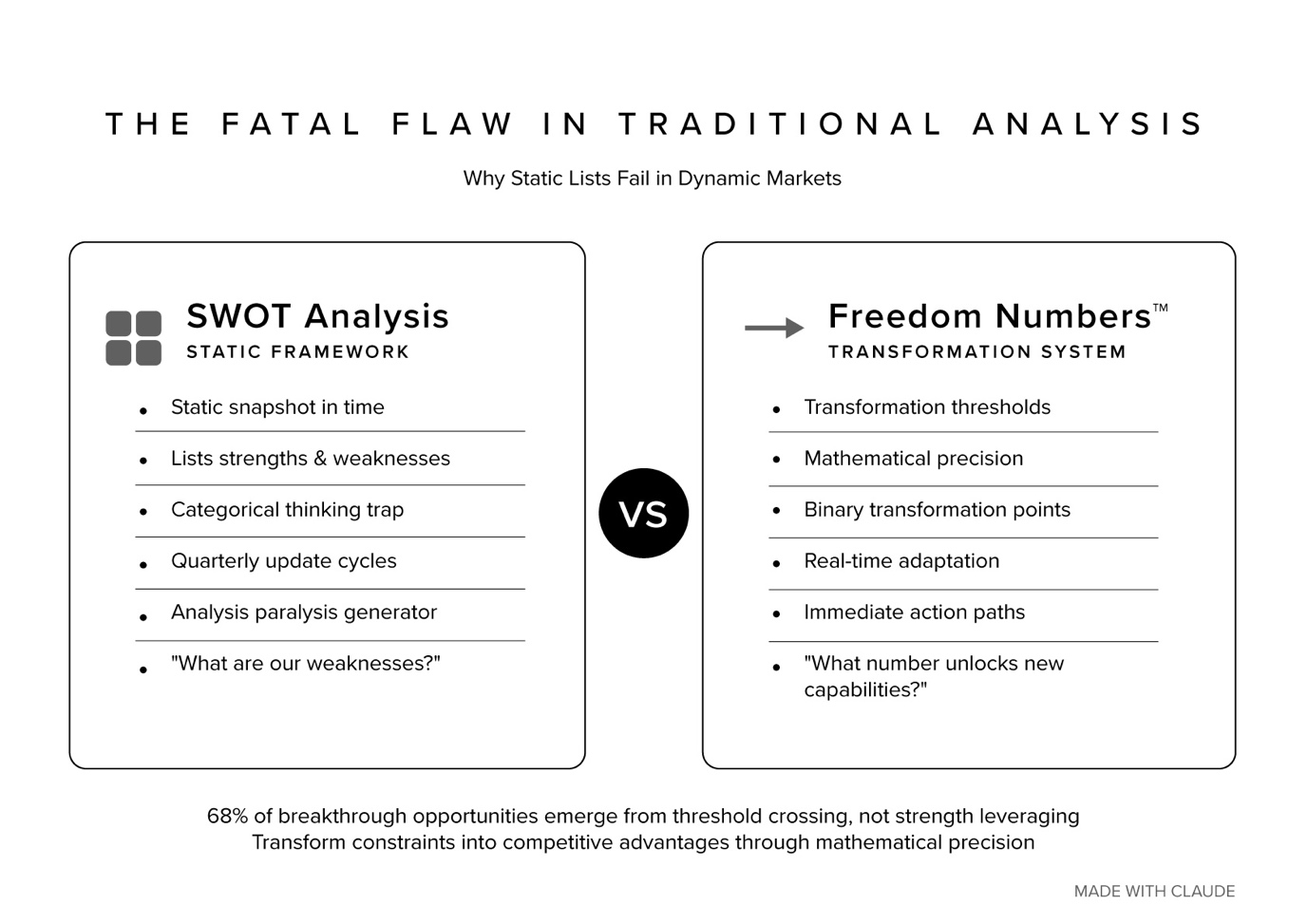
Most businesses approach strategy through SWOT frameworks: list your strengths, catalog your weaknesses, identify market opportunities, assess external threats. This sounds logical, but creates three critical strategic failures:
1. Static Snapshot Fallacy
SWOT assumes business capabilities remain fixed while market opportunities exist independently. This worked when competitive landscapes stayed stable for years.
AI-era reality: Your “weaknesses” can become strategic advantages through threshold crossing faster than traditional “strengths” can be leveraged.
Example failure pattern: Company identifies “small team size” as weakness while missing that this constraint forces innovation and agility that larger competitors cannot replicate when specific productivity thresholds are crossed.
2. Categorical Thinking Trap
SWOT forces binary categorization of complex business elements into artificial boxes—strength OR weakness, opportunity OR threat.
Freedom Numbers™ reality: Most strategic elements are transformation thresholds where crossing specific numerical points fundamentally changes what’s possible.
Example transformation: “Limited €50K budget” (SWOT weakness) becomes “€50K concentrated investment threshold enabling AI automation superiority” (threshold crossing advantage).
3. Analysis Paralysis Generator
SWOT produces lists requiring separate strategic planning to connect insights to action. Teams spend weeks analyzing categories but struggle to convert analysis into systematic transformation.
Freedom Numbers approach: Binary transformation points provide immediate execution paths with mathematical precision and automatic cascade effects.
How SWOT Analysis AI Era Failures Miss Transformation Thresholds
Recent Harvard Business Review research shows that 68% of breakthrough business opportunities emerge from areas initially categorized as “weaknesses” or “threats” in traditional SWOT analysis.
The Emergence Blindness Problem
Traditional SWOT Response to Market Change:
- Update opportunity/threat lists quarterly
- Reassess strength/weakness categories annually
- Hope classifications remain accurate between reviews
- React when emergence makes analysis obsolete
Market Reality in AI Era:
- New categories emerge every 6-12 months
- Competitive advantages shift faster than quarterly reviews
- Strategic transformation opportunities appear at specific mathematical thresholds, not gradual improvements
- Traditional strengths become liabilities while “weaknesses” become advantages through threshold crossing
Real-World SWOT Analysis AI Era Failure: Missing Transformation Points
Blockbuster’s SWOT Analysis (2008):
- Strengths: 9,000 physical locations, established customer base, inventory management systems
- Weaknesses: High real estate costs, limited digital presence
- Opportunities: International expansion, gaming partnerships
- Threats: Netflix competition, digital downloads
What SWOT missed: The transformation threshold where high real estate costs (weakness) could become competitive advantage through immediate pickup/gaming experience that digital-only competitors couldn’t replicate.
Freedom Numbers™ approach would have identified: “€X investment per location enables gaming lounge transformation creating experiential differentiation impossible for digital competitors”
Result: SWOT categorization prevented recognition of threshold crossing opportunity that could have converted “weakness” into unassailable competitive advantage.
Freedom Numbers: Mathematical Transformation Points
Freedom Numbers identify precise numerical thresholds where crossing a specific point fundamentally transforms what’s possible in your business system.
They’re not categories or improvement targets—they’re binary transformation points that create entirely new strategic capabilities.
The Threshold Recognition Framework
Every Freedom Number must pass three tests:
1. Does crossing this number unlock capabilities that were impossible before? Not just “easier”—actually impossible before the threshold, possible after crossing it.
2. Does achievement change the fundamental system, not just performance? System transformation versus system optimization within existing constraints.
3. Do cascade effects multiply throughout the business architecture? One threshold crossing triggers beneficial effects across multiple business areas.
Real-World SWOT vs Freedom Numbers Transformation Examples
“€5K additional monthly revenue enables SDR hire”
Before threshold: Founder trapped in manual prospecting, limiting strategic capacity After threshold: Complete system transformation
- SDR handles prospecting (30+ hours weekly liberation)
- Founder focuses on high-value strategy and client work
- Systematic sales process replaces ad-hoc efforts
- Premium positioning possible through improved capacity
Mathematical precision: Not “increase revenue”—specific threshold that creates fundamental transformation.
“15 sales per representative validates methodology”
Before threshold: Uncertain whether sales approach can scale systematically After threshold: Mathematical proof of scalability
- 5 representatives = 75 predictable sales
- Geographic expansion confidence justified
- Methodology authority enables premium positioning
- Investment decisions based on validated systems, not hope
Threshold recognition: Exact number that proves system works, not gradual improvement.
“€200K strategic reserve enables market disruption positioning”
Before threshold: Market volatility threatens survival After threshold: Market volatility becomes competitive weapon
- Acquisition opportunities during competitor struggles
- Aggressive expansion when others retreat
- Premium talent acquisition during industry uncertainty
- Strategic patience while competitors react desperately
Transformation point: Specific amount that converts market threats into strategic advantages.
SWOT vs Freedom Numbers: The Strategic Architecture Comparison
| Element | SWOT Analysis | Freedom Numbers™ |
|---|---|---|
| Analysis Type | Static categorical listing | Binary transformation threshold identification |
| Execution Path | Requires separate strategic planning | Mathematical precision with immediate action steps |
| Change Response | Quarterly category updates | Real-time transformation as thresholds crossed |
| Resource View | Constraints as limitations | Constraints as transformation opportunities at specific thresholds |
| Strategic Focus | Current position assessment | Precise points where capabilities fundamentally change |
| Competitive Logic | Leverage strengths, fix weaknesses | Cross thresholds that convert constraints into advantages |
| Market Approach | React to opportunities/threats | Create transformation through mathematical threshold crossing |
The Threshold Recognition Process: From SWOT to Freedom Numbers
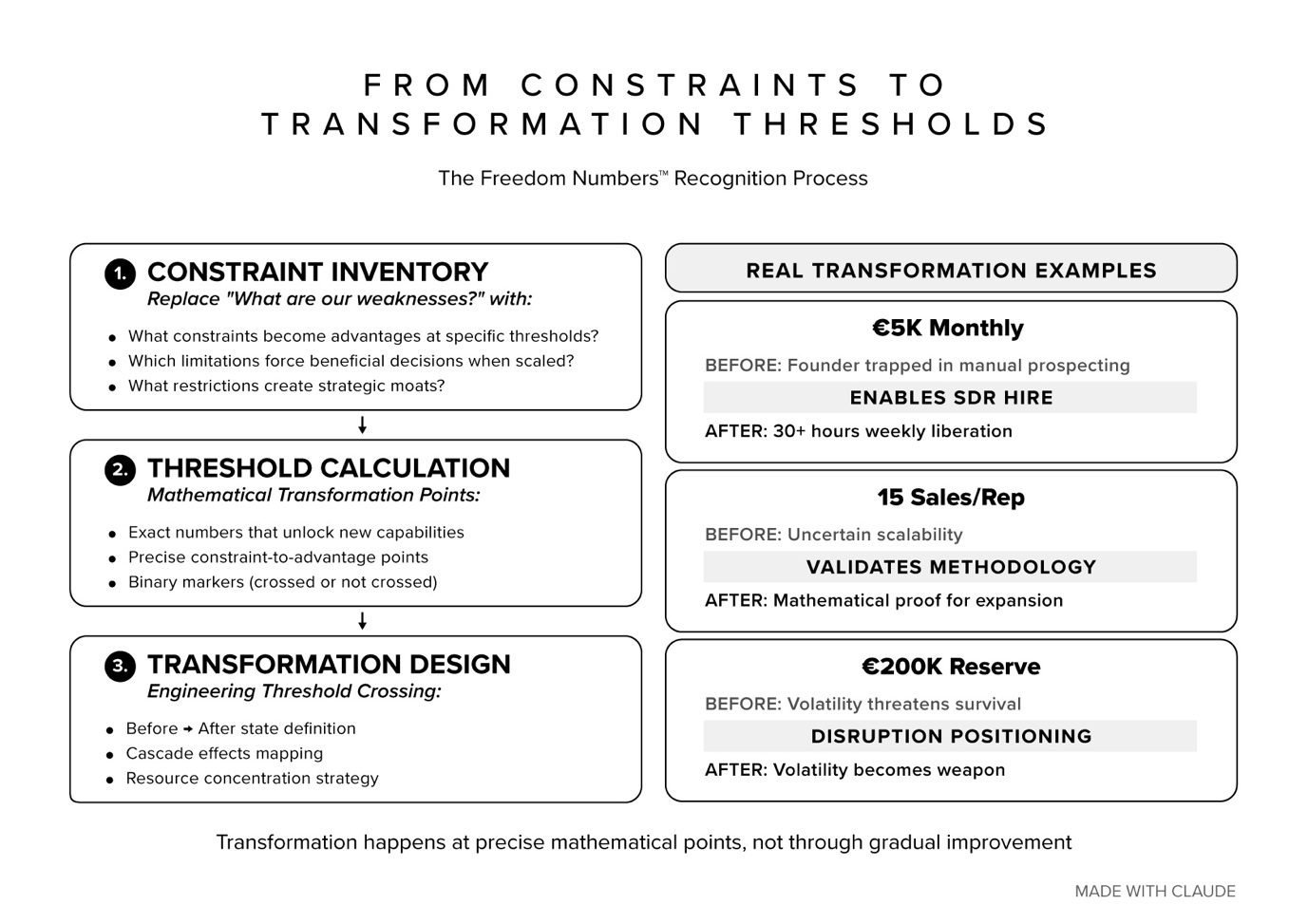
Step 1: Constraint Inventory (Replace SWOT Weakness Analysis)
Instead of listing weaknesses, identify potential transformation thresholds:
Replace “What are our weaknesses?” with:
- What constraints could become competitive advantages at specific numerical thresholds?
- Which limitations force beneficial decisions that become strategic moats when scaled?
- What resource restrictions create focus that generates superior outcomes at precise investment levels?
- Which operational constraints enable positioning impossible for larger competitors when specific efficiency thresholds are crossed?
Step 2: Threshold Calculation (Replace SWOT Opportunity Analysis)
Instead of listing market opportunities, calculate mathematical transformation points:
Replace “What opportunities exist in the market?” with:
- What specific numbers unlock strategic capabilities we don’t currently have?
- Which precise thresholds convert our biggest constraints into competitive advantages?
- What mathematical points enable business model evolution or category creation?
- Which exact metrics validate system scalability and justify major investment?
Step 3: Transformation Design (Replace SWOT Strategic Planning)
Instead of developing plans to leverage strengths and address weaknesses, engineer threshold crossing sequences:
Implementation framework:
- Threshold identification: Exact numerical point where transformation occurs
- Before/after states: Clear definition of capabilities before and after crossing
- Cascade mapping: Secondary and tertiary effects triggered by threshold achievement
- Resource concentration: Maximum force applied to cross specific threshold rather than distributed improvement
Step 4: Binary Execution (Replace SWOT Action Planning)
Convert Freedom Numbers into executable Strategic Triggers™ with mathematical precision:
Execution elements:
- Mathematical precision: Exact threshold definition eliminating ambiguity
- Binary achievement: Either crossed or not crossed—no partial credit
- Timeline specification: 3-6 month cycles maintaining urgency while allowing substantial progress
- Cascade validation: Clear measurement of transformation effects throughout system
Why Threshold Recognition Works in AI-Era Markets
Speed Advantage: Transformation vs Gradual Improvement
SWOT approach: Quarterly incremental improvements hoping gradual gains accumulate into transformation Freedom Numbers approach: Concentrated force toward specific transformation points creating exponential capability jumps
Emergence Capture: Creating Capabilities vs Analyzing Existing Ones
SWOT approach: Analyze current capabilities and hope market opportunities align with existing strengths Freedom Numbers approach: Engineer threshold crossing that creates new capabilities designed to capture emergence
Resource Efficiency: Focused Transformation vs Scattered Enhancement
SWOT approach: Spread resources across multiple improvement areas based on categorical analysis Freedom Numbers approach: Concentrate maximum resources on crossing specific thresholds that transform entire system capability
Common Threshold Recognition Mistakes
Mistake 1: Confusing Improvement with Transformation
Wrong approach: “Increase revenue by 20%” (gradual improvement) Correct approach: “Cross €100K MRR threshold enabling platform development team and premium market positioning” (binary transformation)
Mistake 2: Vague Numbers Instead of Precise Thresholds
Wrong approach: “Enough customers to feel confident about scaling” Correct approach: “15 customers with 90%+ satisfaction validates methodology enabling systematic geographic expansion” (mathematical precision)
Mistake 3: Ignoring the Binary Nature
Wrong approach: “Making good progress toward €50K goal” Correct approach: “Either crossed €50K threshold (transformation achieved) or haven’t (transformation pending)” (binary recognition)
Mistake 4: Setting Thresholds Without Transformation Validation
Wrong approach: “€1M revenue sounds like a good target” Correct approach: “€1M revenue enables specific capability X, which creates cascade effects Y and Z, fundamentally changing strategic possibilities” (transformation validation)
The Strategic Choice: Categories vs Thresholds
SWOT Analysis worked when businesses could afford gradual improvement within stable competitive categories over predictable timeframes.
Freedom Numbers provide systematic advantage in markets where threshold crossing creates competitive advantages faster than categorical improvements can accumulate.
The Mathematical Difference
SWOT Logic: Analyze current state → Plan improvements → Hope gradual gains create advantage Result: Linear thinking seeking incremental enhancement within existing constraints
Freedom Numbers Logic: Identify transformation thresholds → Concentrate force on crossing → Achieve binary capability transformation Result: Exponential capability jumps through mathematical precision and threshold crossing
The Competitive Outcome
SWOT-based strategy: Compete within existing categories using traditional strength/weakness logic Freedom Numbers strategy: Cross thresholds that create new competitive categories where traditional advantages become irrelevant
Strategic choice: Gradually improve within existing constraints, or cross mathematical thresholds that fundamentally transform what’s possible.
Ready to Replace Analysis with Transformation?
Freedom Numbers represent evolution beyond categorical thinking toward systematic threshold recognition designed for markets where transformation opportunities emerge at specific mathematical points rather than through gradual improvement.
Whether your industry changes rapidly or remains stable, Freedom Numbers provide framework for identifying and crossing the precise numerical thresholds that convert apparent limitations into sustainable competitive advantages.
The question isn’t what category your business elements fit into—it’s what specific numbers, when crossed, will fundamentally transform what’s possible.
Get Freedom Numbers frameworks and Strategic Architecture™ methodology delivered weekly → Subscribe to our Substack newsletter for threshold recognition techniques and mathematical transformation strategies.
Join thousands of strategists learning to engineer transformation through precision rather than hope through analysis.
Prepared by the Strategic Architecture™ Editorial Team, bringing clarity to the frameworks shaping the AI era.
Test it with the three questions: Does crossing this exact number unlock previously impossible capabilities? Does it transform the system, not just improve it? Do cascade effects multiply throughout your business? If yes to all three, you've found a transformation threshold.
Break it into sequential thresholds. Instead of "€500K enables everything," identify "€50K enables first transformation, creating pathway to €150K second threshold." Each threshold should be achievable within 3-6 months with concentrated effort.
Yes, but reframe them as transformation thresholds. Instead of "good customer relationships" (strength), identify "500 documented case studies creates methodology authority enabling premium positioning" (threshold with mathematical precision).
Every business has constraints that become advantages at specific thresholds. The key is recognizing that most transformation happens at precise mathematical points, not gradually. Service businesses, product companies, and platforms all have different threshold types, but the binary nature remains constant.
Trademark Notice
© 2025 Edward Azorbo. All rights reserved.
Strategic Inevitability, Strategic Architecture™, Power Numbers™, iPolaris, Strategic Triggers™, Clear Paths™, Mathematical Freedom Recognition, Trinity Framework™, Freedom Numbers, and all related names, logos, and framework titles are trademarks or registered trademarks of Edward Azorbo in the United States, the European Union, and other jurisdictions.
Unauthorized use, reproduction, or modification of these marks and the proprietary methodologies they represent is strictly prohibited. All other trademarks and trade names are the property of their respective owners.