
Blue Ocean Strategy vs Manufactured Emergence: Why Creating Uncontested Markets Isn’t Enough in the AI Era
Blue Ocean Strategy creates a single uncontested market through value innovation. Manufactured Emergence builds living systems that continuously surface new market spaces faster than AI-powered rivals can imitate.
Blue Ocean Strategy creates single uncontested market spaces that quickly fill with competitors; Manufactured Emergence designs living systems that continuously generate fresh blue oceans through systematic serendipity.
Why traditional market creation fails in accelerating competitive environments and how Manufactured Emergence builds self-renewing opportunity engines
Traditional Blue Ocean Strategy attempts to create uncontested market space through value innovation and competitive differentiation, but these single market creations quickly fill with AI-accelerated competition. Modern business success requires Manufactured Emergence – the systematic architecture of conditions that continuously generate fresh opportunities and market spaces rather than hoping one blue ocean will provide lasting advantage.
Manufactured Emergencereplaces static market creation with dynamic opportunity generation: living systems that create multiple emergence surfaces, enabling continuous blue ocean discovery rather than single-point market innovation.
blue ocean strategy vs manufactured emergence comparison graphic
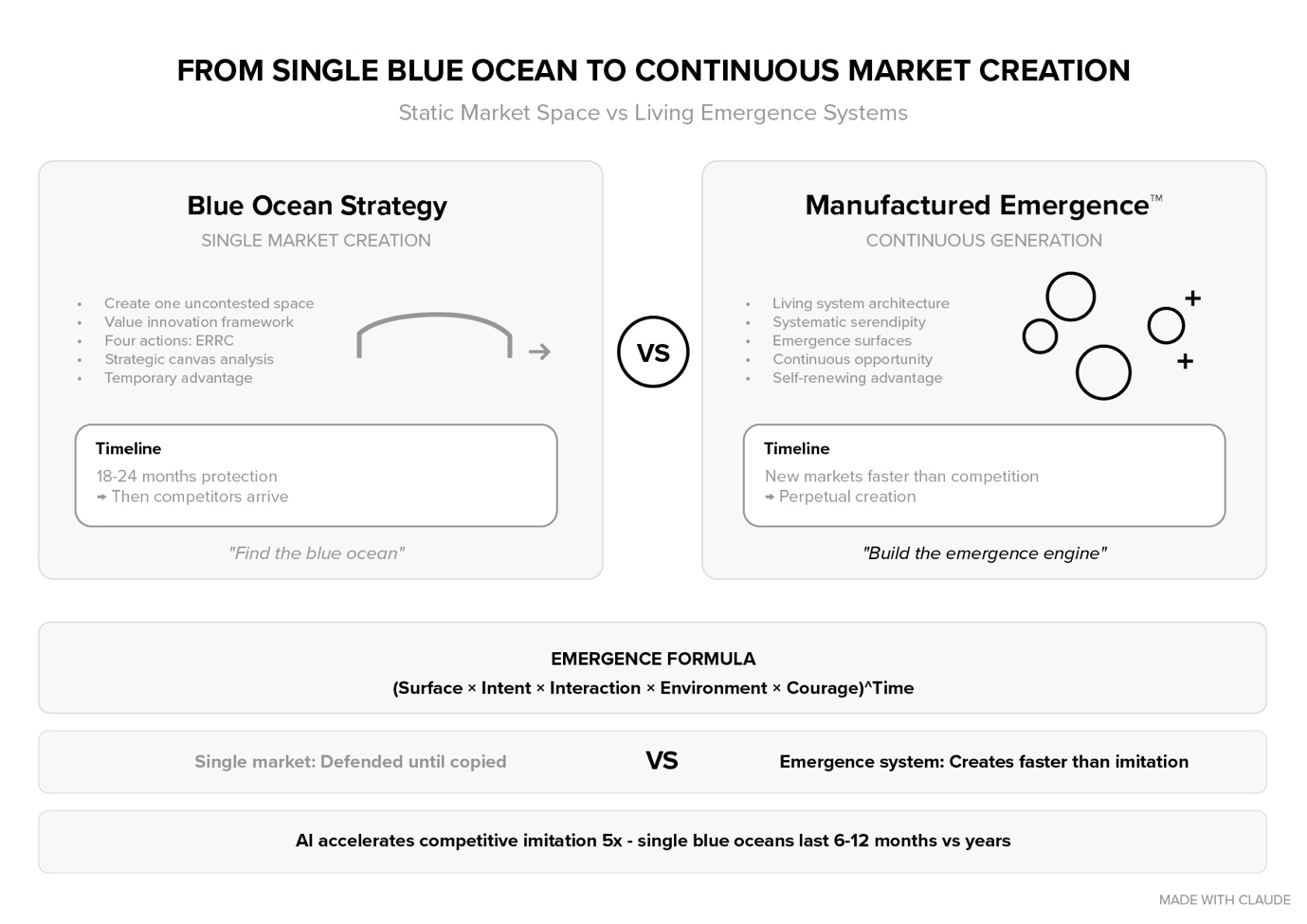
The Blue Ocean Problem: Why Single Market Creation Fails in the AI Era
TL;DR: Blue Ocean Strategy creates temporary market advantages that AI-accelerated competition eliminates faster than sustainable differentiation can be built.
Most organizations implement Blue Ocean Strategy through systematic analysis to create uncontested market space: value curve reconstruction, strategic canvas analysis, and competitive elimination. This single-market approach creates three critical strategic failures in accelerating environments:
1. Static Market Creation vs Dynamic Opportunity Generation
Traditional Blue Ocean approach:
- Analyze industry factors and competitive dimensions for differentiation opportunities
- Eliminate, reduce, raise, and create value elements to break industry trade-offs
- Develop unique value propositions that avoid direct competition
- Execute market creation strategy through focused value innovation
AI-era reality check: Blue Ocean Strategy creates point-in-time market advantages that become contested quickly as AI enables faster competitive analysis, rapid product development, and accelerated market entry.
2. Single Ocean Focus vs Continuous Emergence Architecture
Standard blue ocean examples implementation:
- Cirque du Soleil: Combined circus and theater to create new market category
- Nintendo Wii: Simplified gaming interface targeting non-traditional players
- Yellow Tail Wine: Eliminated complexity to attract beer and cocktail drinkers
- Southwest Airlines: No-frills service model creating new airline category
Investment insight problem: Blue ocean examples demonstrate successful single market creation but don’t provide frameworks for continuous opportunity generation when competitive advantages erode through AI-enabled imitation.
3. Market Analysis vs Emergence System Building
Traditional create uncontested market space methodology:
- Strategic canvas mapping to visualize competitive factors and value curves
- Four Actions Framework (eliminate, reduce, raise, create) for differentiation
- Value innovation through simultaneous cost reduction and value enhancement
- Market boundary reconstruction to escape competitive red oceans
Strategic architecture reality: Success depends on Manufactured Emergence that creates systematic conditions where new market opportunities surface continuously rather than requiring periodic strategic analysis for single market creation.
How Blue Ocean Strategy Misses Continuous Market Creation Intelligence
TL;DR: Research shows AI accelerates competitive imitation 5x faster, making traditional blue ocean advantages temporary rather than sustainable.
Studies from Harvard Business Review’s analysis of AI-driven market competition indicate that AI-enabled competitive analysis and rapid development cycles reduce blue ocean protection windows from years to months. Traditional blue ocean examples that took competitors years to replicate now face imitation within 6-12 months through AI-accelerated development processes.
Real-World Blue Ocean vs Manufactured Emergence Examples
TL;DR: Tesla’s success came from emergence systems creating multiple market innovations, not single blue ocean creation like traditional examples.
Traditional Blue Ocean: Streaming Entertainment Service (Temporary Advantage)
Blue Ocean Analysis Implementation:
Strategic Canvas Factors:
- Content Library Size: Reduced (focused curation vs. comprehensive)
- Original Content: Raised (exclusive productions vs. licensed content)
- Personalization: Created (AI recommendation vs. manual browsing)
- Price Point: Reduced (subscription vs. pay-per-view)
- Device Access: Raised (multi-device vs. single platform)
Four Actions Framework Application:
- Eliminate: Physical media, late fees, limited viewing windows
- Reduce: Content quantity, geographical restrictions
- Raise: Viewing convenience, content quality
- Create: Binge-watching culture, algorithm-driven discovery
Market Creation Success: Successfully created uncontested streaming market space for 18 months
Why this becomes contested: AI enabled competitors to analyze value curve, replicate personalization algorithms, and create competing original content. Result: Saturated streaming market with 15+ major competitors within 3 years.
Manufactured Emergence Alternative: Systematic Opportunity Generation
Manufactured Emergence Architecture:
The Third Category of Opportunity™:
- Planned Opportunities: Direct market creation through strategic analysis
- Random Opportunities: Accidental market discovery through luck
- Emergent Opportunities: Systematic creation of conditions where new markets surface naturally
Emergence Formula Implementation: Manufactured Emergence = (Surface Area × Intent Quality × Interaction Density × Environmental Density × Courage Factor)^Time
Surface Area Expansion:
- Multi-Platform Presence: Content across streaming, social, gaming, AR/VR platforms
- Diverse Stakeholder Engagement: Creators, viewers, advertisers, technology partners
- Format Experimentation: Interactive content, live events, user-generated integration
- Geographic Diversification: Global content creation and localization strategies
Intent Quality Design:
- Value-First Approach: Each interaction provides genuine benefit to ecosystem participants
- Emotional Activation: Content and experiences that create memorable engagement
- Community Building: Platforms that enable user connection and collaboration
- Innovation Partnership: Collaborative creation with technology and content partners
Environmental Density Optimization:
- AI-Era Advantages: Machine learning for content creation, personalization, and distribution
- Technology Integration: Emerging tech adoption for competitive advantage
- Creator Economy: Systematic support for content creator ecosystem development
- Market Volatility Leverage: Using disruption as opportunity creation catalyst
Emergence Loop™ Activation:
- Create Conditions: Multi-platform content ecosystem with creator support
- Emergence Happens: New content formats, viewer behaviors, and market opportunities surface
- Capture Value: Monetize emerged opportunities through platform optimization
- Reinvest in Conditions: Expand ecosystem capability and surface area
- Expanded Emergence: Greater opportunity generation through compound effects
Why this creates continuous advantage: Manufactured Emergence™ builds living systems that generate new market opportunities faster than competitors can analyze and replicate, creating sustainable advantage through systematic serendipity rather than single market innovation.
The Competitive Acceleration Problem
TL;DR: Uber’s blue ocean became red ocean within 2 years due to AI-accelerated competitive entry, proving single market creation insufficient.
Uber’s Market Creation vs. Competitive Reality (2009-2025):
- Traditional Blue Ocean perspective: Created uncontested ride-sharing market through smartphone-enabled transportation
- What Blue Ocean missed: AI enabled rapid competitive replication, regulatory capture, and market saturation within 24 months
Manufactured Emergence approach would have emphasized:
- Continuous platform evolution: Building emergence systems for transportation innovation beyond ride-sharing
- Ecosystem development: Creating conditions where new mobility solutions surface naturally
- Multi-modal opportunity generation: Systematic expansion into delivery, logistics, autonomous vehicles through emergence architecture
Market insight: Uber’s long-term success requires emergence systems creating new transportation categories continuously, not defending single blue ocean creation against AI-accelerated competition.
Manufactured Emergence: Living Systems for Continuous Market Creation
TL;DR: Manufactured Emergence creates systematic conditions where new blue oceans surface naturally rather than requiring periodic strategic analysis.
Manufactured Emergence demonstrates continuous market creation through systematic opportunity generation that produces fresh uncontested spaces faster than competitive analysis and imitation cycles.
The Emergence Yield Rate™ (EYR): Measuring Systematic Serendipity
EYR Calculation Framework
Emergence Yield Rate = (Captured Opportunities ÷ Created Surfaces) × 100%
Why EYR Matters for Continuous Market Creation:
- Makes emergence measurable: Track exactly which surfaces generate new market opportunities
- Reveals patterns: Identify highest-yield surface types for market creation
- Enables optimization: Allocate resources to highest EYR activities for maximum opportunity generation
- Shows improvement: Track how emergence capability improves over time
Implementation Example for Market Creation:
Monthly Emergence Tracking:
- Created: 50 emergence surfaces across platforms and stakeholder interactions
- Captured: 8 valuable market opportunities and business innovations
- Overall EYR: 16% (industry-leading performance)
Surface-Specific Analysis:
- Strategic Partnerships: 30% EYR (3 opportunities from 10 collaborations)
- Content Experiments: 40% EYR (2 opportunities from 5 new formats)
- Technology Integration: 10% EYR (2 opportunities from 20 tech trials)
- Market Research: 7% EYR (1 opportunity from 15 studies)
The Four Phases of Emergence-Driven Market Creation
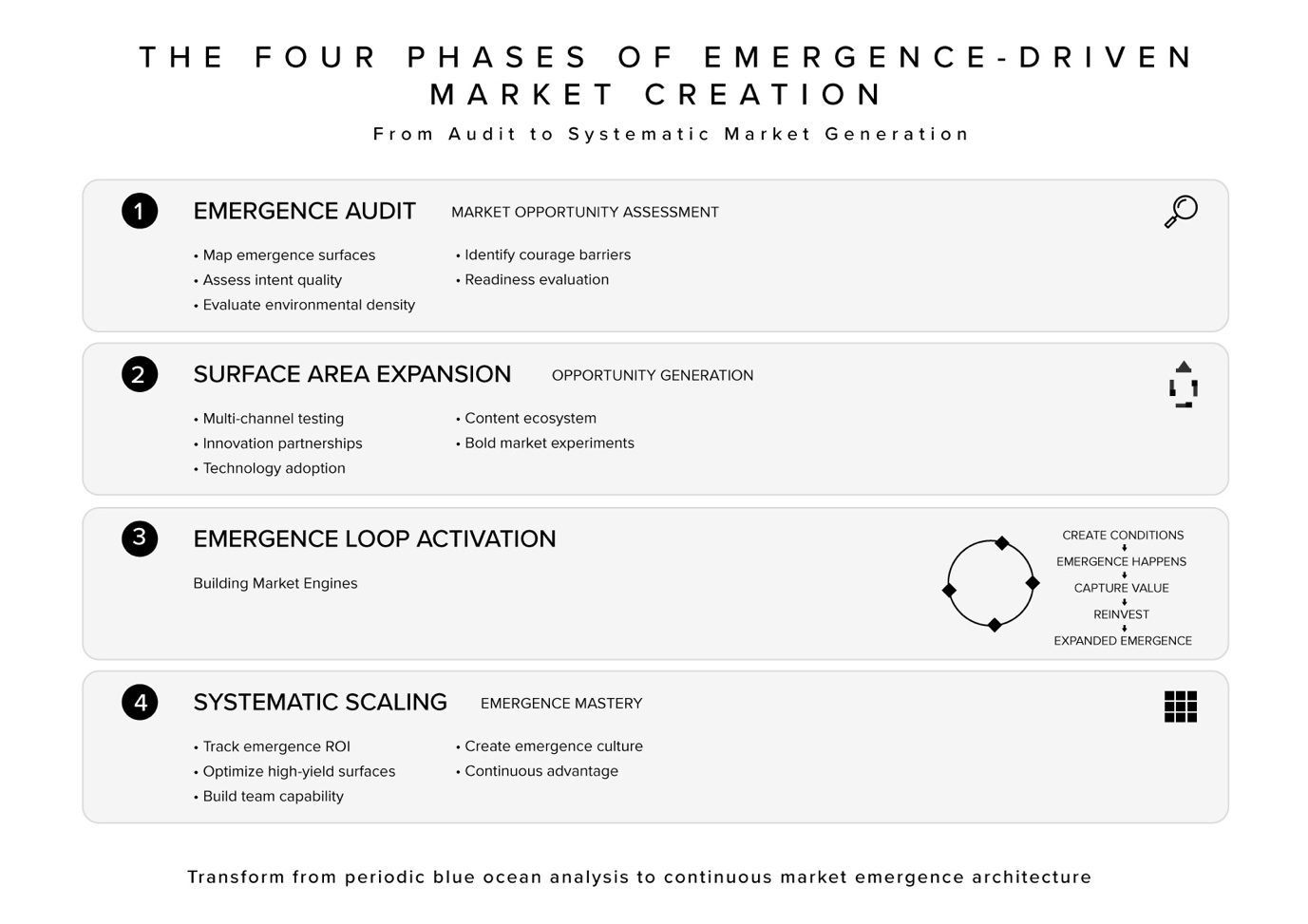
Phase 1: Emergence Audit for Market Opportunity Assessment
Strategic Questions for Market Creation:
- How many emergence surfaces are we creating across market interactions?
- What’s the quality of our intentional design for market opportunity generation?
- Where is our environmental density highest for new market creation?
- What courage barriers limit our market creation surface expansion?
- Are we ready to capture market opportunities when they emerge?
Market Creation Surface Mapping:
- Customer Interaction Points: All touchpoints where market insights surface
- Technology Integration: Emerging tech adoption creating new market possibilities
- Partnership Ecosystems: Collaborative relationships generating market opportunities
- Content and Communication: Platforms where market feedback and innovation ideas emerge
Phase 2: Surface Area Expansion for Market Opportunity Generation
Strategic Actions for Continuous Market Creation:
- Map potential market surfaces: List all possible market interaction and innovation points
- Design with market intent: Add value and emotional activation that reveals market needs
- Increase market density: Create regular interaction rhythms with market participants
- Choose market courage: Take bold actions others won’t to create unique market positions
- Prepare market capture systems: Ensure readiness when market opportunities emerge
Market Surface Examples:
- Multi-channel market testing: Systematic experimentation across customer segments and channels
- Innovation partnerships: Collaborative development creating new market categories
- Technology adoption: Early integration creating competitive advantages and market insights
- Content ecosystem development: Platform creation enabling market participant interaction
Phase 3: Emergence Loop Activation for Systematic Market Creation
Building Market Creation Engines:
- Start with current market resources: Leverage existing capabilities for emergence surface creation
- Create initial market surfaces: Deploy systematic market interaction and innovation experiments
- Capture first market emergences: Monetize and leverage initial market opportunities discovered
- Reinvest in expanded market surfaces: Use captured value to increase market opportunity generation
- Let market loop compound: Enable systematic market creation through emergence architecture
Market Creation Loop: CREATE MARKET CONDITIONS → MARKET EMERGENCE HAPPENS → CAPTURE MARKET VALUE → REINVEST IN MARKET CONDITIONS → EXPANDED MARKET EMERGENCE
Phase 4: Systematic Market Scaling Through Emergence Mastery
Advanced Market Creation Practice:
- Track market emergence ROI: Measure return on investment in market creation surfaces
- Identify highest-yield market surfaces: Focus resources on most productive market opportunity generation
- Optimize market courage deployment: Strategic risk-taking for market creation advantage
- Build team market emergence capability: Organizational competency in systematic market creation
- Create market emergence culture: Company-wide mindset focused on continuous market opportunity generation
Blue Ocean Strategy vs Manufactured Emergence: The Market Creation Comparison
| Element | Blue Ocean Strategy | Manufactured Emergence |
|---|---|---|
| Market Focus | Single uncontested market space creation | Continuous market opportunity generation through living systems |
| Competitive Protection | Temporary advantage through value innovation | Systematic advantage through emergence velocity exceeding imitation speed |
| Strategic Analysis | Periodic industry analysis and strategic canvas mapping | Real-time emergence surface optimization and opportunity capture |
| Market Sustainability | Hope that blue ocean remains uncontested | Mathematical inevitability of fresh market creation through systematic design |
| Innovation Approach | Planned value innovation through four actions framework | Emergent market discovery through systematic serendipity and surface creation |
| Competitive Advantage | Differentiation through industry factor elimination and creation | Advantage through emergence architecture and systematic opportunity generation |
| Time Horizon | Point-in-time market creation with gradual competitive erosion | Continuous market creation faster than competitive analysis and replication cycles |
Blue ocean examples showing single market creation vs systematic emergence architecture approaches
Market Creation Success Through Blue Ocean Examples
Traditional blue ocean examples like Cirque du Soleil and Nintendo Wii demonstrate the power of create uncontested market space strategies but also reveal the limitations of single-point market innovation in AI-accelerated competitive environments.
The Law of Emergence: Why Influence Scales Faster Than Control
TL;DR: In complex AI-era markets, the ability to influence through context creation becomes exponentially more powerful than direct control attempts.
The Law of Emergence: “In environments of increasing complexity, influence scales faster than control.”
Why This Matters for Market Creation:
Traditional Blue Ocean Logic: Control market factors through strategic analysis and planned value innovation Emergence Logic: Influence market contexts through systematic surface creation and emergence architecture
The Competitive Reality in AI Era:
- Control becomes harder: Too many variables to predict and manage specific market outcomes
- Influence becomes exponential: Context creation enables unlimited market opportunity generation
- Emergence density increases: AI creates more interaction points and collision opportunities
- Speed advantage compounds: Emergence systems create markets faster than analysis-based approaches
The Strategic Choice for Market Creation
Traditional Approach: “Plan specific market creation through strategic analysis” Emergence Approach: “Architect conditions where multiple market opportunities must surface”
Companies Operating Traditional Blue Ocean: Limited to planned market creation + random market discovery Companies Operating Manufactured Emergence: Unlimited market potential through systematic emergence architecture
The gap isn’t incremental—it’s dimensional. Like playing 3D market creation while others use 2D strategic canvas analysis.
Building Your Manufactured Emergence Market Creation Engine
TL;DR: Transform from hoping blue oceans stay uncontested to building systems that continuously generate fresh market opportunities.
The Emergence Formula for Market Creation
Market Emergence = (Market Surface Area × Market Intent Quality × Market Interaction Density × Market Environmental Density × Market Courage Factor)^Time
Component Optimization for Market Creation:
Market Surface Area: Number of potential market collision points you create
- Multiple market testing channels and customer interaction platforms
- Diverse stakeholder engagement across value chain participants
- Varied market experiment formats and innovation approaches
Market Intent Quality: Strategic value designed into each market interaction
- Thoughtful market participant targeting and value creation
- Value-first approach to market relationship building
- Emotional activation design for memorable market engagement
Market Interaction Density: Frequency of market emergence opportunities
- Consistent market presence and systematic market engagement
- Regular market value delivery and innovation sharing
- Systematic market feedback and opportunity identification rhythms
Market Environmental Density: Natural emergence rate of your market environment
- AI/Tech sectors = High market emergence density
- Traditional industries = Lower market emergence density but AI transformation increasing
- Market volatility = Increased emergence density and opportunity creation
Market Courage Factor: Multiplier of bold market creation action
- Willingness to create bold market experiments and surface bold market innovations
- Comfort with uncertain market returns and systematic market risk-taking
- Emotional readiness to act on market opportunities when they emerge
Blue Ocean Strategy vs Manufactured Emergence: What Market Creation Really Needs in 2025
TL;DR: 2025 requires systematic emergence architecture over single blue ocean creation for sustainable market advantage.
Beyond Static Market Creation: Dynamic Opportunity Intelligence
2025 market creation priorities:
- Systematic emergence generation over single blue ocean analysis
- Living market creation systems over static strategic canvas mapping
- Continuous opportunity architecture over periodic value innovation
- Emergence velocity advantage over temporary differentiation protection
The AI-Era Market Creation Thesis
Traditional market logic: Create uncontested market space through strategic analysis and value innovation 2025 market logic: Build Manufactured Emergence systems that generate market opportunities faster than competitive analysis and replication cycles
Why Manufactured Emergence matters more: AI accelerates competitive imitation and market analysis, making static blue ocean advantages temporary. Success requires emergence systems creating market opportunities continuously rather than hoping single blue ocean creation will provide lasting advantage.
Engineering Your Systematic Market Creation Architecture
Manufactured Emergence represents evolution beyond traditional Blue Ocean Strategy toward systematic market creation that generates continuous opportunities through emergence architecture rather than hoping single uncontested markets will remain uncontested.
Whether you’re launching new products, entering existing markets, or building platform businesses, Manufactured Emergence provides the methodology for creating systematic serendipity that generates market advantages faster than competitive cycles.
The choice: Continue implementing Blue Ocean Strategy hoping single market creation will provide lasting advantage, or build Manufactured Emergence systems that systematically generate fresh market opportunities.
Get Manufactured Emergence implementation guides and complete Strategic Architecture methodology delivered weekly → Subscribe to our Substack newsletter for systematic market creation and emergence architecture techniques that build continuous competitive advantage.
Join thousands of strategic leaders learning to build systematic market creation through Manufactured Emergence rather than hoping single blue ocean advantages will remain uncontested.
Prepared by the Strategic Architecture™ Editorial Team, bringing clarity to the frameworks shaping the AI era.
Blue Ocean Strategy creates single uncontested market spaces through strategic analysis and value innovation. Manufactured Emergence builds living systems that continuously generate market opportunities through systematic emergence architecture. Instead of “we created one blue ocean,” you build “our emergence systems generate fresh market opportunities faster than competitive cycles.”
Yes, but prioritize Manufactured Emergence for systematic opportunity generation, then support with Blue Ocean analysis for specific market creation initiatives. Focus on emergence architecture first (proof of continuous creation capability), then use traditional frameworks for tactical market development within systematic opportunity contexts.
Use the Emergence Yield Rate (EYR): (Captured Opportunities ÷ Created Surfaces) × 100%. Track which emergence surfaces generate the most valuable market opportunities and optimize resource allocation accordingly. Advanced practitioners achieve 15-25% EYR through systematic surface creation and capture readiness.
Focus on creating high-quality surfaces within your environmental constraints while building capability for higher-density environments. “We’re achieving 12% EYR in traditional manufacturing through systematic supplier partnerships and technology integration.” Even low-density environments create opportunities through systematic emergence architecture design using Power Numbers™ principles. </div> </div>
Trademark Notice
© 2025 Edward Azorbo. All rights reserved.
Strategic Inevitability, Strategic Architecture™, Manufactured Emergence, Power Numbers™, Strategic Triggers™, Clear Paths™, Mathematical Freedom Recognition, Trinity Framework™, and all related names, logos, and framework titles are trademarks or registered trademarks of Edward Azorbo in the United States, the European Union, and other jurisdictions.
Unauthorized use, reproduction, or modification of these marks and the proprietary methodologies they represent is strictly prohibited. All other trademarks and trade names are the property of their respective owners.