
Compound vs Catalyst Moves: The Two Forces That Drive Strategic Architecture
Compound and Catalyst Moves are two types of strategic progress: systematic optimization cycles that compound value, and architectural transformations that redefine what’s possible—showing when to improve versus when to revolutionize.
The Compound and Catalyst Moves framework identifies two distinct types of strategic progress: Compound Moves that create systematic improvement through optimization cycles, and Catalyst Moves that fundamentally transform your strategic architecture—revealing when to optimize versus when to revolutionize.
Not all strategic progress is created equal. Most businesses improve incrementally, optimizing what already exists through careful refinement. But occasionally, a move doesn’t just improve the system—it transforms the entire architecture of what’s possible.
This distinction between optimization and transformation determines whether businesses achieve linear growth or exponential breakthroughs. Understanding which type of move to deploy—and when—becomes the difference between companies that incrementally improve and those that redefine their markets.
The Mathematical Reality of Strategic Progress
Why Traditional Strategy Misses the Distinction
Traditional strategic planning treats all improvements as equal. Increase sales by 20%. Reduce costs by 15%. Improve efficiency by 25%. But this approach misses a fundamental truth: some moves optimize within constraints while others shatter the constraints entirely.
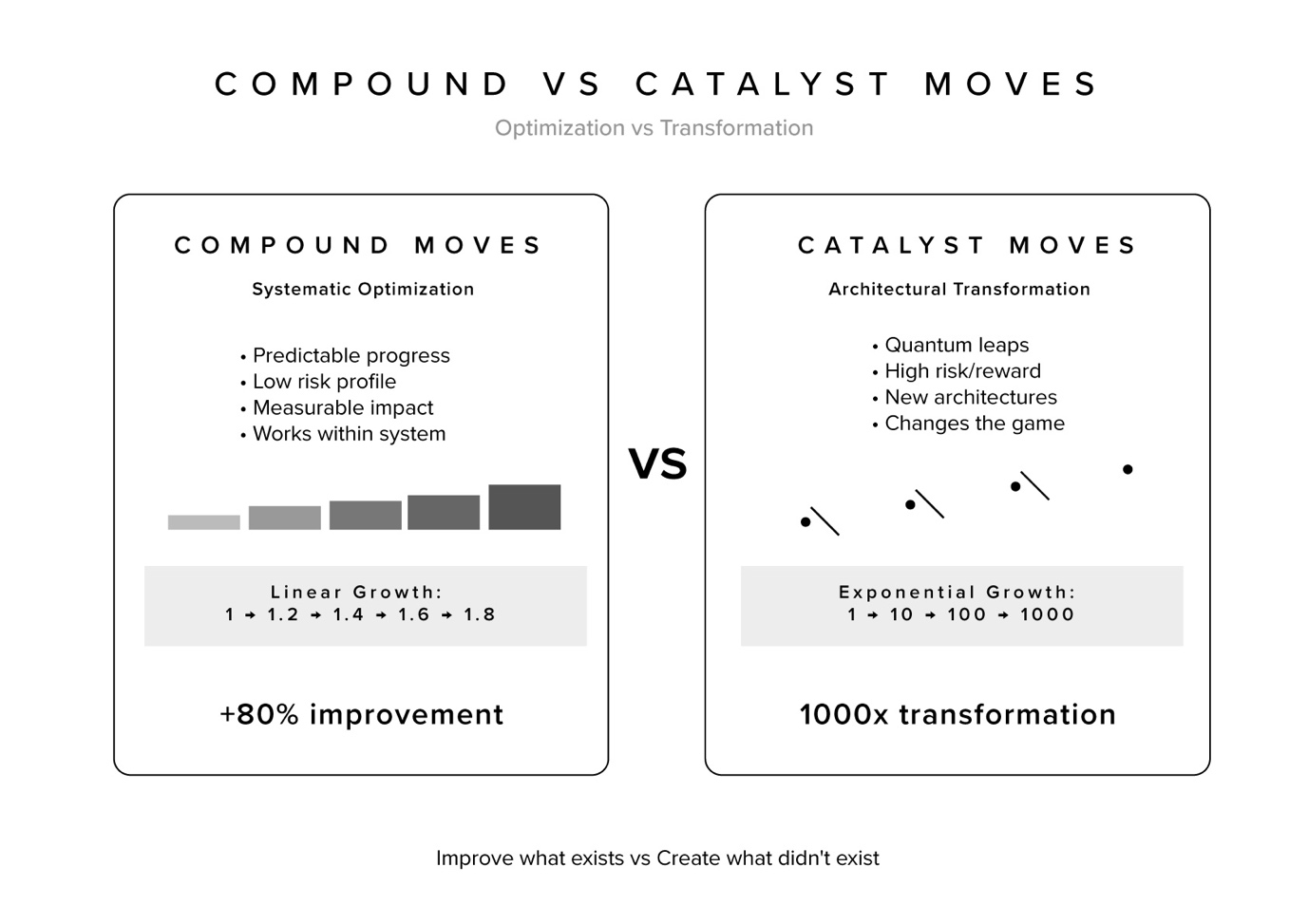
The mathematical difference is profound:
Linear Optimization: 1 → 1.2 → 1.4 → 1.6 → 1.8 (Predictable improvement) Architectural Transformation: 1 → 1 × 10 → 10 × 10 → 100 (Exponential possibility)
One improves what exists. The other creates what didn’t exist before.
Compound Moves: The Power of Systematic Optimization
Definition and Characteristics
Compound Moves are systematic improvements that advance you toward Strategic Triggers™ through repeated optimization cycles. They work within your existing strategic architecture to create predictable, measurable progress.
Core Characteristics:
- Predictable Progress: Clear cause-and-effect relationships
- Low Risk Profile: Works within proven systems
- Measurable Impact: Quantifiable improvements at each step
- Compound Effects: Each improvement enables the next
The Compound Mathematics
Compound Moves follow a multiplication pattern where each improvement builds on the previous:
Month 1: Base performance × 1.1 = 10% improvement Month 2: New base × 1.1 = 21% cumulative improvement Month 3: New base × 1.1 = 33.1% cumulative improvement Month 12: Original base × 3.14 = 214% cumulative improvement
The power lies in consistency and systematic application.
Categories of Compound Moves
1. Process Optimization
- Example: Improving sales scripts to increase conversion from 8% to 12%
- Impact: 50% performance improvement within existing system
- Strategic Value: Validates scaling readiness
2. System Enhancement
- Example: Implementing AI qualification to improve lead quality
- Impact: Reduces wasted effort, increases close rates
- Strategic Value: Creates efficiency multipliers
3. Capability Development
- Example: Training team in advanced frameworks
- Impact: Enhanced service delivery and premium positioning
- Strategic Value: Builds competitive differentiation
4. Asset Building
- Example: Growing email list from 50K to 200K engaged subscribers
- Impact: Creates owned distribution channel
- Strategic Value: Reduces dependency on paid channels
Real-World Compound Move: Premium Tier Implementation
A subscription business tests adding a premium tier:
- Standard subscription: €10/month
- Premium subscription: €15/month
- Result: 70% of customers choose premium
The Compound Effect:
- Lifetime Value increases by 35%
- Customer Acquisition Cost remains constant
- Unit economics improve by 50%
- Marketing budget effectiveness increases proportionally
This exemplifies a perfect Compound Move—working within the existing system to multiply value systematically.
Catalyst Moves: The Architecture of Transformation
Definition and Power
Catalyst Moves are transformational actions that fundamentally evolve your strategic architecture, creating new capabilities and competitive advantages previously impossible. They don’t optimize the game—they change which game you’re playing.
Core Characteristics:
- Quantum Leaps: Non-linear progress jumps
- High Risk/Reward: Potential for massive transformation
- New Architectures: Creates previously impossible options
- Irreversible Change: No returning to previous state
The Transformation Mathematics
Catalyst Moves don’t follow multiplication—they change the entire equation:
Before Catalyst Move: Revenue = Hours worked × Hourly rate Growth limited by time availability
After Catalyst Move: Revenue = (Hours × Rate) + (Subscriptions × ∞ months) + (Products × Customers) Growth becomes unlimited and compound
Types of Catalyst Moves
1. Business Model Revolution
- Example: Consulting firm launching subscription service
- Transformation: From time-for-money to scalable revenue
- New Architecture: Recurring revenue base enabling strategic freedom
2. Market Position Shift
- Example: Commodity provider becoming methodology owner
- Impact: From price competition to category creation
- New Reality: Premium pricing through unique positioning
3. Capability Transformation
- Example: Traditional business adopting AI-first approach
- Change: From human-limited to AI-amplified
- Result: 10x productivity with same resources
4. Strategic Pivot
- Example: Product company becoming platform
- Shift: From linear sales to network effects
- Outcome: Exponential versus linear growth curves
Real-World Catalyst Move: The Subscription Transformation
A consulting firm launches a subscription product alongside traditional services:
The Architectural Transformation:
- New Revenue Stream: Predictable monthly recurring revenue
- Lead Generation System: Subscription buyers become consulting prospects
- Business Resilience: Multiple revenue streams reducing risk
- Strategic Options: Previously impossible moves now available
This wasn’t optimization—it was metamorphosis. The entire strategic architecture transformed.
The Recognition Framework: When to Deploy Each
Deploy Compound Moves When:
1. System Validation Needed
- Current architecture shows promise
- Need proof before scaling
- Risk tolerance is lower
- Building toward specific Power Numbers™
2. Strategic Surplus Building
- Accumulating resources for future moves
- Creating stable foundation
- Reducing operational risk
- Preparing for transformation
3. Clear Path to Goals
- Strategic Triggers™ are defined
- Path to achievement is visible
- Optimization can reach targets
- System works but needs refinement
Deploy Catalyst Moves When:
1. Architecture Limits Reached
- Optimization can’t achieve needed results
- Fundamental constraints blocking progress
- Competition making incremental improvement insufficient
- Market demanding transformation
2. Strategic Surplus Available
- Resources accumulated for investment
- Risk capacity established
- Team ready for change
- Protection mechanisms in place
3. Transformation Imperative
- Market disruption approaching
- Current model becoming obsolete
- Exponential opportunity available
- Competitive position demands revolution
The Hidden Truth About Catalyst Moves
The Humbling Requirement
Catalyst Moves often require acknowledging that your current architecture is fundamentally limited. This humbling recognition is why most businesses avoid them—who wants to admit their entire approach might be wrong?
But this is also why Catalyst Moves create massive advantages. While competitors optimize within their constraints, you transform the entire game.
The Courage Factor
Catalyst Moves demand:
- Willingness to abandon what’s working
- Courage to enter unknown territory
- Resources to survive transition
- Vision to see new possibilities
The Integration Strategy: Compound and Catalyst Together
The Power Sequence
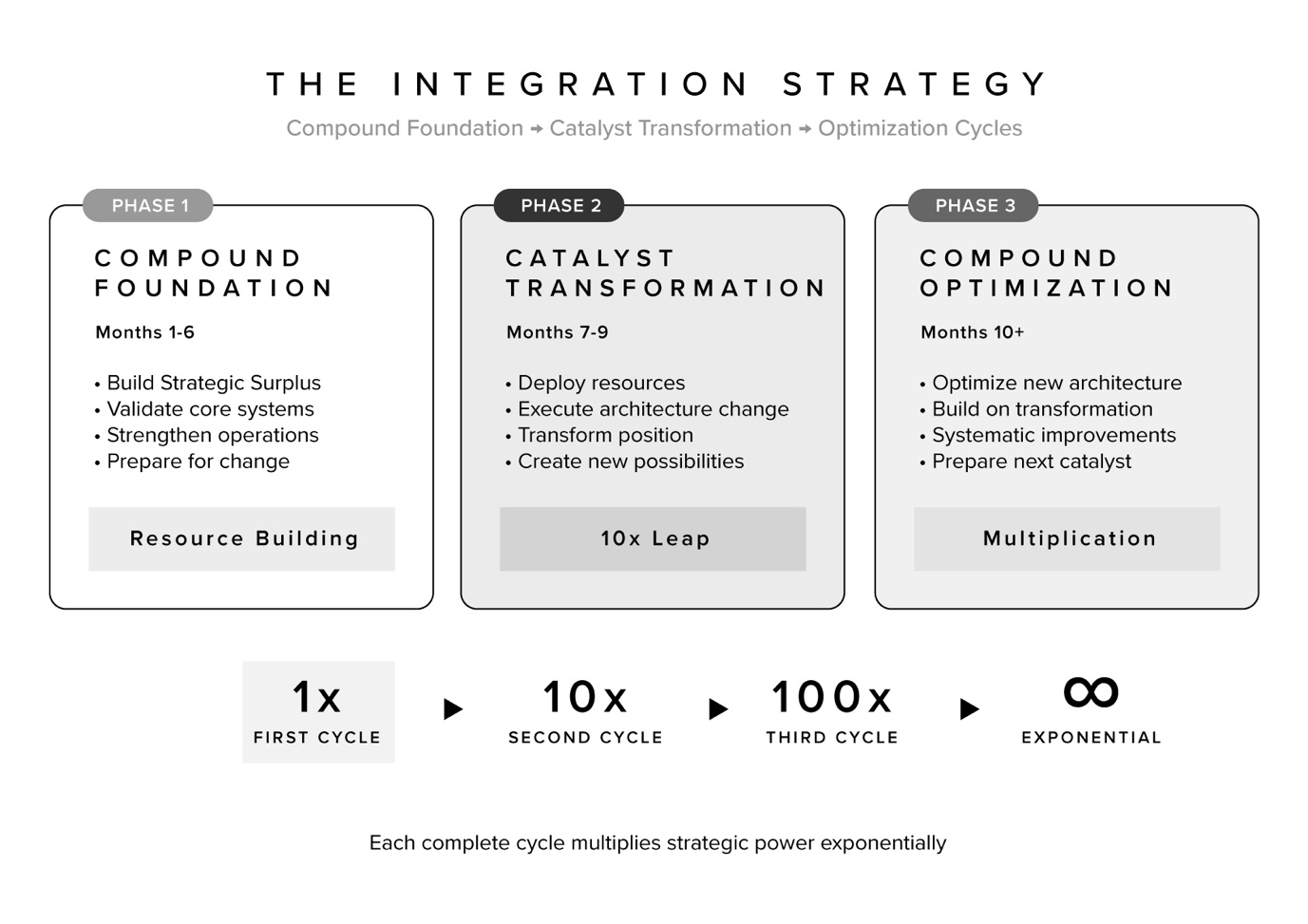
The most powerful strategic approach combines both move types:
Phase 1: Compound Foundation (Months 1-6)
- Build Strategic Surplus through optimization
- Validate core systems
- Strengthen operational excellence
- Prepare organization for change
Phase 2: Catalyst Transformation (Months 7-9)
- Deploy accumulated resources
- Execute architectural change
- Transform strategic position
- Create new possibilities
Phase 3: Compound Optimization (Months 10+)
- Optimize new architecture
- Build on transformation
- Create systematic improvements
- Prepare for next catalyst
The Multiplication Effect
When properly sequenced:
- Compound Moves create resources for Catalyst Moves
- Catalyst Moves create new architectures for Compound optimization
- Each cycle builds greater transformation capacity
- Strategic power multiplies exponentially
Common Framework Mistakes
Mistake 1: Catalyst Without Foundation
Wrong: Attempting transformation without Strategic Surplus Right: Build foundation through Compound Moves first
Transformation requires resources, stability, and organizational readiness.
Mistake 2: Perpetual Optimization
Wrong: Only using Compound Moves when architecture is limiting Right: Recognize when optimization can’t achieve needed outcomes
Sometimes 10% better isn’t enough—you need 10x different.
Mistake 3: Transformation Addiction
Wrong: Constant Catalyst Moves creating chaos Right: Transform, then optimize before next transformation
Organizations need stability to capture value from transformations.
Mistake 4: Missing Integration
Wrong: Treating moves as either/or choice Right: Strategic sequencing of both types
The power comes from integration, not isolation.
Strategic Examples by Industry
SaaS Business Evolution
Compound Moves:
- A/B testing pricing pages (15% conversion improvement)
- Optimizing onboarding flow (25% activation increase)
- Improving customer support (30% churn reduction)
Catalyst Move:
- Launching enterprise version with completely different architecture
- Result: 10x deal sizes, new market segment, transformed business
Professional Services Transformation
Compound Moves:
- Standardizing delivery processes (20% efficiency gain)
- Training team on new methodologies (30% premium increase)
- Building referral systems (40% lead cost reduction)
Catalyst Move:
- Creating proprietary AI tools for service delivery
- Result: 5x capacity, new service categories, market leadership
E-commerce Revolution
Compound Moves:
- Optimizing product pages (10% conversion lift)
- Improving email marketing (25% repeat purchase increase)
- Enhancing logistics (15% cost reduction)
Catalyst Move:
- Transforming to marketplace model
- Result: Inventory-free growth, infinite SKUs, platform economics
The Strategic Architecture Integration
Compound and Catalyst Moves connect to the entire Strategic Architecture™ system:
Strategic Triggers™: Compound Moves advance toward them, Catalyst Moves create new ones
Power Numbers™: Compound Moves optimize them, Catalyst Moves redefine them
Trinity Framework™: Provides structure for both move types
Strategic Surplus™: Generated by Compound Moves, invested in Catalyst Moves
Cascade Thinking: Catalyst Moves create new cascade possibilities
The Recognition Challenge
The hardest part isn’t executing these moves—it’s recognizing which type you need.
Most businesses get trapped in Compound Moves because they’re safer, more predictable, easier to justify. But sometimes, optimization is just rearranging deck chairs on the Titanic.
The question isn’t: “How can we improve?” The question is: “Do we need improvement or transformation?”
The Ultimate Strategic Recognition
In the AI era, this distinction becomes even more critical. AI accelerates both optimization and transformation, but only human strategic insight can determine which to deploy.
Master both types of moves, and you don’t just build a better business—you architect entirely new possibilities. The framework doesn’t tell you to choose between compound and catalyst. It shows you when each creates the strategic leverage you need.
Ready to master strategic transformation? Get the complete Strategic Architecture methodology delivered weekly → Subscribe to our Substack newsletter for frameworks that transform strategic thinking into systematic success.
Prepared by the Strategic Architecture Editorial Team, bringing clarity to the frameworks shaping the AI era.
Trademark Notice
© 2025 Edward Azorbo. All rights reserved.
Strategic Inevitability™, Strategic Architecture™, Power Numbers™, iPolaris, Strategic Triggers™, Clear Paths™, Mathematical Freedom Recognition, Trinity Framework™, Compound Moves, Catalyst Moves, and all related names, logos, and framework titles are trademarks or registered trademarks of Edward Azorbo in the United States, the European Union, and other jurisdictions.
Unauthorized use, reproduction, or modification of these marks and the proprietary methodologies they represent is strictly prohibited. All other trademarks and trade names are the property of their respective owners.
“The canonical definitions of all frameworks are maintained in the Strategic Architecture™ Glossary. The complete methodology is documented across two books: Leverage and The Opportunity Advantage by Edward Azorbo.”
Compound Moves create systematic improvement through optimization cycles. Catalyst Moves fundamentally transform your strategic architecture. Both are essential for complete strategic evolution.
Compound Moves optimize within existing systems for predictable 10-20% improvements. Catalyst Moves transform the entire system for 10x possibilities and new strategic architectures.
Use Compound Moves when your system works but needs optimization. Use Catalyst Moves when optimization can’t achieve your goals and transformation is required.
Yes. The most powerful approach sequences both: Compound Moves build resources, Catalyst Moves create transformation, then new Compound Moves optimize the new architecture.
Examples include: consulting firm adding subscription model, product company becoming platform, traditional business going AI-first, or commodity provider creating proprietary methodology.