
Manufactured Emergence: The Third Category of Strategic Opportunity
Manufactured Emergence is the practice of designing actions and conditions that maximize the probability of beneficial unexpected outcomes—turning emergence from random luck into engineered probability through surface area, intent, and interaction density. :contentReference[oaicite:8]{index=8}
Manufactured Emergence is the strategic practice of intentionally designing actions and conditions that maximize the probability of beneficial unexpected outcomes—transforming emergence from random luck into engineered probability through systematic surface area creation.
For centuries, business strategy has recognized only two types of opportunities: those you plan for and those that happen by luck. This binary thinking creates a massive strategic blind spot, missing an entire category of opportunity that the most successful companies systematically exploit.
Between rigid planning and random chance exists a third category—emergent opportunities that can be manufactured through intentional design. Understanding and mastering this third category transforms strategic capability from linear planning to exponential possibility creation.
The Revolutionary Recognition: Three Categories, Not Two
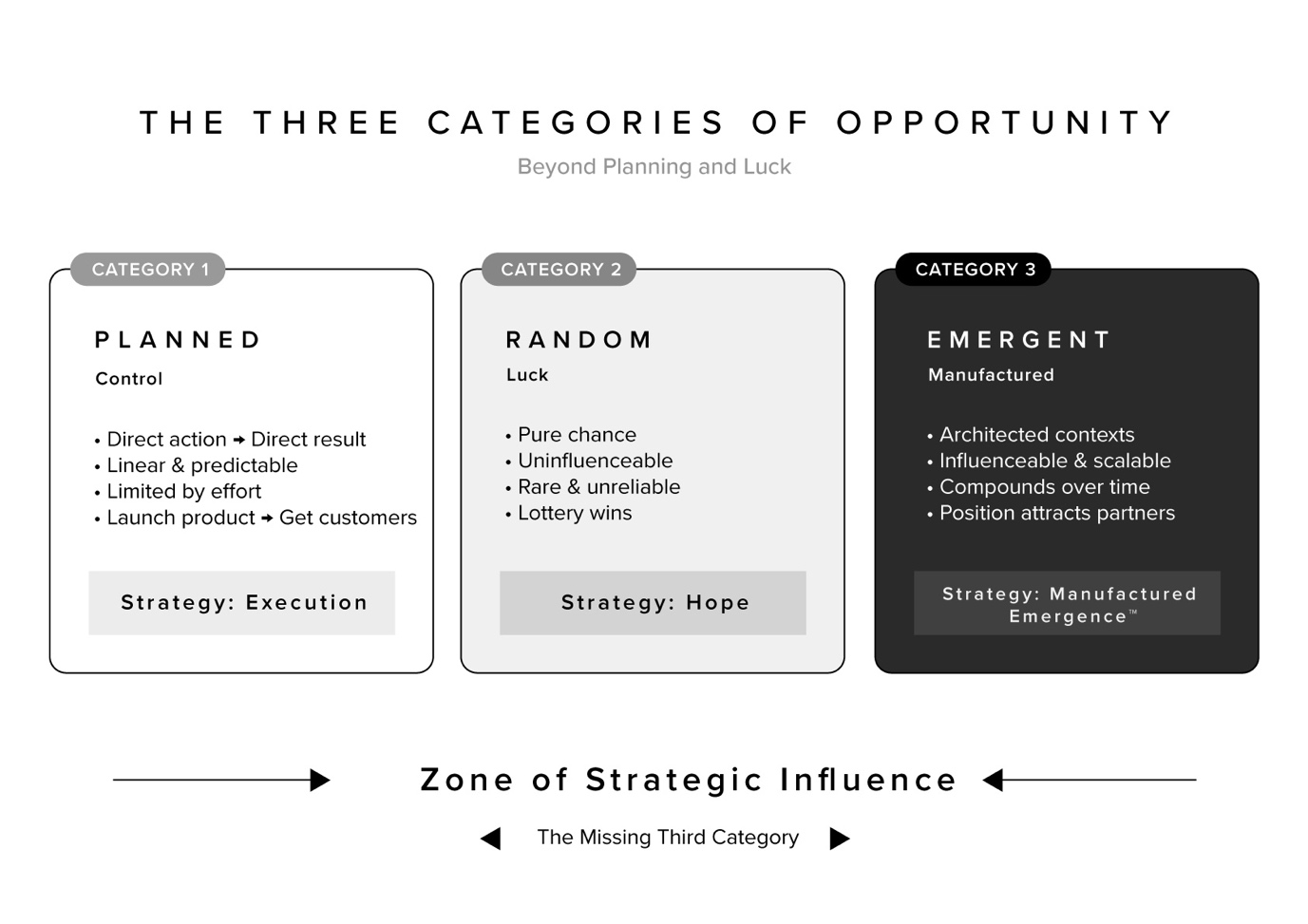
The Traditional Binary
Business thinking has always divided opportunities into two categories:
Category 1: Planned Opportunities (Control)
- Definition: Directly created through deliberate action
- Examples: Launch product → get customers, apply for job → get hired
- Characteristics: Linear, predictable, limited by direct effort
- Strategy: Execution excellence
- Limitation: Can only capture what you directly pursue
Category 2: Random Opportunities (Luck)
- Definition: Pure chance occurrences outside influence
- Examples: Born into wealth, lottery wins, random encounters
- Characteristics: Uninfluenceable, rare, unreliable
- Strategy: Hope (not actually strategy)
- Limitation: Cannot be influenced or scaled
The Missing Third Category
Category 3: Emergent Opportunities (Manufactured)
- Definition: Arise from intentionally architected contexts
- Examples: Strategic position attracts partners, reputation draws opportunities
- Characteristics: Influenceable, scalable, compound over time
- Strategy: Manufactured Emergence
- Power: Unlimited potential through systematic design
This third category changes everything. It proves that between rigid control and random luck exists a zone of strategic influence where you can systematically create contexts generating valuable opportunities.
The Law of Emergence
“In environments of increasing complexity, influence scales faster than control.”
This fundamental law explains why Manufactured Emergence becomes MORE powerful as:
- Change accelerates
- Systems complexify
- Interactions multiply
- AI amplifies connections
While control becomes harder in complexity, the ability to influence through context creation becomes exponentially more powerful.
The Context Creation Principle
Manufactured Emergence = Creating contexts where valuable possibilities must surface
Think of it like creating a garden:
- Planned: Plant specific seeds in specific spots
- Random: Whatever blows in on the wind
- Emergent: Create conditions where beneficial ecosystems develop
You architect the context; emergence delivers the value.
The Manufactured Emergence Formula
Mathematical Architecture
Manufactured Emergence = (Surface Area × Intent Quality × Interaction Density × Environmental Density × Courage Factor)^Time
Component Breakdown
1. Surface Area The number of potential collision points you create:
- Multiple channels and platforms
- Diverse stakeholder engagement
- Varied content formats
- Strategic touchpoints
2. Intent Quality The strategic value designed into each interaction:
- Thoughtful targeting
- Value-first approach
- Emotional activation design
- Meaningful connection potential
3. Interaction Density The frequency of emergence opportunities:
- Consistent presence
- Regular value delivery
- Systematic engagement rhythms
- Reliable availability
4. Environmental Density The natural emergence rate of your environment:
- AI/Tech sectors = High density
- Traditional industries = Lower density
- Market volatility = Increased density
- Network effects = Multiplied density
5. Courage Factor The multiplier of bold action:
- Willingness to create bold surfaces
- Comfort with uncertain returns
- Emotional readiness to act
- Risk tolerance for innovation
Time: The compound effect multiplier where emergence surfaces create more surfaces, captured value enables expansion, and networks amplify exponentially.
Strategic Implementation Patterns
Multi-Channel Publishing Strategy
Organizations implementing Manufactured Emergence through content create systematic opportunities by:
Platform Diversification:
- Publishing across 7-10 platforms simultaneously
- Each platform reaching different audience segments
- Cross-pollination between channels
- Varied formats for same core insights
Emergence Architecture:
- Single article becomes podcast topic
- Podcast listener becomes strategic partner
- Partner introduction leads to speaking opportunity
- Speaking engagement creates investment interest
- Investment enables platform expansion
Each surface creates potential for unexpected value multiplication.
Strategic Partnership Networks
Companies manufacturing emergence through relationships focus on:
Network Design:
- Curated introductions at strategic events
- Value-first connection philosophy
- Regular touchpoint systems
- Multi-stakeholder engagement
Compound Effects:
- Introduction leads to collaboration
- Collaboration creates case study
- Case study attracts similar partners
- Partner network becomes self-expanding
- Each node increases emergence probability
The Emergence Loop: Infinite Value Creation
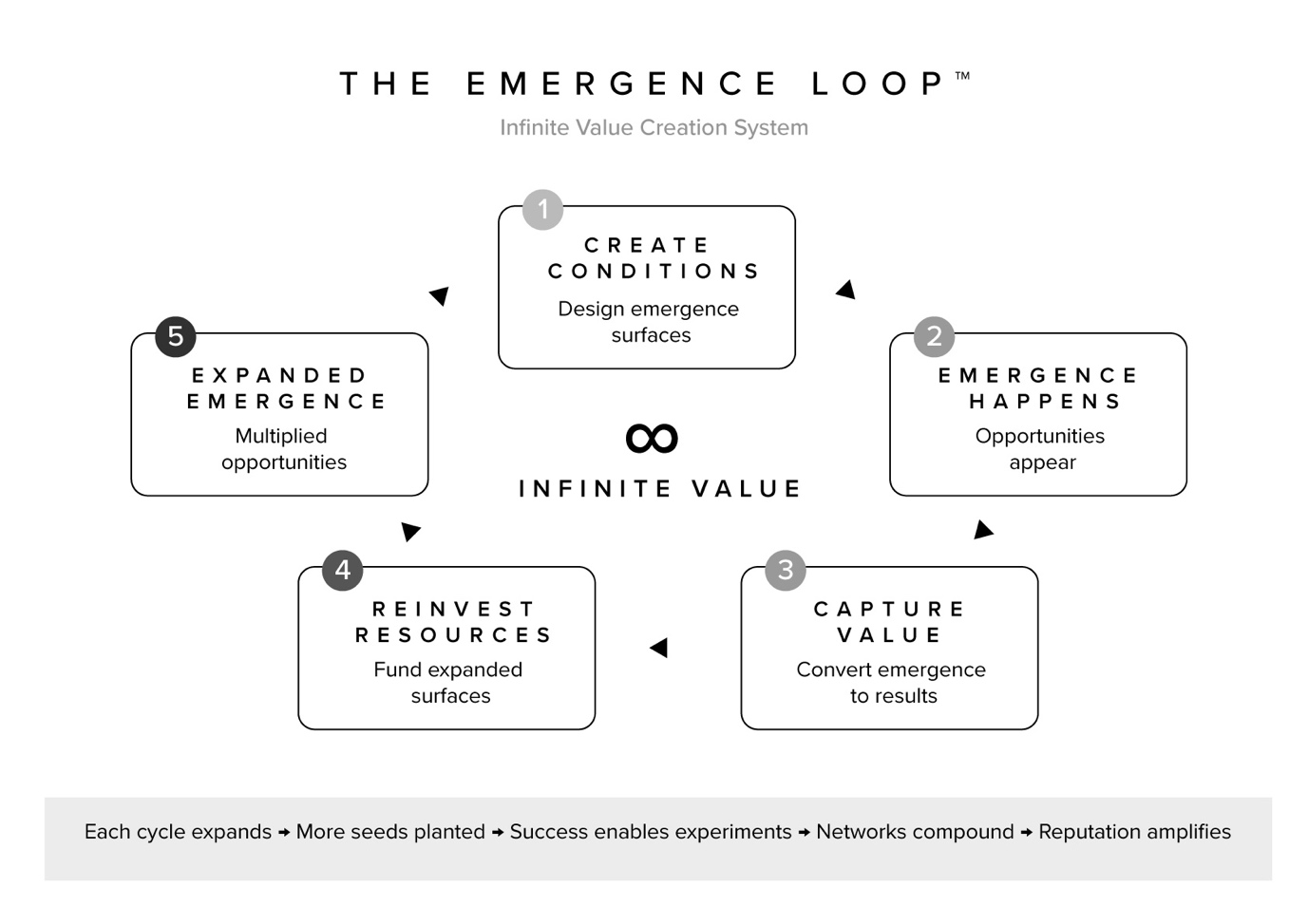
The Self-Reinforcing Architecture
CREATE CONDITIONS → EMERGENCE HAPPENS → CAPTURE VALUE → REINVEST IN CONDITIONS → EXPANDED EMERGENCE → (Loop continues infinitely)
Why The Loop Creates Inevitability
- Each cycle expands surface area: More seeds planted
- Captured value funds expansion: Success enables experiments
- Learning improves quality: Better understanding of what works
- Networks compound: Each connection creates connections
- Reputation amplifies: Success attracts more emergence
Emergence Readiness: The Critical Complement
The Two-Part System
Part 1: Manufacture Emergence (Create conditions) Part 2: Emergence Readiness (Capture value when it appears)
Required Readiness Architecture
Intellectual Readiness: Frameworks and knowledge prepared Emotional Readiness: Courage to act when opportunity appears Resource Readiness: Time, energy, capital available Strategic Readiness: Recognition of emergence significance
Common Failure Point
Most organizations successfully create emergence but fail to capture it:
- Opportunity appears but they hesitate
- Over-analysis creates paralysis
- The emergence window closes
- Value evaporates uncaptured
The Emergence Yield Rate (EYR)
Definition: The percentage of created emergence surfaces that convert into captured opportunities, providing a measurable KPI for systematic serendipity.
Formula: EYR = (Captured Opportunities ÷ Created Surfaces) × 100%
This metric transforms emergence from mystical to manageable, enabling systematic optimization of your emergence strategy.
Implementation Strategy
Phase 1: Emergence Audit (Week 1-2)
Assessment Questions:
- How many emergence surfaces am I currently creating?
- What’s the quality of my intentional design?
- Where is my environmental density highest?
- What courage barriers limit surface creation?
- Am I ready to capture emergence when it appears?
Phase 2: Surface Area Expansion (Week 3-6)
Strategic Actions:
- Map potential surfaces: List all possible interaction points
- Design with intent: Add value and emotional activation
- Increase density: Create regular interaction rhythms
- Choose courage: Take bold actions others won’t
- Prepare capture systems: Ensure readiness when emergence happens
Phase 3: Loop Activation (Week 7-12)
Building Your Emergence Engine:
- Start with current resources
- Create initial surfaces
- Capture first emergences
- Reinvest in expanded surfaces
- Let the loop compound
Phase 4: Systematic Scaling (Month 4+)
Advanced Practice:
- Design for multi-dimensional impact
- Build organizational emergence culture
- Create systematic capture processes
- Develop emergence recognition skills
- Scale successful surface types
Common Implementation Mistakes
Mistake 1: Surface Without Substance
Wrong: Many touchpoints but no value Right: Focus on Intent Quality over Surface Area quantity
Creating 100 meaningless connections yields less than 10 meaningful ones.
Mistake 2: Lacking Capture Readiness
Wrong: Opportunities emerge but can’t capitalize Right: Build readiness infrastructure before manufacturing emergence
Emergence without readiness equals wasted opportunity.
Mistake 3: Impatience with Time Factor
Wrong: Expecting immediate emergence from new surfaces Right: Trust the compound formula, maintain consistency
Emergence follows exponential curves—early progress seems slow.
Mistake 4: Courage Deficit
Wrong: Playing it safe with conventional surfaces Right: Bold surfaces create disproportionate emergence
The Courage Factor multiplies all other components.
Strategic Integration with Business Models
For SaaS Companies
High-Density Surfaces:
- Free tool releases creating user communities
- Open-source contributions attracting talent
- Educational content building thought leadership
- Integration partnerships expanding reach
For Service Businesses
Relationship-Based Emergence:
- Speaking at industry events
- Publishing methodology frameworks
- Strategic pro-bono work
- Alumni network cultivation
For Product Companies
Market-Creation Surfaces:
- Beta testing communities
- User-generated content campaigns
- Innovation challenges
- Strategic retailer partnerships
The AI-Era Multiplication Effect
Why Manufactured Emergence Matters Now
In an AI era where:
- Change velocity exceeds prediction capability
- Opportunities emerge faster than planning cycles
- Traditional strategy becomes obsolete before implementation
- Success requires capturing unpredictable value
Manufactured Emergence becomes essential strategic capability.
AI as Emergence Amplifier
AI doesn’t replace Manufactured Emergence—it amplifies it:
- Surface Creation: AI helps identify and create more touchpoints
- Pattern Recognition: AI spots emergence patterns humans miss
- Capture Assistance: AI helps process and respond to opportunities
- Scale Enablement: AI allows managing 10x more surfaces
The Competitive Reality
Companies Operating in Two Categories: Limited to what they plan + random chance Companies Operating in Three Categories: Unlimited potential through emergence architecture
The gap isn’t arithmetic—it’s dimensional. Like playing 3D chess while others play checkers.
Strategic Indicators of Success
Early Stage (Months 1-6)
- Increased unexpected opportunities
- Growing network effects
- Rising inbound interest
- Expanding surface creation capacity
Growth Stage (Months 7-18)
- Self-reinforcing loops established
- Emergence becoming predictable
- Resource multiplication visible
- Strategic options expanding
Maturity Stage (Year 2+)
- Emergence engines self-sustaining
- Organizational culture shift complete
- Competitive advantage widening
- New emergence dimensions discovered
The Strategic Transformation
From Random to Systematic
Manufactured Emergence transforms opportunity creation from:
- Hope-based → Design-based
- Random → Engineered
- Scarce → Abundant
- Lucky → Inevitable
The Ultimate Recognition
In a world of exponential change and infinite complexity, the ability to manufacture emergence while maintaining capture readiness becomes the meta-skill enabling all other strategic advantages.
Master this framework and you master:
- Creating your own luck systematically
- Surfacing opportunities others miss
- Building engines generating increasing possibility
- Thriving in uncertainty through design
The strategic choice is clear: You can plan it. You can hope for it. Or you can architect the conditions where it must appear.
Ready to engineer your own emergence? Get the complete Strategic Architecture™ methodology delivered weekly → Subscribe to our Substack newsletter for frameworks that transform random luck into systematic opportunity.
Prepared by the Strategic Architecture™ Editorial Team, bringing clarity to the frameworks shaping the AI era.
Trademark Notice
© 2025 Edward Azorbo. All rights reserved.
Strategic Inevitability™, Strategic Architecture™, Power Numbers™, iPolaris, Strategic Triggers™, Clear Paths™, Mathematical Freedom Recognition, Trinity Framework™, Manufactured Emergence, The Third Category, The Law of Emergence, Emergence Yield Rate, The Emergence Loop, and all related names, logos, and framework titles are trademarks or registered trademarks of Edward Azorbo in the United States, the European Union, and other jurisdictions.
Unauthorized use, reproduction, or modification of these marks and the proprietary methodologies they represent is strictly prohibited. All other trademarks and trade names are the property of their respective owners.
“The canonical definitions of all frameworks are maintained in the Strategic Architecture™ Glossary. The complete methodology is documented across two books: Leverage and The Opportunity Advantage by Edward Azorbo.”
Manufactured Emergence is the strategic practice of creating conditions where valuable opportunities must appear, representing the third category between planned opportunities and random luck.
The three categories are: Planned Opportunities (direct control), Random Opportunities (pure luck), and Emergent Opportunities (manufactured through intentional context design).
Manufactured Emergence = (Surface Area × Intent Quality × Interaction Density × Environmental Density × Courage Factor)^Time. Each component multiplies to create exponential opportunity generation.
AI amplifies Manufactured Emergence by helping create more surfaces, recognize patterns, capture opportunities, and scale to 10x more touchpoints than humanly possible alone.
Planned opportunities are linear and limited by direct effort. Emergent opportunities are manufactured through context creation, scale infinitely, and compound over time.