
What Is The Dimensional Jump Law?
The Dimensional Jump Law™ states that when a domain lacks a dimension in its language, it cannot systematize, scale, or deliberately design the capabilities that dimension enables—but the moment the missing dimension is named, entirely new capabilities become executable, teachable, and scalable. Introduced by Edward Azorbo in his book Leverage, this law operates as the meta-principle underneath every strategic breakthrough.
Unlike traditional strategy that teaches you to optimize harder inside the frame you already have, The Dimensional Jump Law reveals that most business ceilings aren’t performance ceilings—they’re linguistic ceilings. You cannot defend what you cannot name. You cannot build what your vocabulary does not contain. You cannot teach, measure, or systematize a capability your domain has no word for.
This is why the most sophisticated operators in any industry often plateau while newcomers with fewer resources reorganize entire categories. The newcomers aren’t working harder. They’re naming what the incumbents cannot see.
Why Your Optimization Has a Ceiling You Can’t See
Most strategic plateaus feel like execution problems. The team is working harder. Tactics are more sophisticated than ever. Budgets are deployed intelligently. And the needle barely moves.
This pattern—intensifying effort with flat results—is almost never a performance problem. It’s a dimensional problem. You’ve exhausted what your current dimension permits, and no amount of additional force within the existing geometry will break through. The ceiling is structural, not operational.
The trap is that optimization feels like progress. You can spend years refining conversion rates, tightening operations, training teams—all within a frame that has a hard mathematical limit. The harder you push, the more the ceiling reveals itself as a wall rather than a gap. Only a new dimension dissolves it.
The Three Stages of a Dimensional Jump
The law operates through three stages that unfold almost simultaneously once the missing dimension is articulated.
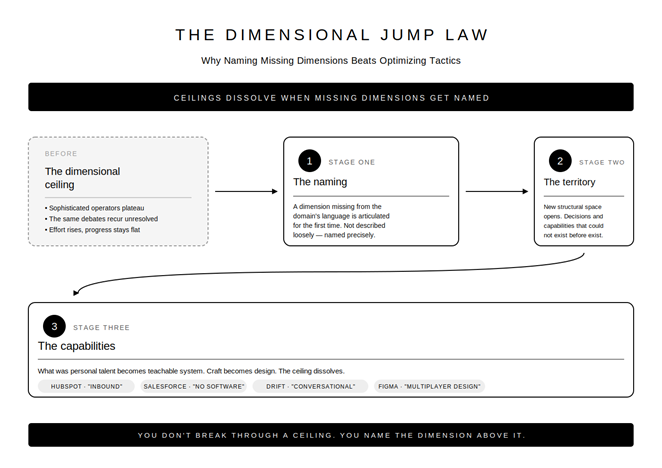
Stage 1: The Naming
A dimension absent from the domain’s language is articulated for the first time. Not described loosely—named precisely. The naming must be operational, giving the dimension a handle that makes it usable. The specificity of the word matters enormously. Vague description preserves the ceiling. Operational naming dissolves it.
Stage 2: The Territory
The naming creates new structural territory—a space where designs, decisions, and capabilities can exist that could not exist before. The territory isn’t the activity itself. It’s the architectural category that makes the activity designable. Positions, transitions, sequences, and measurement points all become possible once the territory has a name.
Stage 3: The Capabilities
Inside the new territory, capabilities become deliberately designable that were previously only accessible through craft, intuition, or accident. What was personal talent becomes teachable methodology. What was scattered tactics becomes coherent discipline. What existed in embryo becomes systematically buildable.
The pattern: Missing dimension → Missing language → Capability trapped as craft → Structural ceiling. Named dimension → New language → Capability becomes designable, teachable, scalable → Domain reorganizes permanently.
The Four Signs You’ve Hit a Dimensional Ceiling
Before you can execute a dimensional jump, you need to feel the ceiling. Dimensional ceilings have a specific sensation. Four diagnostic signs reveal you’re operating inside one.
1. Sophisticated Operators Hitting Unexplainable Plateaus
Your tactics are good. Your team is capable. Your execution is real. And you’re stuck—not failing, stuck. When smart people with strong execution consistently plateau, the constraint is almost never effort or intelligence. It’s a missing dimension. They are optimizing inside a geometry with a structural limit they can’t see.
2. The Same Debate Recurring Without Resolution
“Brand versus performance.” “Short-term versus long-term.” “Growth versus profitability.” Every unresolvable binary in a domain is a signal. Both sides are correct within their dimension—and the dimension that would unify them hasn’t been named. The resolution isn’t choosing a side. It’s naming the axis that dissolves the binary entirely.
3. Capabilities That Seem Obvious in Retrospect
When a new framework arrives and practitioners say “of course—I already knew that”—that’s the signature of a dimensional jump. It wasn’t obvious before. It was structurally impossible. The naming makes it feel inevitable because the dimension, once visible, seems like it was always there. That retroactive obviousness is the clearest marker.
4. Optimization Intensifies But Progress Stays Flat
The team is working harder than ever. Tactics are more sophisticated than ever. And the needle barely moves. That pattern—increasing effort, static results—is the clearest sign that the domain has hit a dimensional wall. You are not under-optimizing. You have exhausted what your dimension permits.
Four Dimensional Jumps That Reorganized Business
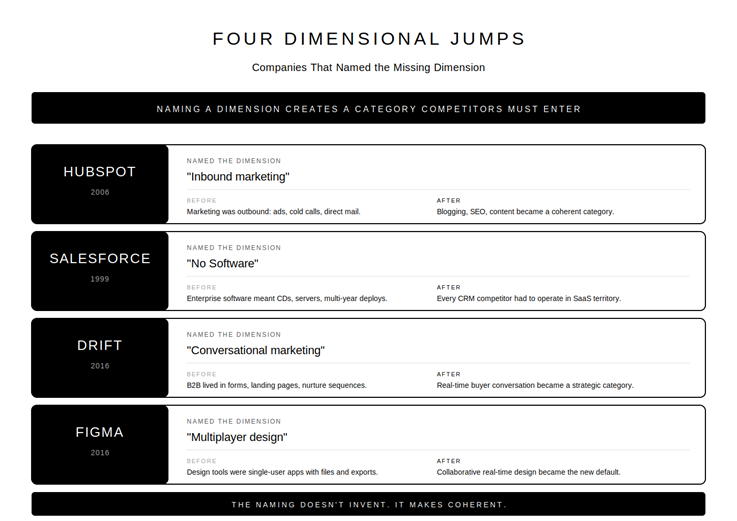
The Dimensional Jump Law isn’t theoretical. It’s the underlying mechanism behind every company that has successfully created a category rather than competed within one. Four examples reveal the pattern with unusual clarity.
HubSpot and “Inbound Marketing”
Before 2006, marketing vocabulary was organized around outbound tactics—ads, cold calls, direct mail, interruption-based advertising. Companies were publishing blog posts, optimizing for search, and creating educational content, but these existed as scattered tactics, not a discipline. There was no coherent category to place them in.
HubSpot named “inbound marketing” as a dimension. The naming did three things that no amount of better tactics could have done. It created a teachable methodology that eventually became HubSpot Academy, training hundreds of thousands of marketers. It defined a product category—inbound marketing automation—that HubSpot still leads two decades later. And it made the capability portable across organizations, so that every marketing team now has an inbound strategy whether they use HubSpot or not.
The naming didn’t invent blogging, SEO, or content marketing. It named the dimension that made them coherent. Before the naming, they were tactics. After the naming, they were a discipline.
Salesforce and “No Software”
Before 1999, enterprise software meant on-premise installation—CDs, servers, consultants, multi-year deployments. The idea of business-critical software running over the internet wasn’t just unusual. It was structurally incoherent in the vocabulary of enterprise IT.
Marc Benioff named the missing dimension with a deliberately provocative phrase: “No Software.” The naming wasn’t just branding. It articulated a dimension that enterprise vocabulary didn’t contain—software as a service, delivered over the internet, paid for monthly, updated continuously. Once named, the capability became buildable at scale. Salesforce didn’t just launch a product. They reorganized enterprise technology.
The ceiling dissolved the moment the dimension was named. Every CRM competitor eventually had to operate inside the territory Salesforce created.
Drift and “Conversational Marketing”
Before 2016, B2B marketing vocabulary was dominated by forms, landing pages, lead capture, and nurture sequences. The entire architecture assumed asynchronous, forms-based engagement. Live chat widgets existed, but they sat outside the marketing discipline—treated as support tools, not demand generation.
Drift named “conversational marketing” as a new dimension. The naming transformed real-time buyer conversation from a support feature into a strategic category. Once named, sales and marketing teams could design around it, measure it, and build it into their revenue architecture. Conversational marketing became a discipline, with its own playbooks, certifications, and product category.
The capability existed before Drift. The naming made it architecturally available to everyone else.
Figma and “Multiplayer Design”
Before 2016, design tools were single-player by default. Photoshop, Sketch, and Illustrator were built for one designer working alone. Collaboration existed as a workaround—export the file, email it, collect comments, re-import the feedback. The entire workflow assumed isolation.
Figma named “multiplayer design” as a dimension, borrowing vocabulary from gaming. The naming reframed design collaboration as a native architectural property rather than a workaround. Once named, the dimension generated new capabilities: live cursors, real-time co-editing, shared components, collaborative prototyping. Every design tool that followed had to answer whether it was single-player or multiplayer. That question did not exist before the naming.
Figma didn’t just build a better design tool. They named the dimension that made every other design tool look structurally obsolete.
Why This Law Operates in Every Domain
The Dimensional Jump Law isn’t confined to technology companies. It operates wherever human knowledge meets a structural ceiling.
Mathematics hit a ceiling for centuries because zero didn’t exist as a usable object in calculation. Civilizations could count and trade but could not develop positional notation, algebra, or calculus. The moment zero was named as a mathematical object, entirely new branches of mathematics became buildable. Not incrementally better math—structurally impossible math that required the dimension to exist before it could be conceived.
Medicine operated under the same constraint for millennia. Surgeons performed operations with dirty hands, not because they were incompetent, but because “contamination by invisible organisms” was not a concept their vocabulary contained. The moment germ theory named microorganisms as causal agents, the same physical act—washing hands before surgery—went from folk wisdom to a universal, teachable protocol. The physics had always been there. The naming made the capability architecturally available.
The pattern is identical across every domain. The dimension exists in reality before it exists in language. Effects are observable. But without the name, the capability remains trapped as craft, intuition, or accident—available to the few who stumble into it, inaccessible to the many who could systematically use it.
The Dimensional Jump Law vs Traditional Strategy
| Traditional Strategy | The Dimensional Jump Law |
| Optimize inside the known game | Name the missing dimension |
| Effort produces linear results | Naming produces exponential territory |
| Intelligence wins the game | Sight transcends the game |
| Ceilings broken by force | Ceilings dissolved by language |
| Tactics proliferate | Dimensions proliferate |
| “How can we improve?” | “What are we missing the word for?” |
| Domain expertise | Domain architecture |
The fundamental shift: intelligence optimizes inside the game as defined. Sight notices the game is missing a dimension—and names the axis that changes what is possible. Intelligence improves your conversion rate. Sight reveals that the model itself is wrong.
How to Execute Your Own Dimensional Jump
Step 1: Find Your Ceiling
Where is effort intensifying while progress stays flat? Where have you optimized within one dimension until the ceiling became invisible? That pattern is the signature. You are not under-performing within your dimension. You have exhausted what your dimension permits.
Step 2: Identify the Recurring Unresolved Binary
Which debate in your industry refuses to resolve? Brand versus performance? Quality versus speed? Growth versus profitability? Every unresolvable binary is a symptom of a missing dimension. The resolution isn’t choosing a side. It’s naming the third axis that dissolves the binary entirely.
Step 3: Articulate the Capability You Can’t Yet Systematize
What do you sense is possible but can’t design deliberately? What works in your best moments but can’t be made repeatable? The gap between “I sense this should work” and “I can design it deliberately” is a dimensional gap. The capability exists as craft. It needs a name to become architecture.
Step 4: Name the Dimension Operationally
Not describe—name. The naming must be operational, not decorative. “Inbound marketing” works because it contrasts cleanly with outbound and implies a buildable discipline. “Multiplayer design” works because it imports a precise mental model from gaming. Weak names preserve the ceiling. Strong names dissolve it.
Step 5: Build the Territory
Once named, design the positions, transitions, and capabilities inside the new territory. What can you now do deliberately that was previously accident? What can you teach that was previously intuition? What can you measure that was previously invisible? That is where compound advantage begins.
Common Dimensional Jump Mistakes
Mistake 1: Describing Instead of Naming
Wrong: “We need to focus more on long-term thinking.”
Right: Naming the distinct dimension that makes long-term action architecturally designable.
Mistake 2: Confusing Optimization With Transcendence
Wrong: Working harder inside the existing dimension when results stay flat.
Right: Recognizing that intensifying effort with flat results is a ceiling signal, not a performance problem.
Mistake 3: Resolving Binaries by Choosing Sides
Wrong: Picking “brand” over “performance” in a recurring debate.
Right: Naming the third dimension that dissolves the binary entirely.
Mistake 4: Keeping Capabilities as Personal Craft
Wrong: Treating what works for you as personal talent that cannot be systematized.
Right: Naming the dimension so the capability becomes portable, teachable, and scalable.
Intelligence vs Sight: The Meta-Skill of the AI Era
In the AI era, the act of naming becomes a dividing line. AI is the most powerful computational intelligence ever built. It can optimize any dimension that has a name—faster, deeper, and more consistently than any human. But it cannot name what a domain doesn’t yet know is missing. It cannot develop vocabulary for a ceiling it hasn’t been taught to notice.
This makes dimensional recognition—the meta-skill of sensing missing dimensions and naming them—the most valuable strategic capability in a post-AI landscape. AI handles optimization. Humans handle dimensional jumps. The businesses that dominate the next decade will be those whose leaders can see what their competitors’ vocabulary cannot contain.
Intelligence compounds where dimensions are named. Sight creates where they are not.
The Dimensional Jump Law in Strategic Architecture™
The Dimensional Jump Law sits at the foundation of Strategic Architecture™ as its meta-principle. Every other framework in the methodology is an instance of the same generative pattern: find a dimension that business language doesn’t contain, name it precisely, and watch previously impossible capabilities become systematically buildable. The law is the generator. The frameworks are what the generator produces.
From Optimization to Architecture
Most entrepreneurs spend their careers optimizing inside the game they can see. They win tactical battles while their strategic ceiling stays invisible. The Dimensional Jump Law offers a different path. You learn to sense gaps others cannot see. You name what is missing instead of pushing harder on what is present. You dissolve ceilings instead of breaking them.
As Edward Azorbo writes in Leverage: “Intelligence optimises inside the game as defined. Sight notices the game is missing a dimension—and names the axis that changes what’s possible. Intelligence optimises. Sight transcends.”
Somewhere in your business is a dimension waiting to be named. A constraint that, once articulated, would change how everything behaves. Not a goal to reach. A ceiling to dissolve.
The choice is binary: keep optimizing inside a dimension you’ve already exhausted, or learn to name the ones others don’t yet know exist.
Ready to build dimensional recognition as a strategic capability? Get the complete Strategic Architecture™ methodology delivered weekly → Subscribe to our Substack newsletter (https://stratarch.co/subscribe) for frameworks that transform how you see business itself.
Prepared by the Strategic Architecture™ Editorial Team, drawing on Leverage by Edward Azorbo, bringing clarity to the frameworks shaping the AI era.
Trademark Notice
© 2025 Edward Azorbo. All rights reserved.
Strategic Inevitability™, Strategic Architecture™, Power Numbers™, iPolaris™, Strategic Triggers™, Clear Paths™, Mathematical Freedom Recognition™, Trinity Framework™, Dimensional Jump Law™, and all related names, logos, and framework titles are trademarks or registered trademarks of Edward Azorbo in the United States, the European Union, and other jurisdictions.
Unauthorized use, reproduction, or modification of these marks and the proprietary methodologies they represent is strictly prohibited. All other trademarks and trade names are the property of their respective owners.
“The canonical definitions of all frameworks are maintained in the Strategic Architecture™ Glossary. The complete methodology is documented across two books: Leverage and The Opportunity Advantage by Edward Azorbo.”