
What Is the Three Games Framework?
The Three Games™ is a strategic framework that treats business as three simultaneous time-based games—immediate triggers, compound systems, and transcendent moats—each feeding the others to produce exponential rather than linear results. Introduced by Edward Azorbo in his book Leverage, this framework operates as the complete definition of strategy itself in the AI era.
Most companies play only one game. They chase this month’s revenue and call it strategy. Then the month ends, and they start again from zero. The Three Games™ reveals why that pattern keeps repeating, and what changes when the same action is designed to deposit value across three different time horizons at once.
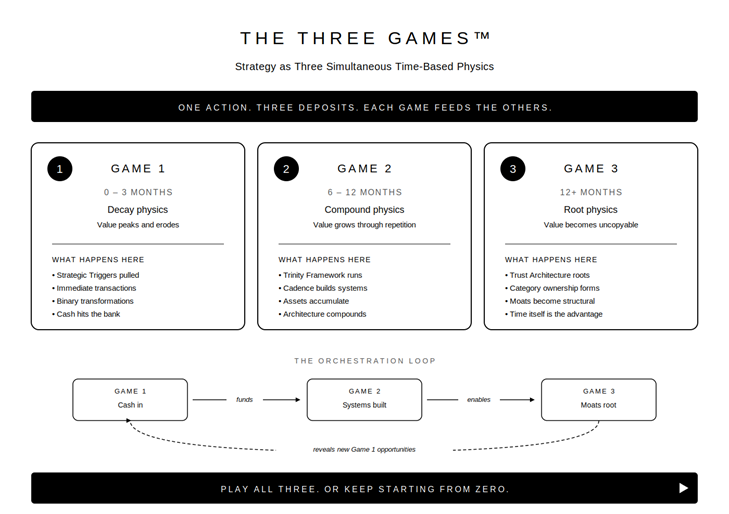
Each game operates under a different physics of value. Revenue in Game 1 peaks and erodes within weeks. Systems in Game 2 compound through repetition over months. Moats in Game 3 root over years and become structurally uncopyable. A business that plays only Game 1 works harder each month. A business that plays all three accumulates architecture that makes every future move easier.
Why Single-Game Thinking Fails in the AI Era
Execution speed is approaching infinity. Anyone can spin up a landing page in an afternoon, launch an ad campaign by Friday, ship a product in a quarter. When execution itself becomes a commodity, playing harder inside one game stops producing an advantage. You can run the fastest hamster wheel in the industry and still arrive nowhere.
That is why the old strategic categories—Porter’s Five Forces, SWOT analysis, five-year plans—have started to feel strangely weightless. They were built for a world where the constraint was figuring out what to do. The constraint now is figuring out what to build that still matters six months later.
The Three Games™ treats time itself as the strategic mechanism. Different time horizons create different physics of value. A company that orchestrates across all three horizons simultaneously builds advantages that competitors cannot copy at any speed, because time is the one resource no amount of capital compresses.
Game 1: The Trigger & Transformation Game (0–3 Months)
Game 1 lives in decay physics. Value appears quickly, peaks, and disappears. A sale hits the bank and the clock starts. A campaign generates leads and the cohort cools. A launch creates a spike and the spike fades.
The goal in Game 1 is not to avoid decay—decay is the nature of the physics. The goal is to pull Strategic Triggers™: binary transformation points that convert immediate pressure into structural change. You either cross the threshold or you do not. There is no partial credit.
The Execution Reality Threshold
Before designing any Game 1 trigger, there is a brutal check that most strategies skip. It is the gap between knowing what to do and being able to do it. Plans die in that gap.
A capable outsider should be able to repeat your weekly execution loop by following instructions. If they cannot, you do not have a system. You have intent dressed as a plan. Ad strategies collapse when nobody on the team has actually run paid media. Content strategies collapse when nobody knows how to ship weekly. Partnership strategies collapse when nobody has closed a deal like the one being proposed.
Power Numbers™: Mathematical Freedom Recognition
Traditional goals use percentages. “Grow revenue by 20%.” Power Numbers™ use thresholds. They identify the precise number at which the game changes—where quantity turns into quality, where constraint flips into freedom.
Netflix discovered that number at 100 million subscribers. Below it, licensing partnerships looked reasonable. Above it, content creators had to negotiate with Netflix on Netflix’s terms. The number was not a goal. It was the threshold where market gravity reversed.
Good Power Numbers satisfy four variables at once: velocity (how quickly you can reach them), inevitability (how decisively they end the question), viability (whether you can actually execute), and transformation (whether crossing the threshold actually changes the physics). When all four align, you have a number worth building the quarter around.
Game 2: The Architecture Game (6–12 Months)
Game 2 operates under compound physics. Value does not decay here. It grows through repetition, as each cycle builds on the last.
This is where real strategy lives. A newsletter that publishes weekly for a year is not twelve monthly newsletters added together. It is a compounding asset where each edition trains the audience, sharpens the voice, expands the list, and improves the content library at once. Break the cadence and the compound curve resets. Protect it, and the asset becomes uncopyable by time alone.
The fatal mistake in Game 2 is trying to build everything. Most companies attempt five or six systems in parallel, starve each one of attention, and produce nothing that compounds. The solution is constraint.
The Trinity Framework
Every Game 2 engine runs on three layers.
The Strategic Linchpin™ is the single foundational element that makes everything else easier or unnecessary. Ask the linchpin question about any activity: if this does not directly strengthen the linchpin, why are we doing it? For most SaaS companies, the linchpin is monthly recurring revenue. For most content businesses, it is weekly publishing. For most agencies, it is a retainer structure.
The Linchpin Enabler™ is the repeatable process that systematically feeds the linchpin. This is the weekly loop—the exact sequence of actions that a capable operator could execute without thinking. If the enabler cannot survive the capable-outsider test, it is not an enabler. It is a habit hiding as a system.
The Core Cadence™ is the rhythm that forces the enabler to run regardless of chaos. Not motivation. Not quarterly planning. A fixed cadence that treats consistency as the strategic output. Most founders confuse cadence with hope: “we plan to publish weekly.” That is not cadence. That is a wish. Cadence is the structural commitment that publishing happens whether or not anyone feels inspired that Tuesday.
Game 3: The Transcendence Game (12+ Months)
Game 3 is where transcendent physics appear. Patience becomes exponential. Time itself becomes the moat.
The Strategic Center Principle comes from chess. Beginners fight for pieces. Masters fight for the center. Amateurs in business fight for quarterly revenue. Architects fight for Game 3 position—the center from which all future revenue flows.
Illegible Compounding Assets™
In Game 3 you build what competitors cannot copy even when they see exactly what you are doing. These assets look simple on the surface and contain hidden complexity underneath. There are three clusters.
Cognition assets are the mastery, knowledge, and pattern recognition that compound inside the organization. When a team has shipped a thousand videos, communication becomes instant. When a company has run ten thousand ad tests, pattern recognition outpaces any newcomer. Surface appearance: “they can make good videos.” Hidden reality: years of recursive skill development impossible to compress.
Network assets are the resources, relationships, and tribal bonds that multiply through connection. A newsletter with 500,000 engaged subscribers is not a list. It is a distribution system with network effects baked in. Relationships with industry partners accumulated over a decade cannot be replicated by a startup with unlimited capital. Identity communities—CrossFit members, Harley riders, Apple users—defend the brand because defending the brand defends who they have become.
Narrative-temporal assets are the positioning, timing, and trust that compound through consistency and patience. Tesla owns “electric innovation” in the public mind not because of engineering but because of eighteen years of consistent signal. Amazon owns “customer obsession” through two decades of visible prioritization. Trust Architecture™ is the most powerful of these, because trust accumulated over five years cannot be bought at any price.
The 5-Year Rule
What takes five years to build with daily compounding cannot be copied in less than five years, regardless of resources. Trust compounds daily and uncopyably. Language territory expands through consistent use and becomes protected mental real estate. Systems interweave until the complexity itself is the barrier. Relationships deepen through shared history that no introduction can manufacture.
This is why Game 3 patience is power, not passivity. While competitors exhaust themselves scrambling for quarterly revenue, a Game 3 player is building a position that makes future revenue structurally easier to generate.
The Orchestration Principle: Why Each Game Feeds the Others
The framework does not work if you play the games in sequence. It works because they feed each other in a recursive loop.
Game 1 funds Game 2. Immediate revenue creates the financial surplus that protects cadence. Without Game 1 wins, survival competes with system-building, and system-building loses every time.
Game 2 enables Game 3. Consistency maintained long enough becomes identity. A company does not decide to build authority. It protects cadence, and authority forms underneath. What began as something the company does gradually becomes something the company is.
Game 3 reveals new Game 1 opportunities. Accumulated trust and capability make every new Game 1 move easier. Pricing power becomes natural. Outreach becomes inbound. Launches require less force because the audience and reputation already exist.
Without this recursive loop, you have three parallel activities that add. With it, you have a system that multiplies. After twelve months the difference is structural. After thirty-six months it is unbridgeable.
Strategic Surplus™: The Entry Fee to Each Game
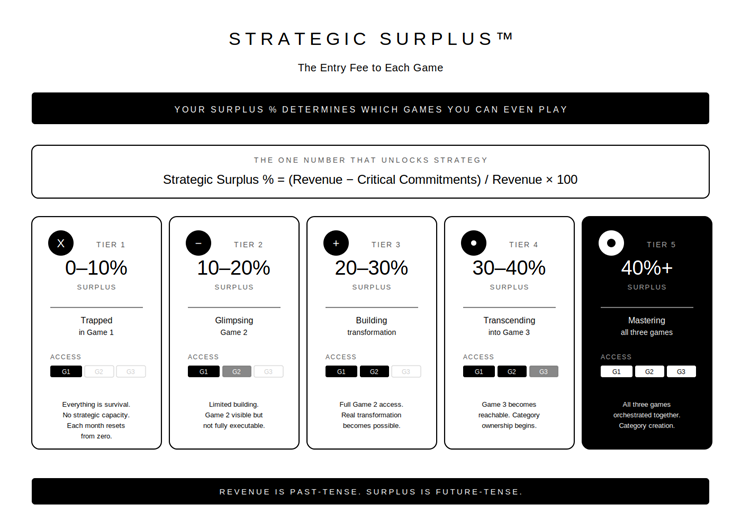
Most strategies fail not because they are wrong but because there is no surplus to execute them. Strategic Surplus™ is the percentage of resources available for strategic moves beyond survival. It determines which games a company can even access.
Below 10% surplus, only Game 1 is playable. Everything is survival. Between 10% and 20%, Game 2 becomes visible but not fully executable. Between 20% and 30%, Game 2 opens up and real transformation becomes possible. Above 30%, Game 3 becomes reachable. Above 40%, all three games can be orchestrated together.
The trap is revenue obsession. A company with ten million in revenue and zero surplus is trapped in a more expensive Game 1 prison. A company with five hundred thousand in revenue and 30% surplus has access to all three games. Revenue is past-tense. Surplus is future-tense. Surplus is what strategy is made of.
Three Games in Practice: Amazon, Netflix and ClickFunnels
Amazon is the canonical example. Jeff Bezos did not build an online bookstore. He built a Three Games™ machine. Game 1 was book sales generating immediate cash flow. Game 2 was the infrastructure, logistics, and warehouse architecture that compounded with every order shipped. Game 3 was the “everything store” category creation and the AWS moat that emerged from decades of solving infrastructure problems at scale. The free-shipping decision that seemed like a cost was actually a Game 2 bridge that forced warehouse expansion, which fed Game 3 logistics dominance, which became AWS, which now runs a meaningful slice of the internet.
Netflix demonstrates the recursive break pattern. The DVD-by-mail business was profitable. Streaming cannibalized it anyway, because streaming was Game 3 positioning and DVDs were Game 1 revenue. Later, licensing content was profitable. Original content cannibalized it anyway, because original content was the Game 3 moat that licensing could never become. Each deliberate break created a dimensional jump, not an incremental improvement.
ClickFunnels under Russell Brunson follows the same pattern in the direct-response world. Game 1 was daily webinars generating immediate revenue. Game 2 was the platform development compounding with every new user cohort. Game 3 was the category ownership of the word “funnel” itself—a linguistic moat that forced every competitor to either use ClickFunnels’ language or remain invisible in the conversation.
The failure pattern is equally instructive. WeWork played Game 1 hypergrowth with no systematic Game 2 architecture and a Game 3 “space as a service” narrative that had no foundation underneath. Blockbuster played Game 1 store rentals without building Game 2 digital systems, then watched Netflix orchestrate all three games around it until Blockbuster was irrelevant.
Common Mistakes That Collapse the Architecture
Single-game trapping is the most common failure. Founders become addicted to Game 1 because it produces visible revenue. Every month feels productive. Nothing compounds. After five years, the company still starts every quarter from zero.
Game-switching whiplash kills progress in a different way. The founder jumps from Game 1 to Game 2 to Game 3 and back, starving each game of the cadence it needs to compound. Three parallel attempts each at 30% intensity produce less than one game executed at 80%.
Game 2 without Trinity is the advanced failure mode. The company plays all three games but Game 2 is chaotic—random experiments, inconsistent cadence, no linchpin. The compound curve never activates, and the architecture never solidifies.
Revenue obsession masks all three failures. Downstream metrics look fine while the upstream architecture is empty. A €5M launch followed by silence looks identical on the P&L to a €5M first quarter of a compounding engine. The numbers are the same. The futures are not.
The Three Games™ in Your Strategic Architecture
The Three Games™ is not a planning tool. It is the definition of what strategy actually is. Strategy is orchestrating three time-based physics simultaneously, where each strengthens the others, funded by Strategic Surplus™ and powered by the Trinity Framework in Game 2.
Audit the current state first. What percentage of company time sits in each game? Which game is starved? Is Game 2 systematic or random? Most companies discover they are at 90% Game 1, 10% Game 2, 0% Game 3—and they call this “focus.”
Design Strategic Surplus™ before anything else. Without it, you can see all three games but only play one. Build financial surplus, temporal surplus, cognitive surplus, and relational surplus. The percentage matters more than the absolute number.
Install the Trinity Framework for Game 2. Identify the Strategic Linchpin™, design the Linchpin Enabler™, fix the Core Cadence™. Game 2 without Trinity is hope. Game 2 with Trinity is mathematical inevitability.
Then protect the orchestration. Every Monday, audit: did Game 1 fund Game 2 this week? Did Game 2 strengthen Game 3? Did Game 3 reveal new Game 1 opportunities? The loop is the strategy.
FAQ
Is the Three Games framework different from time management?
Yes. Time management assumes all hours are equal and tries to use more of them productively. The Three Games™ recognizes that hours operate under different physics depending on which game they serve. Two hours placed in a Game 2 engine compound for years. Two hours scattered across Game 1 tasks decay in weeks. The difference is not effort. It is placement.
How do I know if an action qualifies as a real engine instead of a tactic?
Apply the deposit test. Every recurring action should produce three deposits per cycle: an immediate trigger or transaction (Game 1), a compounding asset that did not exist before (Game 2), and a durable advantage that accumulates over time (Game 3). If the action only deposits in one or two games, it is a tactic, not an engine.
How long does it take to see results from orchestrating all three games?
Game 1 produces immediate results within the first cycle. Game 2 shows compound effects between month six and month twelve, once the cadence has enough history to accelerate. Game 3 becomes visible between year two and year three, when the market starts reacting to the position. The orchestration itself—where the games begin feeding each other—typically activates around month nine for companies executing consistently.
Does the framework work for small businesses without large Strategic Surplus?
Yes, but with constraints. Below 20% surplus, focus on Game 1 execution to generate the surplus, while designing minimum-viable Game 2 architecture that requires very little time. Weekly publishing, for example, can be a Game 2 engine that costs two hours and compounds for years. Once surplus crosses the 20% line, Game 2 expands. Once surplus crosses 30%, Game 3 becomes a real option.
What happens if I skip Game 2 and jump straight to Game 3?
Game 3 collapses without Game 2 underneath. Long-term positioning requires systematic execution to actually root. WeWork is the textbook case: a Game 3 narrative with no Game 2 foundation. Category ownership does not come from vision statements. It comes from years of consistent Game 2 cadence that eventually produces Game 3 recognition as a byproduct.
Ready to orchestrate all three games in your business? Get the complete Strategic Architecture™ methodology delivered weekly → Subscribe to our Substack newsletter for frameworks that transform single-game scrambling into compounding time-based architecture.
Prepared by the Strategic Architecture™ Editorial Team, bringing clarity to the frameworks shaping the AI era.
Trademark Notice
© 2025 Edward Azorbo. All rights reserved.
Strategic Inevitability™, Strategic Architecture™, Power Numbers™, iPolaris™, Strategic Triggers™, Clear Paths™, Mathematical Freedom Recognition™, Trinity Framework™, The Three Games™, Strategic Surplus™, Strategic Linchpin™, Linchpin Enabler™, Core Cadence™, Illegible Compounding Assets™, Trust Architecture™, and all related names, logos, and framework titles are trademarks or registered trademarks of Edward Azorbo in the United States, the European Union, and other jurisdictions.
Unauthorized use, reproduction, or modification of these marks and the proprietary methodologies they represent is strictly prohibited. All other trademarks and trade names are the property of their respective owners.
“The canonical definitions of all frameworks are maintained in the Strategic Architecture™ Glossary. The complete methodology is documented across two books: Leverage and The Opportunity Advantage by Edward Azorbo.”