
Ansoff Matrix Is Obsolete: Meet the Threshold Grid
The Threshold Grid is a growth framework that replaces Ansoff diversification with mathematical threshold crossing—where specific numbers unlock new capabilities, cascade effects, and growth vectors without changing products or markets. :contentReference[oaicite:7]{index=7}
How mathematical threshold crossing replaces product-market diversification when the same offering transforms at specific numerical points
Igor Ansoff’s growth matrix made perfect sense in 1957 when products stayed stable for decades and market boundaries were fixed. But in an AI era where the same product can serve radically different markets based on how it’s positioned and what thresholds you’ve crossed, the Ansoff Matrix creates artificial constraints that prevent recognition of transformation opportunities.
The Threshold Grid is a growth framework that replaces product-market diversification with numerical thresholds. Crossing precise numbers creates binary capability unlocks and cascade effects—transforming the same offering into new realities without changing products or markets.
The Threshold Grid replaces Ansoff’s product-market combinations with mathematical transformation points that unlock new growth vectors through capability evolution rather than diversification risk.
The 1957 Assumption That Breaks in 2025
Ansoff built his matrix on three assumptions that no longer hold in AI-accelerated markets:
Assumption 1: Products and Markets Are Separate Entities
What Ansoff believed: A product is a fixed offering, and markets are distinct customer segments with clear boundaries.
AI-era reality: The same core offering becomes entirely different products based on threshold achievements. Your «product» at €10K MRR is fundamentally different from your «product» at €100K MRR—not because you changed it, but because crossing thresholds unlocked new capabilities.
Example: Slack’s path wasn’t «new market, new product»—it was threshold crossing. Tens → thousands → millions of active users triggered capability unlocks (infrastructure, ecosystem, enterprise sales). The core product became a new reality after each threshold.
Assumption 2: Growth Requires New Development
What Ansoff believed: To grow beyond current market penetration, you must develop new products (product development), enter new markets (market development), or both (diversification).
AI-era reality: Growth comes from crossing thresholds that transform what your existing offering can do. You don’t need new products—you need to hit specific numbers that unlock latent capabilities.
I discovered this running my own AI consultancy. At €30K MRR, we were selling implementation services. At €100K MRR—without changing our core offering—we were selling strategic transformation. The threshold crossing changed everything: our positioning, pricing, even client results.
Assumption 3: Diversification Equals Risk
What Ansoff believed: Moving into new products AND new markets simultaneously (diversification) represents maximum risk because you lack experience in both dimensions.
AI-era reality: Threshold crossing eliminates diversification risk by creating mathematical proof before expansion. When you know that hitting 15 enterprise clients unlocks platform capabilities, you’re not diversifying—you’re executing validated transformation.
The Threshold Grid: Mathematical Evolution Beyond Ansoff
The Threshold Grid identifies four types of growth thresholds, each creating different transformation opportunities without traditional product-market risk.
The Four Threshold Quadrants
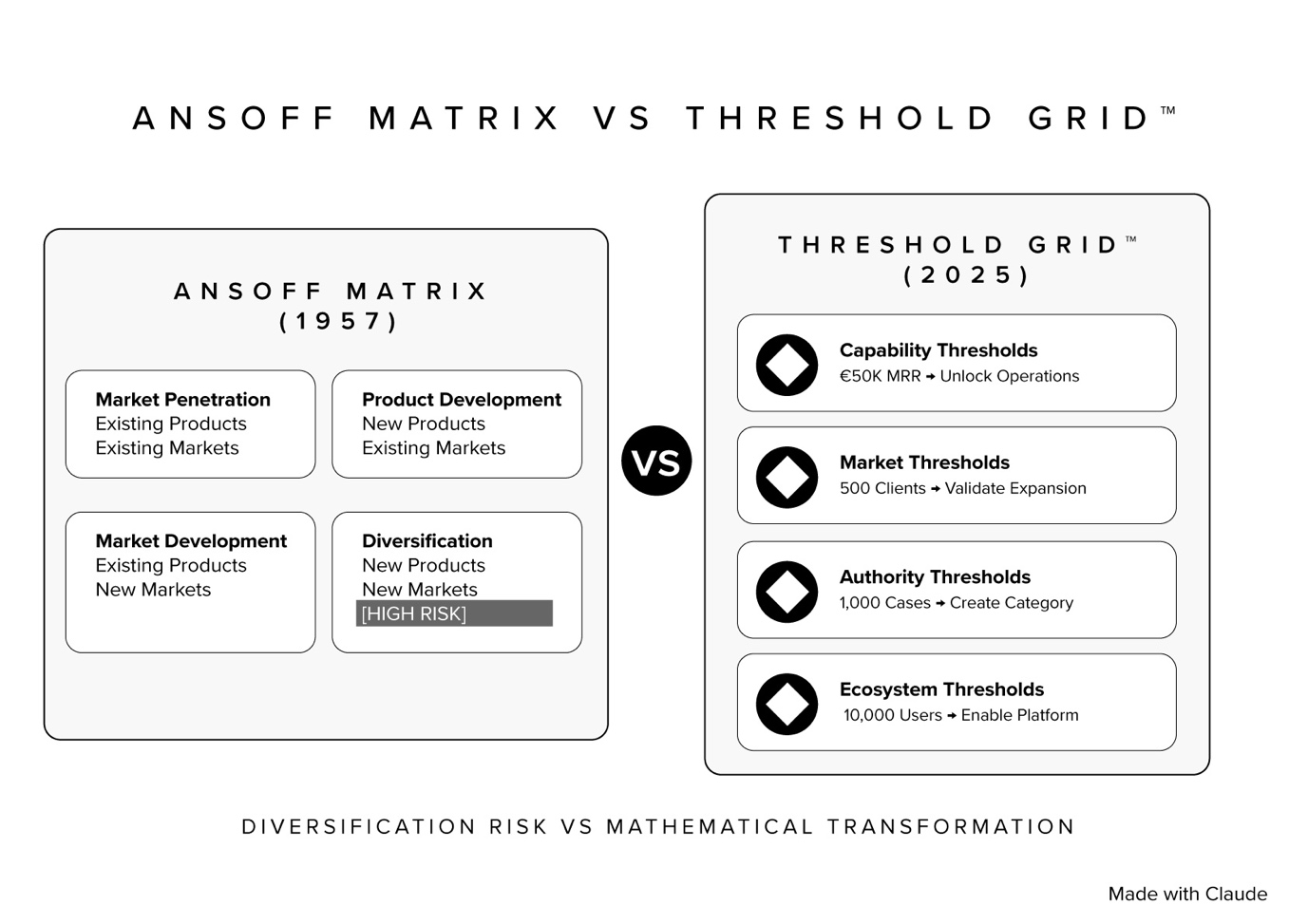
Capability Thresholds (Lower Left)
- Definition: Numbers that unlock new technical or operational capabilities
- Example: «€50K MRR enables hiring senior developer, unlocking enterprise features»
- Growth Type: Vertical expansion within existing market
- Risk Level: Lowest (mathematical validation before investment)
Market Thresholds (Lower Right)
- Definition: Numbers that validate expansion into adjacent segments
- Example: «500 SMB clients proves methodology, enabling enterprise entry»
- System Understanding: Same core offering, different positioning
- Risk Level: Low (proof before pivot)
Authority Thresholds (Upper Left)
- Definition: Numbers that create category leadership positioning
- Example: «1,000 case studies enables methodology productization»
- Transformation: From service provider to category creator
- Risk Level: Medium (requires sustained execution)
Ecosystem Thresholds (Upper Right)
- Definition: Numbers that enable platform or ecosystem creation
- Example: «10,000 active users justifies marketplace development»
- New Reality: From product to platform without diversification
- Risk Level: Managed (threshold provides validation)
The Mathematical Transformation Framework
Each threshold must pass three validation tests:
- Binary Transformation Test
- Before threshold: Capability doesn’t exist
- After threshold: Capability becomes possible
- No gradual transition—it’s binary
- Cascade Multiplication Test
- Primary effect: Direct capability unlock
- Secondary effects: What becomes possible because of primary
- Tertiary effects: System-wide transformations
- Investment Justification Test
- Mathematical proof: Numbers validate investment
- Risk mitigation: Threshold achievement before major commitment
- ROI clarity: Predictable returns based on threshold crossing
Real-World Ansoff vs Threshold Grid Transformations
Case 1: SaaS Platform Evolution
Ansoff Matrix Approach:
- Current: Project management for startups (existing product, existing market)
- Growth: Develop CRM features (product development) OR target enterprises (market development)
- Risk: Building features users might not want OR entering markets we don’t understand
Threshold Grid Approach:
- Identify threshold: «1,000 paying teams unlocks network effects»
- Focus: Maximum force toward crossing 1,000 team threshold
- Transformation: At 1,000 teams, collaboration between teams creates new product category
- Result: Same core product becomes platform through threshold crossing
Outcome: No diversification risk, mathematical validation before transformation.
Case 2: Consulting Firm Scaling
Ansoff Matrix Approach:
- Current: AI consulting for SMBs
- Growth options: Add implementation services (product) OR target enterprises (market)
- Challenge: Each requires different capabilities and carries separate risks
Threshold Grid Reality (my actual experience):
- Threshold identified: «€100K MRR validates methodology scalability»
- Execution: Concentrated force on hitting €100K with existing service
- Transformation: At €100K, exact same service became enterprise-ready
- Cascade effects: Case studies, team depth, systematic delivery—all emerged from threshold
Result: Entered enterprise market with mathematical proof, not hope.
Case 3: Content Business Model Evolution
Ansoff Matrix Approach:
- Current: Newsletter for entrepreneurs
- Growth: Create courses (product development) OR target corporations (market development)
- Problem: Splitting focus between product creation and market exploration
Threshold Grid Approach:
- Threshold: «10,000 engaged subscribers enables community monetization»
- Focus: All effort toward 10,000 subscriber threshold
- Transformation: At 10,000, community dynamics create peer-to-peer value
- New reality: Subscription model emerges without product development
Outcome: €50K MRR from community, no course creation needed.
The Five-Step Threshold Grid Implementation
Step 1: Current State Threshold Mapping
Instead of plotting products against markets, identify your current numerical position:
Key metrics to evaluate:
- Revenue thresholds (MRR/ARR)
- Customer thresholds (quantity, quality, concentration)
- Capability thresholds (team, technology, systems)
- Authority thresholds (content, recognition, validation)
Example mapping: «€45K MRR, 200 customers, 5-person team, 50 published frameworks»
Step 2: Transformation Threshold Identification
For each quadrant, calculate specific thresholds that would unlock new capabilities:
Capability Threshold Calculation:
- What number enables hiring key talent?
- Which threshold justifies technology investment?
- When does systematic delivery become possible?
Market Threshold Calculation:
- How many customers validate methodology?
- What retention rate proves market fit?
- Which concentration enables expansion?
Authority Threshold Calculation:
- How much content creates category leadership?
- What social proof enables premium positioning?
- Which metrics establish expertise?
Ecosystem Threshold Calculation:
- When do network effects emerge?
- What scale justifies platform investment?
- Which density creates community value?
Step 3: Cascade Effect Mapping
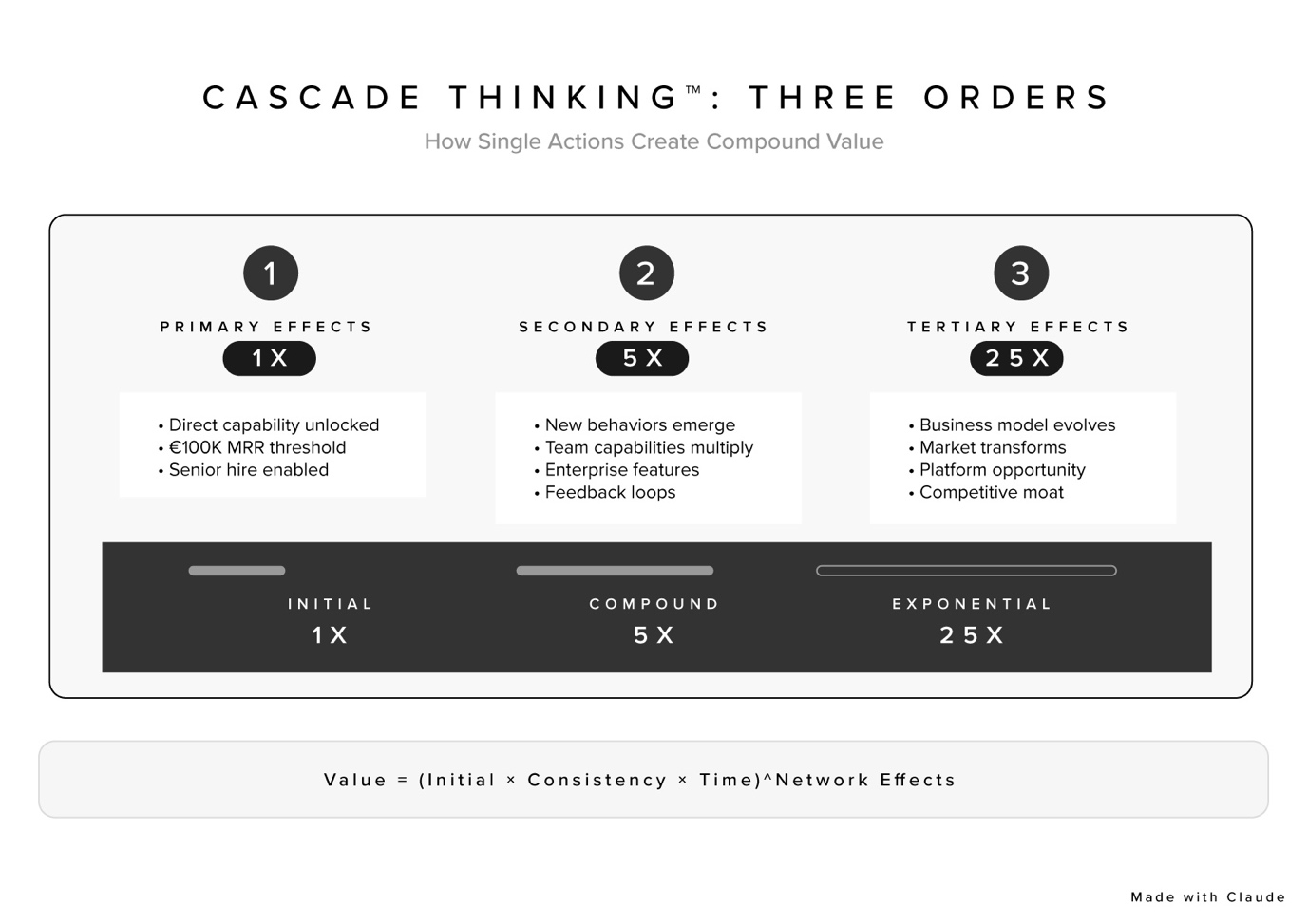
For each threshold, document the cascade effects:
Primary: Direct capability unlocked Secondary: What primary enables Tertiary: System-wide transformations Quaternary: New thresholds revealed
Example cascade:
- €100K MRR (primary) →
- Senior team hiring (secondary) →
- Enterprise capabilities (tertiary) →
- Platform opportunity visible (quaternary)
Step 4: Concentration Force Design
Unlike Ansoff’s distributed approach, The Threshold Grid demands concentrated force:
Resource Allocation:
- 80% toward nearest threshold
- 15% maintaining current operations
- 5% exploring next threshold
Timeline Setting:
- 3-6 month threshold cycles
- Weekly progress measurement
- Binary success criteria
Step 5: Threshold Crossing Execution
Transform thresholds into executable triggers with mathematical precision:
Execution Framework:
- Daily question: «Does this move us toward threshold?»
- Weekly measurement: «Distance to threshold?»
- Monthly calibration: «Resource concentration sufficient?»
- Threshold moment: «Cascade effects activated?»
Why Threshold Recognition Beats Diversification
Speed Advantage: Transformation Through Concentration
Ansoff approach: Spread resources across product development AND market development, hoping something works
Threshold Grid approach: Concentrate maximum force on single threshold, creating transformation through focused execution
Mathematical difference: Distributed effort = linear progress. Concentrated threshold crossing = exponential transformation.
This only works if you have Strategic Surplus—the «oxygen» that lets you concentrate force on one threshold without starving the rest of the system.
Risk Mitigation: Proof Before Pivot
Ansoff approach: Invest in new products/markets based on research and projections
Threshold Grid approach: Threshold achievement provides mathematical validation before major investment
Example: Don’t build enterprise features hoping for enterprise clients. Hit 500 SMB clients first—this threshold proves methodology scales, justifying enterprise development.
Capability Compound: Each Threshold Enables Next
Ansoff approach: Each quadrant requires separate capabilities and investments
Threshold Grid approach: Crossing one threshold creates capabilities that make next threshold easier
Cascade example:
- €50K MRR → hire senior developer
- Senior developer → enterprise features
- Enterprise features → €200K MRR threshold
- €200K MRR → platform justification
Common Threshold Grid Implementation Mistakes
Mistake 1: Setting Arbitrary Thresholds
- Wrong: «€1M ARR sounds impressive»
- Right: «€1M ARR enables 20-person team creating platform capabilities»
Mistake 2: Pursuing Multiple Thresholds Simultaneously
- Wrong: Try to hit revenue AND customer AND content thresholds together
- Right: Identify highest-leverage threshold, concentrate all force there
Mistake 3: Ignoring Cascade Validation
- Wrong: Assume threshold crossing automatically creates benefits
- Right: Document and measure specific cascade effects
Mistake 4: Gradual Progress Thinking
- Wrong: «We’re making progress toward the threshold»
- Right: «We either crossed it (transformation achieved) or haven’t (transformation pending)»
How Threshold Grid Connects to Power Numbers and Strategic Triggers
The Threshold Grid operates as part of a larger Strategic Architecture system where different frameworks interconnect to create systematic transformation.
Connection to Power Numbers™
Power Numbers are the specific metrics that, when achieved, create fundamental business transformation. The Threshold Grid helps you identify which Power Numbers matter most for growth:
- Freedom Numbers: Thresholds that unlock new strategic options (€50K MRR enables first strategic hire)
- Validation Numbers: Thresholds that prove system scalability (15 sales per rep validates methodology)
- Capability Numbers: Thresholds that accelerate execution speed (100 documented processes enables delegation)
- Transformation Numbers: Thresholds that enable exponential growth (1,000 users creates network effects)
- Protection Numbers: Thresholds that ensure stability (€200K cash reserves enables market disruption positioning)
Each quadrant in the Threshold Grid reveals different types of Power Numbers. Capability Thresholds often surface Freedom Numbers. Market Thresholds reveal Validation Numbers. Authority Thresholds create Protection Numbers through market position.
Connection to Strategic Triggers™
Strategic Triggers are the 3-6 month executable objectives that create irreversible business transformation. The Threshold Grid helps you convert abstract growth ambitions into concrete Strategic Triggers:
From Ansoff to Triggers:
- Ansoff: «Enter new market» (vague, risky)
- Threshold Grid: «Cross 500 SMB client threshold» (specific, validated)
- Strategic Trigger: «Achieve 500 SMB clients by March 31st through concentrated outbound campaign»
The Threshold Grid provides the what (specific threshold to cross), Power Numbers provide the why (transformation that occurs), and Strategic Triggers provide the how (executable plan with timeline).
The Strategic Choice: Diversification vs Transformation
The Ansoff Matrix made sense when products were physical, markets were geographic, and change was gradual. It created a useful framework for thinking about growth options when those options were genuinely distinct.
The Threshold Grid recognizes that in AI-accelerated markets, the same offering can serve infinite markets based on what thresholds you’ve crossed. You don’t need new products or new markets—you need to hit specific numbers that fundamentally transform what’s possible with what you already have.
In the AI era, leverage comes from amplifying cognition and orchestration—not from adding products. Thresholds turn the same work into new realities by compounding capability over time.
The question isn’t «What new products or markets should we pursue?»
The question is «What threshold, when crossed, will transform our current capabilities into new realities?»
Ready to Replace Diversification with Transformation?
The Threshold Grid provides systematic framework for growth through capability evolution rather than diversification risk. Whether you’re running a SaaS platform, consultancy, or content business, your next level of growth isn’t hiding in new products or markets—it’s waiting at a specific numerical threshold.
Stop spreading resources across Ansoff’s four quadrants. Start concentrating force toward the one threshold that will transform everything.
Get The Threshold Grid framework, Power Numbers methodology, and complete Strategic Architecture system delivered weekly → Subscribe to my Substack newsletter for threshold recognition techniques and mathematical transformation strategies.
Join thousands of founders discovering that transformation happens at precise mathematical points, not through diversification risk.
Frequently Asked Questions
Look for numbers that unlock capabilities you don’t currently have. Prioritize thresholds that trigger cascade effects (team, delivery, or trust) and pass a binary before/after test.
Break them into sequential sub-thresholds. For example, hire-enabling revenue first, then delivery capacity, then market validation. Each unlock compounds the next.
Use Ansoff to list options, then the Threshold Grid to select and validate the path with precise numbers that de-risk expansion through binary capability unlocks.