
Balanced Scorecard vs Clear Paths™ Framework: Why KPIs Lag Reality in Strategic Execution
Traditional Balanced Scorecard creates dangerous measurement lag by tracking what happened after strategic initiatives fail, while Clear Paths Framework™ validates execution readiness before resource commitment.
Most organizations discover their strategic initiatives are failing through Balanced Scorecard KPIs – but by then it’s too late. Financial metrics drop, customer satisfaction declines, and internal processes break down, all because traditional measurement tracks results instead of validating readiness.
Clear Paths Framework eliminates this lag by validating execution capability before resource commitment: mathematical proof that economics work, system understanding that integration is planned, and execution evidence that teams can deliver results.
balanced scorecard KPIs vs clear paths framework strategy execution comparison
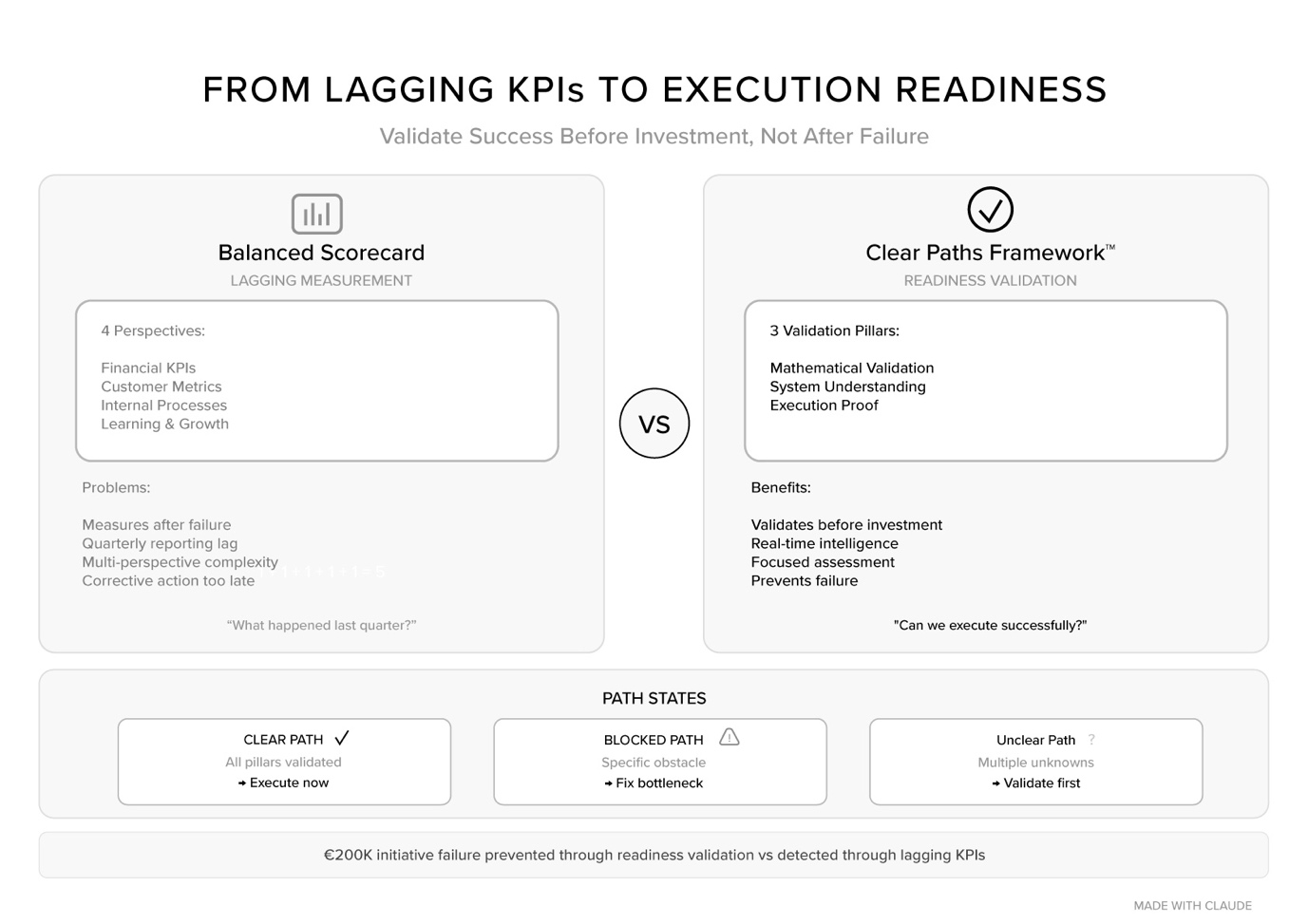
The Balanced Scorecard Problem: Why KPIs Create Strategic Execution Lag
TL;DR: Balanced Scorecard measures what happened after initiatives fail instead of validating whether they can succeed beforehand.
Most organizations implement Balanced Scorecard methodology through KPIs across multiple perspectives: financial outcomes, customer satisfaction, internal processes, and learning capabilities. This multi-perspective approach creates three critical strategy execution framework failures:
1. Lagging Indicator Measurement vs Real-Time Execution Validation
Traditional Balanced Scorecard approach:
- Track financial KPIs like revenue growth, profit margins, and cost efficiency
- Monitor customer metrics including satisfaction scores, retention rates, and acquisition costs
- Measure internal process efficiency through cycle times, quality metrics, and productivity indicators
- Assess learning and growth through employee satisfaction, training completion, and skill development
Strategic execution reality check: Balanced Scorecard KPIs measure what happened after strategic initiatives are already implemented, creating measurement lag that prevents course correction during critical execution phases.
2. Multi-Perspective Complexity vs Focused Readiness Assessment
Standard Balanced Scorecard framework:
- Financial Perspective: Revenue growth, profitability, cost management, shareholder value creation
- Customer Perspective: Market share, customer satisfaction, retention, acquisition metrics
- Internal Process Perspective: Operational efficiency, quality, innovation, regulatory compliance
- Learning & Growth Perspective: Employee capabilities, information systems, organizational alignment
Investment insight problem: Balanced Scorecard spreads attention across multiple measurement categories without validating whether strategic pathways are actually ready for execution or will create intended value.
3. Static KPI Tracking vs Dynamic Pathway Validation
Traditional strategy execution framework:
- Quarterly and monthly KPI reporting across all scorecard perspectives
- Performance dashboards tracking progress against predetermined targets
- Variance analysis between actual performance and strategic objectives
- Corrective action planning based on lagging indicator deviation
Strategic architecture reality: Success depends on Clear Paths Framework that validates execution readiness through mathematical clarity, system proof, and capability evidence before committing resources to strategic initiatives.
How Balanced Scorecard KPIs Miss Strategic Execution Intelligence
TL;DR: Traditional measurement creates dangerous lag between strategic failure and detection, preventing course correction when it matters most.
The fundamental problem with Balanced Scorecard approaches is measurement timing. By the time KPIs reveal strategic initiative problems, resources have been committed, teams have been allocated, and failure costs have already been incurred.
This measurement lag prevents organizations from identifying execution readiness gaps before they become costly failures.
Real-World Balanced Scorecard vs Clear Paths Framework™ Examples
TL;DR: Traditional KPIs showed «success» while €200K strategic initiative failed – Clear Paths would have prevented this through readiness validation.
Traditional Balanced Scorecard: Technology Services Company (Strategic Initiative Failure)
Balanced Scorecard KPI Dashboard:
Financial Perspective:
- Revenue Growth: 15% year-over-year (target: 20%)
- Profit Margin: 18% (target: 22%)
- Cost per Employee: €75K annually (benchmark: €70K)
Customer Perspective:
- Net Promoter Score: 68 (target: 75)
- Customer Retention: 88% (industry average: 85%)
- Customer Acquisition Cost: €2,200 (target: €2,000)
Internal Process Perspective:
- Project Delivery Time: 87% on-time (target: 95%)
- Quality Score: 4.2/5 (target: 4.5)
- Utilization Rate: 78% (target: 85%)
Learning & Growth Perspective:
- Employee Satisfaction: 7.8/10 (target: 8.5)
- Training Hours per Employee: 32 annually (target: 40)
- Internal Promotion Rate: 15% (target: 20%)
Strategic Decision: Launch AI-powered client delivery platform to improve all scorecard metrics
Why this misses execution readiness: Strong Balanced Scorecard performance but no validation that AI platform initiative was actually executable or would create intended value. The result: €200K investment failure due to lack of readiness assessment.
Clear Paths Framework Alternative: Execution Readiness Intelligence
Clear Paths Framework Validation:
Mathematical Validation Assessment:
- Resource Requirements: €200K investment over 12 months clearly defined
- Economic Proof: Client efficiency improvements must generate 25% cost savings to justify investment
- Value Evidence: Pilot testing shows 15% efficiency improvement (below viability threshold)
- Return Predictability: Current pilot data insufficient for confident scaling investment
System Understanding Evaluation:
- Value Chain Clarity: Integration requirements with existing client management systems undefined
- Leverage Points: Critical dependencies on external AI vendor capabilities not validated
- Protection Mechanisms: Client data security and compliance requirements not systematically addressed
- Optimization Loops: Performance improvement measurement and optimization protocols incomplete
Execution Proof Verification:
- Implementation Capability: Technical team lacks AI integration experience for reliable execution
- Team Readiness: Current staff requires 6+ months additional training before system deployment
- System Validation: Pilot testing revealed 3 critical integration failures blocking scalability
- Value Creation Evidence: Client feedback indicates feature request rather than transformation need
Clear Paths Assessment: BLOCKED PATH – Mathematical validation insufficient, system understanding incomplete, execution capability not proven
Strategic Decision: Pause AI platform initiative, focus on improving pilot results and building internal capabilities before resource commitment
Why this prevents execution failure: Clear Paths Framework identified execution readiness gaps before resource commitment, preventing €200K investment in non-viable strategic initiative.
The KPI Blindness Problem
TL;DR: Netflix’s streaming success came from execution readiness validation, not traditional KPI measurement of their DVD business.
Netflix’s DVD-to-Streaming Transition (2007):
- Traditional Balanced Scorecard metrics: Strong financial performance, customer satisfaction, operational efficiency across DVD business
- What Balanced Scorecard missed: Execution readiness for streaming technology, content licensing capabilities, and market transformation requirements
Clear Paths Framework approach would have emphasized:
- Mathematical validation: Streaming cost structure viability and subscription model proof
- System understanding: Technology infrastructure requirements and content acquisition strategies
- Execution proof: Capability building roadmap and systematic transformation planning
Investment insight: Netflix’s success came from systematic execution readiness validation that Balanced Scorecard KPIs completely missed, proving pathway validation drives strategic success.
Clear Paths Framework: Real-Time Execution Intelligence Beyond KPIs
TL;DR: Clear Paths validates whether strategic initiatives will succeed before you invest resources, eliminating execution failure.
Clear Paths Framework demonstrates strategy execution framework effectiveness through systematic readiness validation. This eliminates vanity metrics and ensures strategic initiatives are executable before resource allocation.
The Three Pillars of Clear Paths Validation
1. Mathematical Validation: Numbers That Prove Viability
Purpose: Verify that strategic initiative economics are sound and resource requirements are realistic Execution insight: Mathematical clarity prevents resource waste on economically unviable initiatives
Mathematical Validation Framework:
- Resource Requirements Clarity: Exact investment needs, timeline, and capability costs defined
- Economic Proof: Return on investment calculations with realistic assumptions and market validation
- Value Evidence: Quantified benefits with proof points from testing or pilot implementations
- Return Predictability: Confidence intervals and risk assessment for expected outcomes
Mathematical Validation Examples:
- Market Expansion: €50K investment requires 200 new customers at €300 LTV to break even (validated through pilot)
- Technology Platform: €100K development cost justified by 30% operational efficiency improvement (proven in controlled testing)
- Process Optimization: €25K automation investment generates €8K monthly savings (demonstrated through small-scale implementation)
2. System Understanding: Architectural Clarity for Execution
Purpose: Ensure comprehensive understanding of how strategic initiative integrates with existing systems Execution insight: System clarity prevents implementation failures and integration problems
System Understanding Framework:
- Value Chain Clarity: Complete understanding of how initiative creates and captures value
- Leverage Points: Identification of critical success factors and dependency management
- Protection Mechanisms: Risk mitigation strategies and failure prevention systems
- Optimization Loops: Continuous improvement processes and performance enhancement protocols
System Understanding Examples:
- Customer Success Program: Integration with sales CRM, support systems, and product development feedback loops
- AI Implementation: Data pipeline requirements, model training processes, and human-AI collaboration protocols
- Geographic Expansion: Local partnership requirements, regulatory compliance, and operational infrastructure needs
3. Execution Proof: Capability Validation for Reliable Implementation
Purpose: Confirm organizational capability to execute strategic initiative successfully Execution insight: Execution proof prevents initiative failure due to capability gaps or readiness deficits
Execution Proof Framework:
- Implementation Capability: Team skills, experience, and resource availability for successful execution
- Team Readiness: Training, alignment, and commitment levels required for initiative success
- System Validation: Technology, processes, and infrastructure readiness for initiative support
- Value Creation Evidence: Demonstrated ability to generate intended benefits through execution
Execution Proof Examples:
- Digital Transformation: Team has successfully implemented 3 similar technology projects with measurable results
- New Market Entry: Key personnel have geographic market experience and validated local partnership network
- Product Development: Engineering team has delivered comparable features within budget and timeline constraints
Balanced Scorecard vs Clear Paths Framework: The Strategy Execution Comparison
| Element | Balanced Scorecard | Clear Paths Framework™ |
|---|---|---|
| Measurement Focus | Lagging KPIs across four perspectives | Real-time execution readiness validation |
| Timing | Quarterly and monthly performance reporting | Pre-execution pathway assessment and in-flight validation |
| Resource Protection | Performance tracking after investment commitment | Readiness validation before resource allocation |
| Strategic Direction | Multi-perspective performance optimization | Focused execution capability building and pathway validation |
| Risk Management | Variance analysis and corrective action planning | Proactive readiness assessment and capability gap identification |
| Success Measurement | KPI achievement across balanced perspectives | Pathway clearance and execution readiness confirmation |
| Value Creation | Performance improvement through balanced measurement | Strategic initiative success through validated execution readiness |
strategy execution framework comparison showing readiness validation vs lagging measurement
The Three Clear Path States: Dynamic Execution Intelligence
TL;DR: Every strategic initiative is either Clear (execute now), Blocked (fix specific issue), or Unclear (validate through testing).
Clear Path: Ready for Full Execution
Validation Status: All three pillars confirmed
- ✓ Mathematical Validation: Economics proven, resources defined, returns predictable
- ✓ System Understanding: Value chains clear, leverage points identified, protection mechanisms ready
- ✓ Execution Proof: Team capable, systems validated, value creation demonstrated
Strategic Action: Move to full execution with confidence, implement monitoring and optimization systems
Blocked Path: Specific Obstacle Identified
Validation Status: Pathway viable but specific bottleneck requires resolution
- Mathematical Validation: May be sound with clear resource requirements
- System Understanding: Comprehensive with identified dependencies
- Execution Proof: Capability gap or resource constraint blocks progress
Strategic Action: Focus resources on removing specific block, create targeted capability building plan
Unclear Path: Multiple Unknowns Require Investigation
Validation Status: Insufficient information across multiple validation pillars
- Mathematical Validation: Economics uncertain, resource requirements undefined
- System Understanding: Value creation mechanisms unclear, integration questions unresolved
- Execution Proof: Capability assessment incomplete, readiness uncertain
Strategic Action: Design validation experiments, conduct pilot testing, build proof points systematically
Strategy Execution Framework Implementation: CAPS System
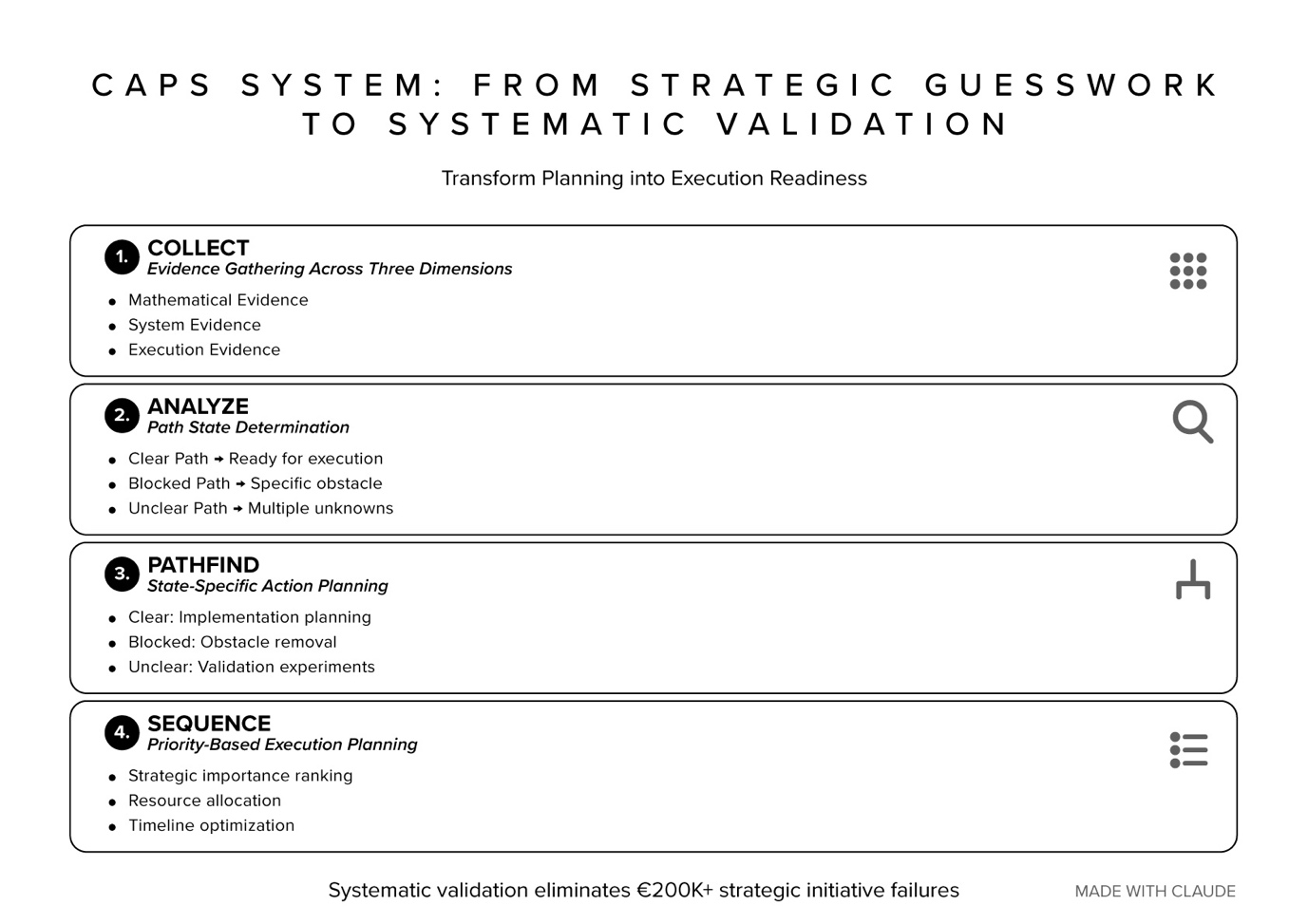
TL;DR: CAPS system (Collect, Analyze, Pathfind, Sequence) transforms strategic planning from guesswork into systematic validation.
Step 1: COLLECT – Evidence Gathering Across Three Dimensions
Mathematical Evidence Collection:
- Resource requirement analysis and cost-benefit calculations
- Economic proof points from pilot testing or market validation
- Return predictability assessment with confidence intervals
- Value evidence documentation from comparable initiatives
System Evidence Gathering:
- Value chain mapping and leverage point identification
- Integration requirement analysis and dependency assessment
- Protection mechanism design and risk mitigation planning
- Optimization protocol development and performance enhancement systems
Execution Evidence Compilation:
- Team capability assessment and skill gap analysis
- Resource availability verification and commitment validation
- System readiness evaluation and infrastructure assessment
- Value creation proof through demonstration or pilot results
Step 2: ANALYZE – Path State Determination
Clear Path Analysis:
- Mathematical validation confirmed with high confidence
- System understanding comprehensive with documented clarity
- Execution proof demonstrated through capability evidence
- Strategic Action: Proceed to full implementation
Blocked Path Analysis:
- Specific bottleneck identified across validation dimensions
- Obstacle nature understood with resolution pathway defined
- Timeline and resource requirements for block removal estimated
- Strategic Action: Focus on targeted obstacle resolution
Unclear Path Analysis:
- Multiple unknowns across validation pillars identified
- Information gaps documented with investigation requirements
- Learning priorities established for validation completion
- Strategic Action: Design systematic validation experiments
Step 3: PATHFIND – State-Specific Action Planning
Clear Path Execution:
- Implementation planning with milestone definition and success metrics
- Resource allocation and team assignment for systematic execution
- Monitoring system establishment for progress tracking and optimization
- Value capture mechanisms and result measurement protocols
Blocked Path Resolution:
- Specific obstacle removal planning with targeted resource allocation
- Capability building initiatives and timeline development
- Alternative pathway exploration and contingency planning
- Progress measurement and readiness reassessment protocols
Unclear Path Validation:
- Systematic investigation design with learning objectives and success criteria
- Pilot program development and controlled testing implementation
- Data collection protocols and evidence gathering systems
- Validation timeline and decision point establishment
Step 4: SEQUENCE – Priority-Based Execution Planning
Sequencing Criteria:
- Strategic Importance: Business impact and competitive advantage potential
- Resource Requirements: Investment needs and capability building costs
- Timeline Dependencies: Prerequisite completion and sequential planning
- Value Potential: Expected returns and strategic leverage creation
Execution Sequence Optimization:
- Clear Paths prioritized for immediate execution and value capture
- Blocked Paths sequenced based on resolution complexity and strategic importance
- Unclear Paths scheduled for systematic validation and learning progression
- Resource allocation balanced across pathway development and execution
Balanced Scorecard vs Clear Paths Framework: What Strategy Execution Really Needs in 2025
TL;DR: 2025 requires real-time readiness validation over quarterly KPI reporting for strategic success.
Beyond KPI Measurement: Readiness Intelligence
2025 strategy execution priorities:
- Real-time pathway validation over quarterly KPI reporting
- Execution readiness assessment over multi-perspective performance tracking
- Resource protection through validation over corrective action after failure
- Dynamic capability building over static balanced measurement
The AI-Era Strategy Execution Thesis
Traditional execution logic: Track KPIs across balanced perspectives to optimize strategic performance 2025 execution logic: Validate pathway readiness through Clear Paths Framework to ensure strategic initiatives succeed before resource commitment
Why Clear Paths Framework matters more: AI accelerates market change and competitive dynamics, making lagging KPIs less useful for strategic decision-making. Success requires real-time readiness validation rather than hoping balanced measurement will reveal strategic problems.
Building Your Clear Paths Execution Architecture
Clear Paths Framework represents evolution beyond traditional Balanced Scorecard toward execution-focused strategic intelligence that validates pathway readiness and eliminates vanity metrics through systematic capability assessment.
Whether you’re implementing digital transformation, market expansion, or operational optimization, Clear Paths Framework provides the methodology for ensuring strategic initiatives are executable before resource commitment and valuable after implementation.
The choice: Continue tracking Balanced Scorecard KPIs hoping lagging indicators will guide strategic success, or implement Clear Paths Framework that systematically validates execution readiness and eliminates strategic initiative failure.
Get Clear Paths Framework implementation guides and complete Strategic Architecture™ methodology delivered weekly → Subscribe to our Substack newsletter for execution readiness and strategic validation techniques that eliminate initiative failure.
Join thousands of strategic leaders learning to validate pathway readiness rather than hoping KPIs will reveal strategic execution problems.
Prepared by the Strategic Architecture™ Editorial Team, bringing clarity to the frameworks shaping the AI era.
Balanced Scorecard tracks lagging KPIs across four perspectives after strategic initiatives are implemented. Clear Paths Framework validates execution readiness before resource commitment through mathematical proof, system understanding, and execution evidence. Instead of "our KPIs show 15% growth," you determine "our pathway analysis confirms this initiative is executable and will create intended value."
Yes, but prioritize Clear Paths Framework for execution planning, then support with Balanced Scorecard for performance monitoring. Focus on readiness validation first (proof of executability), then use KPIs for tracking progress and organizational communication.
Apply the three validation pillars: Mathematical validation (economics proven, resources defined), System understanding (value chains clear, integration planned), and Execution proof (team capable, systems ready). A pathway is "clear" only when all three pillars are confirmed through evidence and testing.
Focus on systematic validation through controlled testing and capability building. "We're conducting pilot programs to validate economic assumptions and building team capabilities for execution readiness." Design learning experiments that transform unclear paths into clear or blocked paths with specific action requirements.
Trademark Notice
© 2025 Edward Azorbo. All rights reserved.
Strategic Inevitability™, Strategic Architecture™, Clear Paths Framework™, Power Numbers™, Strategic Triggers™, Mathematical Freedom Recognition, Trinity Framework™, and all related names, logos, and framework titles are trademarks or registered trademarks of Edward Azorbo in the United States, the European Union, and other jurisdictions.
Unauthorized use, reproduction, or modification of these marks and the proprietary methodologies they represent is strictly prohibited. All other trademarks and trade names are the property of their respective owners.