
Cascade Thinking: Why Strategic Power Comes from Multi-Order Effects, Not Magic Bullets
Cascade Thinking designs single actions that trigger beneficial waves across multiple system levels—creating compound value through first-order impacts, second-order adaptations, and third-order paradigm shifts that transform business models. :contentReference[oaicite:11]{index=11}
What Is Cascade Thinking?
Cascade Thinking is the strategic framework for designing single actions that trigger beneficial waves across multiple system levels, creating compound value that far exceeds the initial investment through interconnected, self-reinforcing effects. Unlike traditional strategy that searches for isolated «magic bullet» solutions, Cascade Thinking recognizes that true leverage comes from understanding how changes ripple through complex systems.
Think of water flowing down a mountainside. It doesn’t fall in a straight line—it creates streams, pools, and new waterfalls at each level. That’s the essence of Cascade Thinking: one strategic move creating multiple value streams that compound over time.
The Evolution Beyond Single Leverage Points
Standing on the Shoulders of Systems Thinking
Donella Meadows revolutionized our understanding of systems with her groundbreaking work on leverage points—places to intervene in a system. She identified 12 different leverage points, from changing numbers and material flows at the lowest level to paradigm shifts and transcending paradigms at the highest.
Meadows gave us the map of WHERE to intervene in systems. Her hierarchy showed us that changing goals is more powerful than changing numbers, that shifting paradigms trumps adjusting feedback loops. This was revolutionary thinking that transformed how we approach complex problems.
But through years of applying her work in real business contexts, a crucial insight emerged: It’s not just about finding the right leverage point—it’s about how leverage cascades through systems.
The Missing Piece: Cascade Dynamics
While Meadows showed us points of maximum impact, what happens after you pull that lever? Traditional thinking stops at the immediate effect. Cascade Thinking™ reveals that when you hit the right leverage point correctly, it doesn’t create just one change—it creates a cascade of changes that ripple through different levels of the system, each triggering the next.
This transforms strategic thinking from hunting for perfect interventions to designing for cascade effects—creating actions that trigger beneficial waves across multiple system levels.
The Spotify Revolution: A Cascade Case Study
Spotify’s transformation of the music industry provides a perfect example of Cascade Thinking in action.
The Initial Trigger: Streaming as a Service
Spotify’s founders didn’t just create another music platform. They fundamentally reimagined music consumption from ownership to access. This wasn’t a small optimization—it was a paradigm-level intervention that would cascade through the entire music ecosystem.
First-Order Effects: Immediate System Changes
The streaming model created instant changes:
- Unlimited access replaced album purchases
- Monthly subscriptions replaced transactional sales
- Cloud storage eliminated device limitations
- Social features transformed solitary listening
These weren’t just features—they were the first ripples of a massive cascade.
Second-Order Effects: Behavioral Transformation
The initial changes triggered deeper behavioral shifts:
- Discovery patterns changed: Algorithm-driven playlists replaced radio and friend recommendations
- Listening habits evolved: Users went from repeated album plays to continuous discovery
- Artist relationships transformed: Direct fan connections through playlist placements
- Data feedback loops emerged: Every play informed better recommendations
Each behavioral change reinforced the others, creating compound effects.
Third-Order Effects: Industry Restructuring
The cascading changes ultimately transformed the entire industry:
- Revenue models inverted: From one-time sales to recurring revenue
- Power dynamics shifted: From label control to platform influence
- Artist economics changed: From album sales to streaming metrics
- Market structure evolved: From fragmented national markets to global platform
The Paradigm Cascade
Spotify didn’t just change how we buy music—they changed what music means in our lives. Music became:
- Contextual: Playlists for every mood and moment
- Social: Shared experiences and collaborative playlists
- Continuous: Always-on soundtrack to life
- Personalized: AI-curated individual experiences
This paradigm shift cascaded back through the system, reinforcing every other change and making the transformation irreversible.
The Three Orders of Cascade Effects
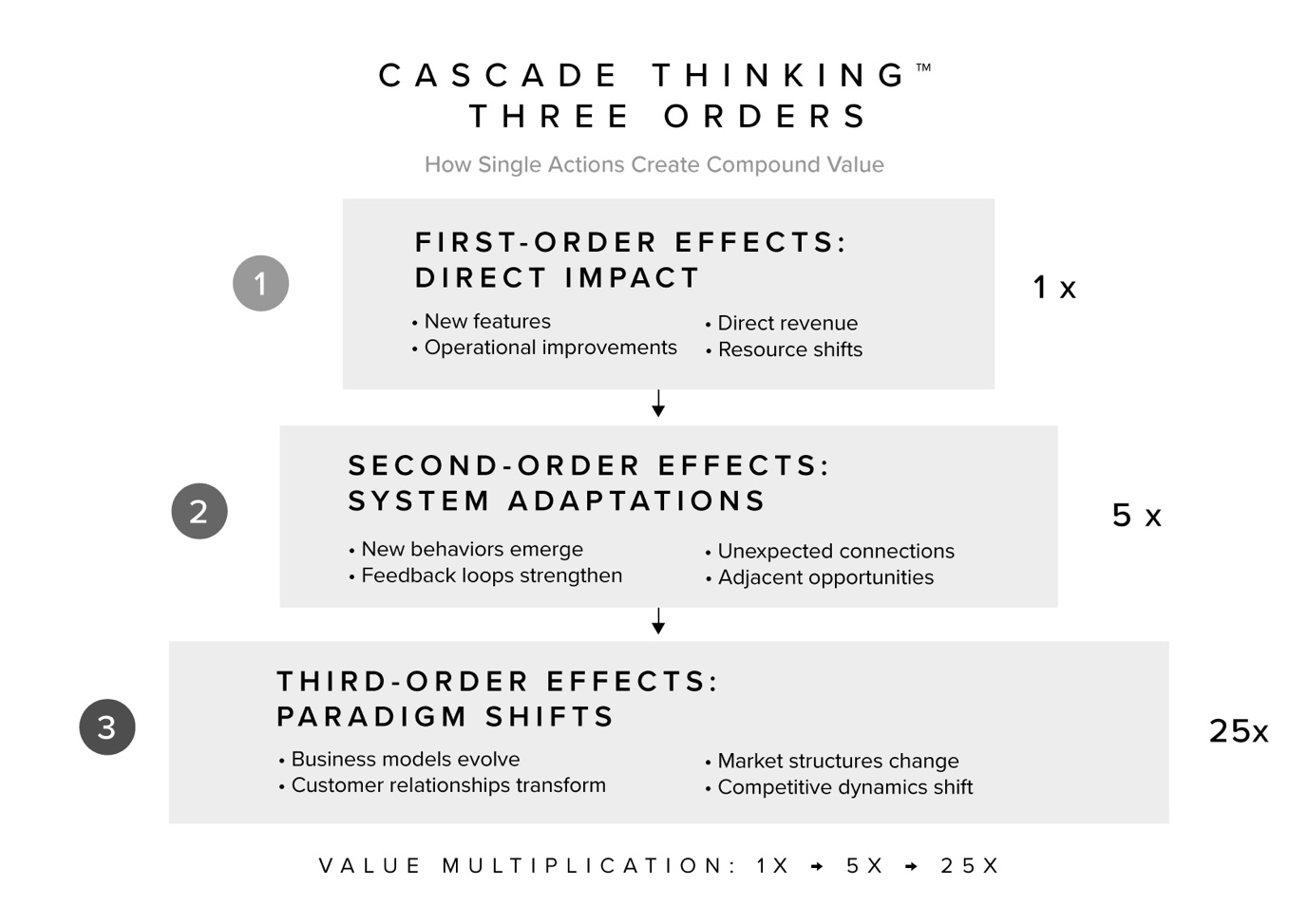
First-Order Effects: Direct Impact
These are the immediate, visible changes from your strategic move:
- New features or capabilities
- Direct revenue impacts
- Operational improvements
- Resource reallocations
First-order effects are what most strategies focus on—and where most strategic thinking stops.
Second-Order Effects: System Adaptations
As first-order changes settle, the system begins adapting:
- New behaviors emerge
- Unexpected connections form
- Feedback loops strengthen
- Adjacent opportunities appear
Second-order effects often surprise even experienced strategists because they emerge from system dynamics rather than direct causation.
Third-Order Effects: Paradigm Shifts
When cascades reach critical mass, fundamental transformations occur:
- Business models evolve
- Market structures change
- Customer relationships transform
- Competitive dynamics shift
Third-order effects represent true strategic transformation—not just doing things better, but doing fundamentally different things.
Cascade Thinking vs Traditional Strategy
| Traditional Strategy | Cascade Thinking |
|---|---|
| Searches for magic bullets | Designs multi-order effects |
| Focuses on direct impact | Maps system-wide ripples |
| Linear cause-and-effect | Compound value creation |
| Isolated interventions | Interconnected changes |
| Predictable outcomes | Emergent opportunities |
| Tactical optimization | System transformation |
The fundamental shift: Traditional strategy asks «What’s the biggest impact we can make?» Cascade Thinking asks «What’s the most valuable cascade we can trigger?»
The Cascade Design Framework
Question 1: «What immediate systems will this action directly impact?»
Identify first-order effects by mapping direct consequences:
- Which processes change immediately?
- What resources shift?
- Which metrics move first?
- What behaviors must adapt?
This establishes your cascade’s starting point.
Question 2: «What new connections or pathways could emerge?»
Explore second-order possibilities by considering:
- How might changed behaviors create new opportunities?
- What feedback loops could strengthen?
- Which constraints might dissolve?
- What adjacent systems could be affected?
This reveals your cascade’s multiplication potential.
Question 3: «How might these changes transform our entire system?»
Envision third-order transformations by asking:
- Could this shift our fundamental business model?
- Might market dynamics restructure?
- How could competitive advantages compound?
- What new paradigms might emerge?
This uncovers your cascade’s transformation potential.
Practical Cascade Design: The Engine Model
Traditional Funnel vs Cascade Engine
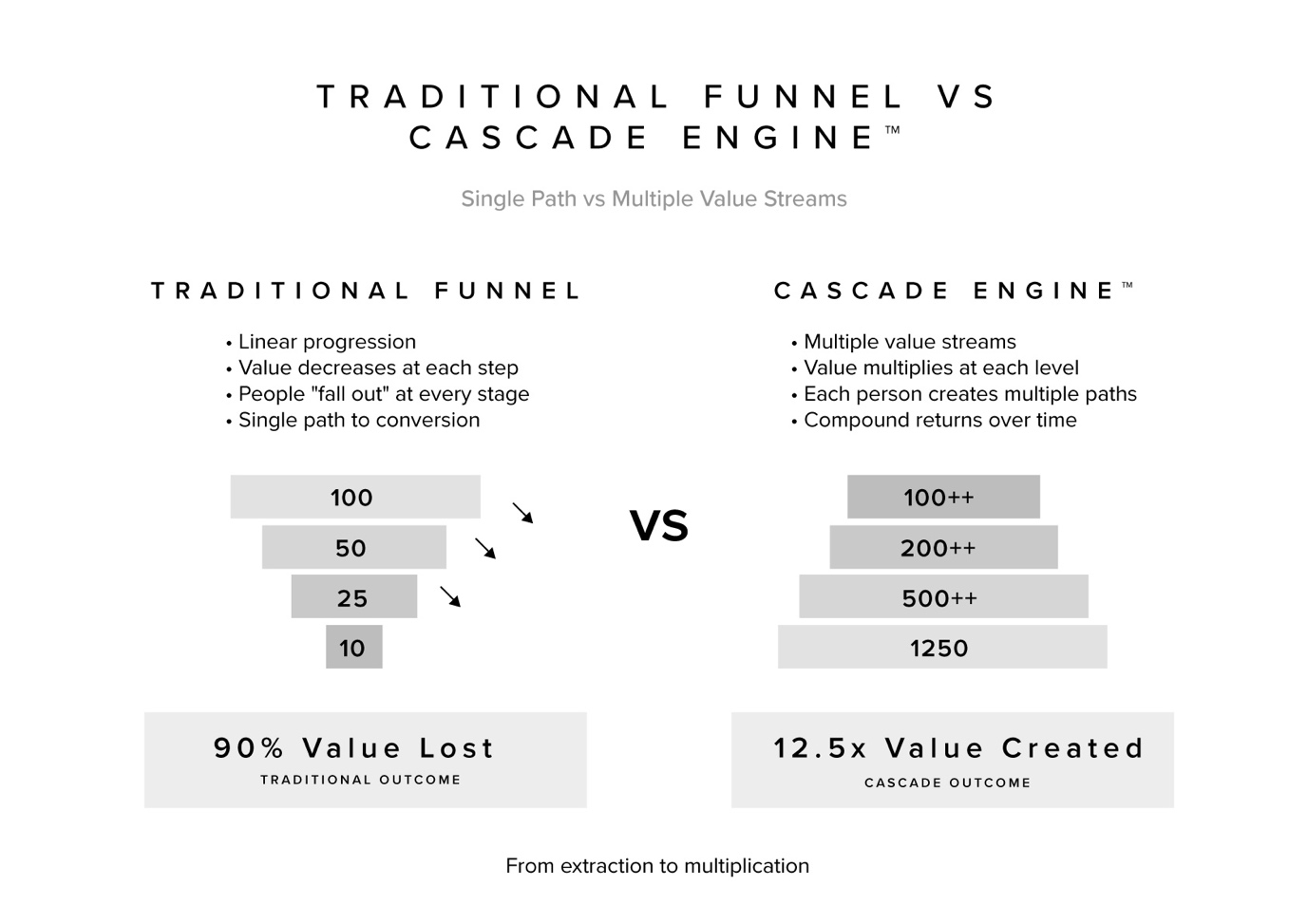
Traditional Funnel:
- Linear progression
- Value decreases at each step
- People «fall out» at every stage
- Single path to conversion
Cascade Engine:
- Multiple value streams
- Value multiplies at each level
- Each person creates multiple paths
- Compound returns over time
Building Your Cascade Engine
Consider a strategic newsletter as cascade trigger:
Initial Action: Launch free newsletter with premium upsell
First-Order Cascades:
- Direct subscriber growth
- Immediate upsell revenue
- Content engagement metrics
- Email list building
Second-Order Cascades:
- Subscribers create multiple revenue streams
- Premium buyers explore additional products
- Free readers become brand advocates
- Content creates SEO value
Third-Order Cascades:
- Business model shifts to recurring revenue
- Market position as thought leader
- Ecosystem of interconnected products
- Self-reinforcing growth engine
Each level doesn’t replace the previous—they compound, creating exponentially more value than any single conversion path.
AI as Cascade Amplifier
Pattern Recognition at Scale
AI transforms cascade design by:
- Detecting hidden connections humans miss
- Modeling multi-order effects before implementation
- Optimizing cascade triggers through simulation
- Measuring cascade velocity in real-time
Cascade Intelligence
Feed AI your business metrics and strategic options. It can reveal:
- Which moves have highest cascade potential
- How changes ripple through your systems
- Where cascades might stall or accelerate
- Which combinations create maximum compound value
This isn’t theoretical—AI-powered cascade analysis helps identify moves where one strategic change triggers transformations across sales, retention, positioning, and culture simultaneously.
Common Cascade Design Mistakes
Mistake 1: Stopping at First-Order Thinking
Wrong: «This will increase sales by 20%» Right: «This will increase sales, which enables new hire, which allows service expansion, which transforms our market position»
Mistake 2: Forcing Linear Cascades
Wrong: Trying to control every ripple effect Right: Designing initial conditions for beneficial emergence
Mistake 3: Ignoring System Constraints
Wrong: Assuming cascades flow without friction Right: Identifying and removing cascade blockers
Mistake 4: Cascade Overload
Wrong: Triggering multiple cascades simultaneously Right: Sequencing cascades for maximum compound effect
Implementing Cascade Thinking
Step 1: System Mapping
- Document current system state
- Identify key leverage points
- Map system interconnections
- Find cascade potential zones
Step 2: Cascade Design
- Choose highest-potential trigger
- Project three orders of effects
- Identify reinforcing loops
- Plan cascade amplifiers
Step 3: Cascade Initiation
- Execute trigger action
- Monitor first-order effects
- Watch for emerging second-order patterns
- Prepare for third-order opportunities
Step 4: Cascade Management
- Measure compound value creation
- Identify cascade accelerators
- Remove cascade blockers
- Design next cascade sequence
The Strategic Architecture™ Connection
Cascade Thinking integrates with every element of Strategic Architecture:
Strategic Triggers™ become cascade initiators—binary transformations designed to ripple through systems.
Clear Paths™ Framework validates cascade potential—ensuring your triggers will create sustainable compound effects.
Power Moves represent maximum cascade moments—when multiple streams converge for exponential impact.
The Power of Compound Strategic Value
In a world obsessed with growth hacks and magic bullets, Cascade Thinking reveals a fundamental truth: there are no magic bullets in business. Only cascades.
The businesses that dominate don’t work harder or find better tactics. They design better cascades. They understand that strategic power comes not from isolated actions but from moves that trigger compounding waves of value.
Every strategic decision is a potential cascade trigger. The question isn’t whether to act—it’s whether you’re thinking deeply enough about the ripples your action will create.
Ready to design cascades that transform your business? Get the complete Strategic Architecture™ methodology delivered weekly → Subscribe to our Substack newsletter for frameworks that multiply strategic value through system thinking.
Prepared by the Strategic Architecture™ Editorial Team, bringing clarity to the frameworks shaping the AI era.
Trademark Notice
© 2025 Edward Azorbo. All rights reserved.
Strategic Inevitability™, Strategic Architecture™, Power Numbers™, iPolaris, Strategic Triggers™, Clear Paths™, Mathematical Freedom Recognition, Trinity Framework™, Cascade Thinking, and all related names, logos, and framework titles are trademarks or registered trademarks of Edward Azorbo in the United States, the European Union, and other jurisdictions.
Unauthorized use, reproduction, or modification of these marks and the proprietary methodologies they represent is strictly prohibited. All other trademarks and trade names are the property of their respective owners.
Cascade Thinking is a strategic framework that designs single actions to trigger beneficial waves across multiple system levels, creating compound value through interconnected, self-reinforcing effects.
While traditional leverage points focus on where to intervene, Cascade Thinking maps how interventions ripple through systems, creating multi-order effects that compound value exponentially.
First-order effects are direct impacts, second-order effects are system adaptations and new behaviors, and third-order effects are paradigm shifts that transform entire business models.
Yes. Cascade Thinking scales to any business size. Small businesses often see more dramatic cascades because they have fewer system constraints and can adapt more quickly.
Use the three-question framework: map immediate impacts, explore emerging connections, and envision system transformations. Look for moves that affect multiple systems simultaneously.