
Clear Paths Framework™ vs Product-Market Fit: Why Engineering Demand Beats Finding Fit
Product-market fit shows if a product satisfies existing demand; Clear Paths™ engineers demand through mathematical proof, system understanding, and execution capability.
Traditional Product-Market Fit thinking assumes demand pre-exists in markets and businesses must «find» this natural fit. But in AI-era market dynamics where entire categories emerge rapidly, successful companies don’t find demand—they engineer it through systematic validation and demand creation strategies.
Clear Paths Framework™ transforms market validation from hopeful discovery to systematic engineering through mathematical proof, system understanding, and execution capability rather than subjective «fit» feelings.
The Product-Market Fit Problem: Why Passive Discovery Fails
Most startups chase the mythical «product-market fit» through trial-and-error testing, hoping to stumble upon market demand that naturally «pulls» their product. This passive approach creates three critical business failures:
The Passive Discovery Myth
Product-Market Fit assumes:
- Demand pre-exists in the market waiting to be discovered
- Markets naturally «pull» the right products toward success
- Binary outcome: you either have fit or you don’t
- Success comes from finding rather than creating
- AI-era reality: Markets evolve faster than discovery cycles, making product market fit validation obsolete before completion. A Stanford Graduate School of Business study found that 70% of early-stage startups misdiagnose PMF, focusing on correlation rather than causation in demand patterns. Successful companies create demand rather than wait for markets to reveal preferences.
Vague Validation Criteria
Traditional PMF metrics:
- «40% of users would be very disappointed if the product disappeared»
- «Strong retention and growth rates»
- «Customers love the product»
- «Market seems to want this»
- Problem: These subjective measures provide no actionable intelligence for scaling decisions or startup market validation beyond hoping current patterns continue.
Single Channel Dependency Risk
Product-Market Fit thinking encourages businesses to find «the market» that wants their product, often leading to dangerous over-dependence on single channels or customer segments.
Market reality: The same product can have zero demand on Meta while achieving viral growth on TikTok, proving demand is engineered through specific channels and value architectures, not discovered in abstract «markets.»
Clear Paths Framework™: Active Demand Engineering
Clear Paths Framework™ replaces passive fit-finding with systematic demand engineering through three validation pillars that create scalable growth strategies rather than hoping for market discovery.
The Three Pillars of Clear Path Validation
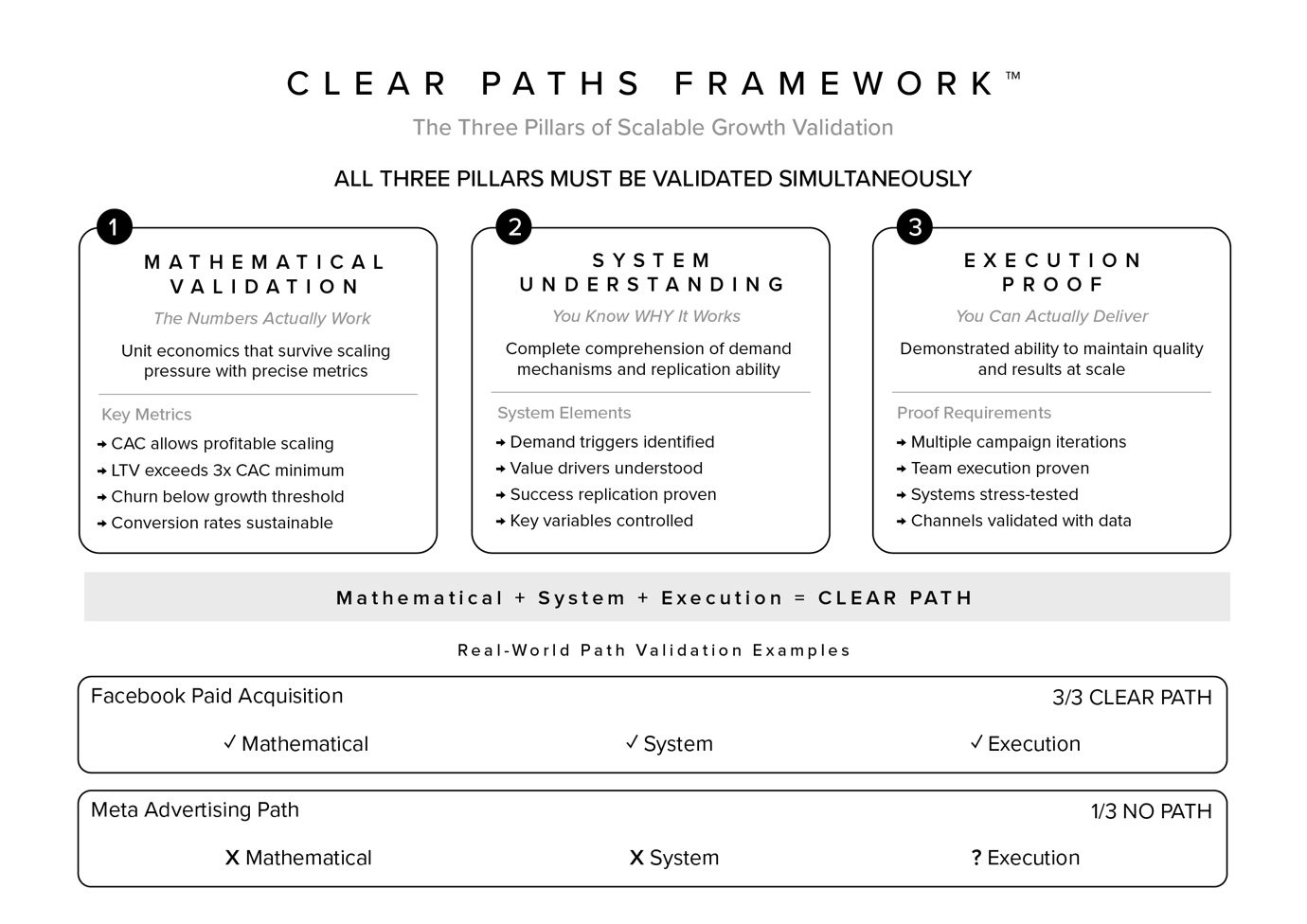
1. Mathematical Validation: Numbers That Enable Scaling
Not just «growth metrics» but precise mathematical proof that economics enable systematic scaling:
- Required metrics:
- Cost Per Acquisition (CPA) that allows profitable scaling at target volumes
- Lifetime Value (LTV) > 3x Customer Acquisition Cost (CAC) minimum threshold
- Churn rate below growth rate enabling net expansion
- Viral coefficient measured (where applicable) for organic amplification
- Conversion rates sustainable at increased volume and competition
- Example: «€30 CPA on Facebook with 25% month-1 retention and €400 LTV validates paid acquisition scaling to €100K monthly spend»
2. System Understanding: Why It Works Mechanically
Beyond correlation to causation—understanding demand creation mechanisms that enable replication and control:
- Required knowledge:
- Demand trigger mechanisms: What specifically creates «AHA moments» in prospects
- Value perception drivers: Why customers choose you over alternatives
- Replication factors: Which elements can be systematically reproduced
- Control variables: What levers affect demand generation and conversion
- Frame effectiveness: How positioning creates overwhelming value perception
- Example: «Communication chaos frame + scarcity methodology + overwhelming ROI demonstration = 40% webinar conversion because prospects recognize unsolved problem and see clear solution path»
3. Execution Proof: Team and System Capability
Not lucky once, but systematic capability to deliver results repeatedly:
- Required evidence:
- Multiple successful iterations across different timeframes and conditions
- Team execution without founder dependency for scalable operations
- Systems documented and proven to maintain quality during scaling
- Channel validation with data showing sustainable demand generation
- Scaling capability tested without breaking core value delivery
- Example: «Sales team consistently closes 15 deals per rep per month using documented methodology, with quality scores >90% across three consecutive quarters»
Diagnostic Scoring Matrix: The 3/3 Clear Paths Test
For each potential growth channel, score mathematical validation, system understanding, and execution proof. Only paths scoring 3/3 qualify as «clear» for scaling investment.
Clear Paths Scoring Framework
| Path Validation Pillar | Scoring Criteria | Pass/Fail Threshold |
|---|---|---|
| Mathematical Validation | Unit economics work at 10x scale | LTV > 3x CAC minimum |
| System Understanding | Know why customers convert | Can replicate demand triggers |
| Execution Proof | Team delivers consistently | Multiple successful cycles |
Real-World Clear Paths Scoring Examples
Facebook Paid Acquisition Path:
- Mathematical: ✓ €30 CPA, €400 LTV, sustainable at €100K monthly spend
- System: ✓ Understand targeting, creative triggers, conversion optimization
- Execution: ✓ Team runs profitable campaigns consistently for 6+ months
- Score: 3/3 = Clear Path → Scale systematically
- TikTok Organic Growth Path:
- Mathematical: ✓ 1.3 viral coefficient, zero acquisition cost, exponential growth
- System: ✓ Understand content triggers, community building, engagement drivers
- Execution: ✓ Content team produces viral content 3+ times monthly consistently
- Score: 3/3 = Clear Path → Invest in viral mechanisms
- Meta Advertising Path:
- Mathematical: ✗ €200 CPA, €400 LTV, unprofitable at any scale
- System: ✗ Don’t understand why same content fails on Meta vs TikTok
- Execution: ? Team capability unclear due to mathematical problems
- Score: 1/3 = No Clear Path → Stop investment, experiment or pivot
Product-Market Fit vs Clear Paths Framework: The Strategic Comparison
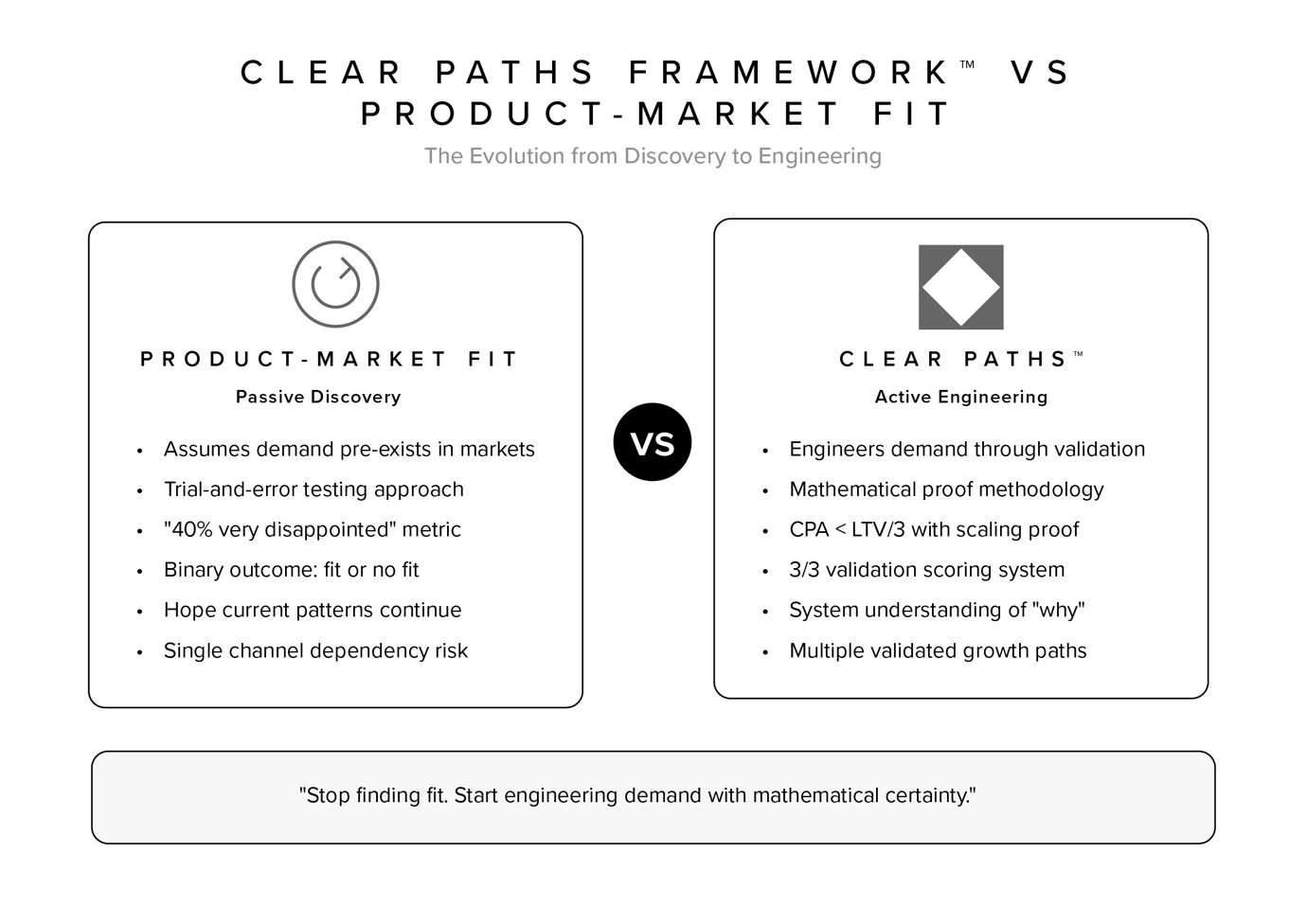
| Element | Product-Market Fit | Clear Paths Framework™ |
|---|---|---|
| Core Approach | Passive discovery of existing demand | Active engineering of systematic demand creation |
| Validation Method | Subjective feeling and general metrics | Mathematical proof across three specific pillars |
| Demand Assumption | Markets naturally want certain products | Demand must be designed through specific mechanisms |
| Scaling Logic | Hope current patterns continue | Mathematical proof that scaling works systematically |
| Channel Strategy | Find «the market» for your product | Engineer demand through specific channel architectures |
| Success Metric | «People want this» feeling | Precise CPA, LTV, conversion data with channel specificity |
| Risk Management | Binary fit/no-fit assessment | Multiple path validation reducing single-channel dependency |
The Five Levels of Market Awareness: From Discovery to Engineering
Eugene Schwartz’s market awareness framework reveals why product-market fit startup approaches fail—most markets require demand creation, not demand discovery.
Level 1: Unaware Markets
Customer state: Don’t know they have a problem PMF approach: Hope problem becomes obvious naturally Clear Paths strategy: Engineer problem awareness through specific triggers Example: «You’re losing 40% productivity to context switching» creates previously unrecognized problem awareness
Level 2: Problem Aware Markets
Customer state: Know they have a problem, don’t know solutions exist PMF approach: Present product hoping customers recognize fit Clear Paths strategy: Design «AHA moment architecture» connecting known problem to your solution Example: Communication chaos (known problem) → Strategic methodology (unknown solution) → Scarcity framework (AHA) → Overwhelming ROI (value)
Level 3: Solution Aware Markets
Customer state: Know solutions exist, don’t know about yours specifically PMF approach: Compete on features and benefits Clear Paths strategy: Create differentiation through overwhelming value design Example: Business content subscriptions exist → «Netflix for business» positioning → 1000+ hours content → €47/month → Impossible to refuse value
Critical insight: At Levels 1-2 (most markets), you’re not finding fit—you’re manufacturing demand from scratch through demand engineering strategies.
Demand Engineering Strategies: Creating Paths vs Finding Fit
Clear Paths Framework™ provides systematic approaches for engineering demand at each market awareness level rather than hoping for natural fit discovery.
AHA Moment Architecture (Level 2 Markets)
Design framework:
- Connect known problem to unknown solution through specific positioning
- Create frame that makes solution obvious to target audience
- Design overwhelming value perception that breaks resistance
- Remove adoption friction through streamlined experience
- Implementation example:
- Known problem: Business communication chaos, inefficient meetings
- Unknown solution: Strategic communication methodology with scarcity principles
- AHA moment: «Your communication chaos is costing €100K annually in lost productivity»
- Overwhelming value: Complete methodology + tools + community for €297
Value Overwhelming Design (Level 3-4 Markets)
Engineering framework:
- Stack value until resistance breaks through systematic offer construction
- Create «how can I NOT do this?» moments through irresistible positioning
- Design perception not just reality through strategic framing and social proof
- Use social proof as multiplier for value perception enhancement
Channel as Demand Creator (All Levels)
Recognition: Different channels activate different awareness levels and create different demand patterns for identical products.
Strategic approach:
- Test channels as demand experiments rather than distribution channels
- Validate channel-specific demand creation before scaling investment
- Understand channel-audience-product interaction for systematic replication
- Build channel-specific value architectures optimized for platform dynamics
Common Mistakes & Fixes
Mistake 1: Confusing Interest with Mathematical Validation
Wrong approach: «People love our product, we must have product-market fit» Clear Paths fix: «Do the unit economics work at scale with mathematical proof?»
Mistake 2: Single Channel Validation Risk
Wrong approach: Find one channel that works and assume you have «fit» Clear Paths fix: Develop multiple validated paths to reduce platform dependency
Mistake 3: Skipping Demand Engineering at Awareness Levels 1-2
Wrong approach: Assume market awareness exists and focus on conversion optimization Clear Paths fix: Engineer AHA moments and problem awareness before optimizing conversion
Mistake 4: Premature Scaling Without 3/3 Validation
Wrong approach: Scale based on early positive signals or partial validation Clear Paths fix: Require mathematical + system + execution proof before major investment
Ready to Replace Hope with Engineering?
Clear Paths Framework™ transforms startup market validation from gambling on market discovery to systematic engineering of demand creation through mathematical validation, system understanding, and execution proof.
Whether you’re building in existing markets or creating new categories, Clear Paths provides the diagnostic framework for identifying truly scalable growth opportunities rather than hoping for natural product-market fit startup success.
The choice: Continue searching for elusive «fit» in mysterious markets, or engineer clear, validated paths to systematic demand creation and scaling confidence.
Get Clear Paths Framework™ and complete Strategic Architecture™ methodology delivered weekly → Subscribe to our Substack newsletter for demand creation strategies and systematic validation techniques.
Join thousands of founders learning to engineer growth rather than hope for market discovery.
Prepared by the Strategic Architecture™ Editorial Team, bringing clarity to the frameworks shaping the AI era.
Product-market fit uses subjective feelings and general metrics like «40% would be disappointed.» Clear Paths requires mathematical proof (unit economics), system understanding (why it works), and execution proof (team can deliver repeatedly). Much more precise and actionable.
Yes—many successful businesses engineer demand in markets that initially show no natural «fit.» TikTok viral growth, engineered scarcity, and overwhelming value design can create clear scaling paths where none existed naturally.
Test the same product across multiple channels and awareness levels. If demand varies dramatically by channel (works on TikTok, fails on Meta), you’re dealing with engineered rather than natural demand, which requires Clear Paths validation.
That’s valuable intelligence. Focus on the lowest-scoring pillar: if mathematical validation fails, adjust pricing/economics; if system understanding lacks, study successful patterns; if execution proof missing, build team capability before scaling.
Trademark Notice
© 2025 Edward Azorbo. All rights reserved.
Strategic Inevitability™, Strategic Architecture™, Power Numbers™, iPolaris™, Strategic Triggers™, Clear Paths™, Mathematical Freedom Recognition™, Trinity Framework™, and all related names, logos, and framework titles are trademarks or registered trademarks of Edward Azorbo in the United States, the European Union, and other jurisdictions.
Unauthorized use, reproduction, or modification of these marks and the proprietary methodologies they represent is strictly prohibited. All other trademarks and trade names are the property of their respective owners.