
Tactical Accelerators: Why Multiple Paths Beat One Perfect Strategy
Tactical Accelerators are independent, high-probability pathways that create mathematical certainty by multiplying success odds through multiple self-sufficient routes to a single strategic goal.
What Are Tactical Accelerators?
Tactical Accelerators are multiple, independent, high-probability execution paths designed to achieve a single, defined Strategic Trigger™. They transform the single-point-of-failure risk in execution into a portfolio of compound success probabilities. When one path fails, the others continue to drive momentum toward the strategic objective.
Instead of betting all your resources on one «perfect» marketing channel, one complex sales process, or one flawless feature launch, you deploy two, three, or four separate, simpler mechanisms that independently move the needle. The combined probability of success for the portfolio drastically outweighs the probability of any single element.
The Single Path Fallacy That Kills Businesses
Most businesses choose one «best» strategy—the silver bullet. They focus 100% of their energy on optimizing a single channel, a single product, or a single major partnership. The moment that one path encounters an unexpected market shift, a major competitor move, or technical failure, the entire business halts or collapses. This is the **Single Path Fallacy**.
This approach is not focus; it is fragility. Tactical Accelerators solve this by decoupling execution paths from the single point of failure.
The Ecosystem Solution: How Nature Solved This
Nature rarely relies on a single success mechanism. An oak tree doesn’t rely on a single perfect acorn—it produces thousands. A species doesn’t rely on one flawless mutation—it uses portfolio variation to thrive. Tactical Accelerators adopt this ecosystem strategy: use multiple independent mechanisms to create redundancy, robustness, and mathematical certainty in outcomes.
From Hope to Mathematics
If you have a 70% chance of success on a major project (Path A), you have a 30% chance of failure. If you run two completely independent 70% paths (Path A and Path B) towards the same strategic goal, your probability of failure is now 0.30 x 0.30 = 9%. The probability of success jumps to 91%.
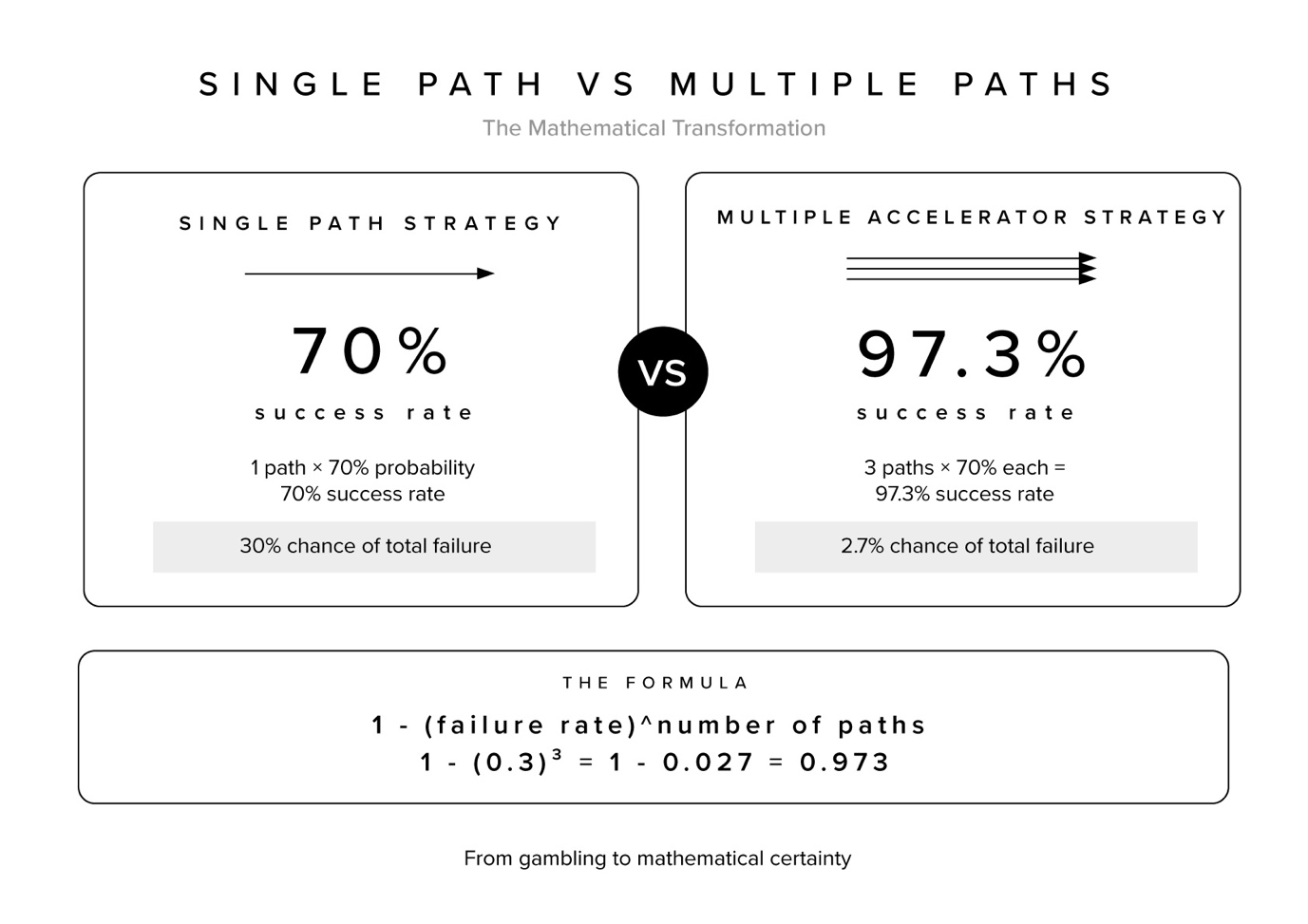
Run three 70% paths, and success becomes 97.3% certain. This is the Mathematical Certainty framework built into Strategic Architecture™. We use mathematics to eliminate hope.
The Four Pillars of Tactical Accelerators™
- Independently Powered: Each accelerator must rely on different resources, teams, or market forces. They cannot be dependent on the same single Strategic Linchpin™ execution element.
- High-Probability (70%+): Each must be simple enough, based on existing Power Numbers™, and focused enough to have a high chance of working on its own.
- Resource Decoupled: The failure or success of one path should not consume the resources (time, cash, cognitive load) of the others.
- Convergent: All paths must lead directly to the same defined **Strategic Trigger** outcome within the 3-6 month window (e.g., «$10k MRR target,» or «First 50 case studies»).
Real-World Tactical Accelerators
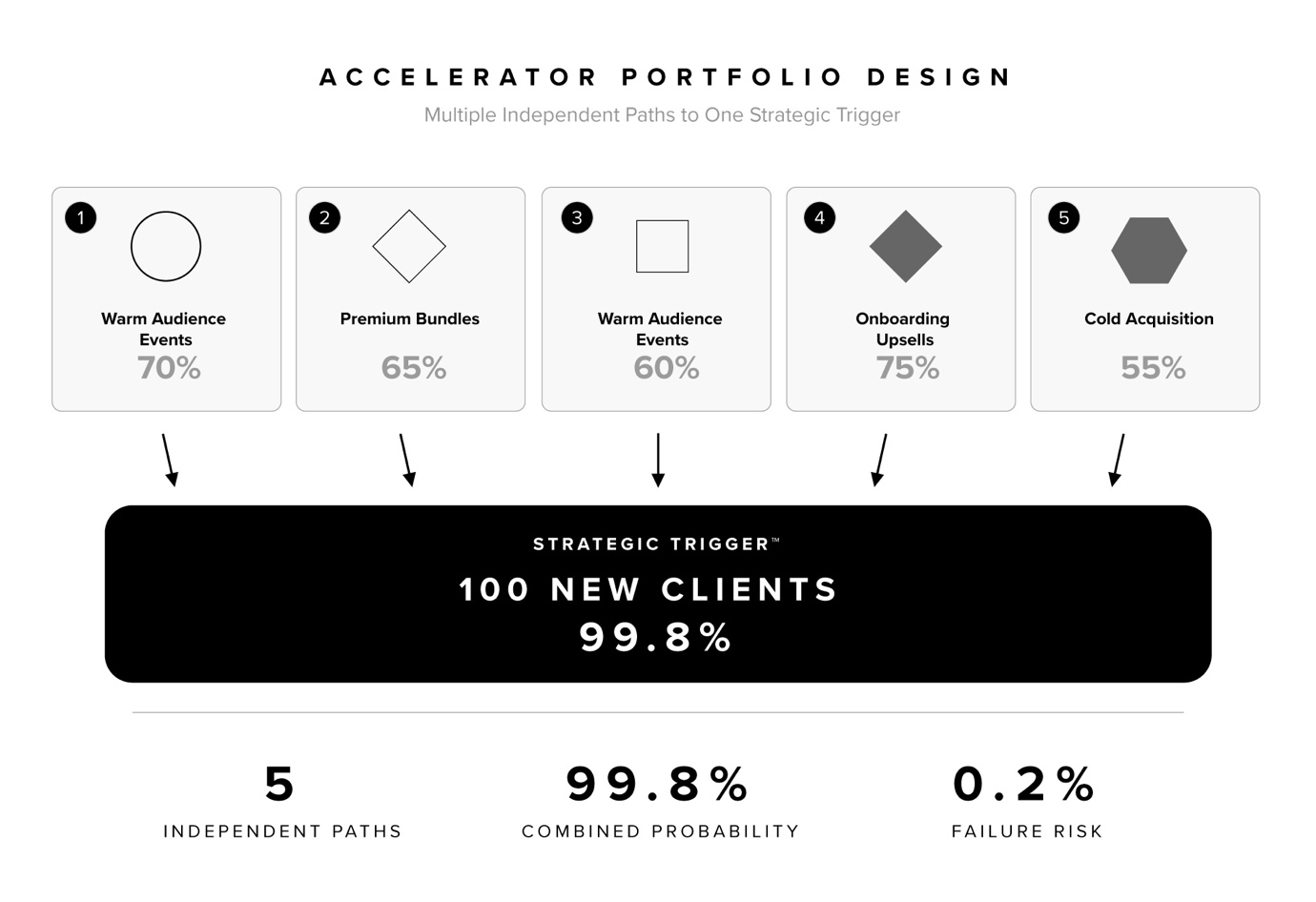
Strategic Trigger Target: Achieving the Power Number™ of 100 qualified leads monthly to hire the first full-time Sales Development Representative (SDR).
- Accelerator 1 (Organic): Launch a 3-part pillar content series (75% probability of generating 40 leads).
- Accelerator 2 (Partnership): Co-host two webinars with non-competing firms (70% probability of generating 40 leads).
- Accelerator 3 (Paid): Run a targeted LinkedIn ad campaign using a proven top-performing ad creative (80% probability of generating 50 leads).
Only one of these accelerators needs to hit its high-end target for the Strategic Trigger to be achieved, but executing all three makes the outcome mathematically inevitable.
The Linchpin Paradox: Why Focus and Multiple Paths Aren’t Contradictory
This is the most common point of confusion. The Strategic Linchpin™ mandates singular, architectural focus. Tactical Accelerators demand multiple, simultaneous execution paths. They are not contradictory—they are hierarchical.
- Linchpin Focus: One long-term, multiplying element (e.g., Trust Architecture™).
- Accelerator Action: Multiple short-term actions to hit the next major Strategic Trigger™ (e.g., launch three separate lead-gen paths).
The Linchpin defines what is important, while Accelerators define how you hit the next exponential milestone in the Trinity Framework™.
Ready to engineer exponential velocity in your business? Get the complete Strategic Architecture™ methodology delivered weekly → Subscribe to our Substack newsletter for frameworks that transform business physics through architectural thinking.
FAQ
A Tactical Accelerator is an independent, high-probability execution path (70%+) designed to achieve a single Strategic Trigger, creating mathematical certainty through redundancy.
The Strategic Linchpin defines the single area of architectural focus (the ‘What’). Tactical Accelerators are the portfolio of execution paths (the ‘How’) used to hit the next major milestone for that Linchpin.
The execution path should be simple and proven enough to have a probability of success (working on its own) of at least 70% to ensure the portfolio effect delivers mathematical inevitability.
No. Tactical Accelerators are reserved for achieving the next Strategic Trigger—the irreversible, binary goal (3-6 month window) that fundamentally upgrades the business architecture.
Mathematical certainty. By making the failure of one path irrelevant, you drastically multiply the overall probability of hitting the strategic goal.
Trademark Notice
© 2025 Edward Azorbo. All rights reserved.
Strategic Inevitability™, Strategic Architecture™, Power Numbers™, iPolaris™, Strategic Triggers™, Clear Paths™, Mathematical Freedom Recognition™, Trinity Framework™, Value Exchange Velocity™, Trust Architecture™, Tactical Accelerators™, and all related framework names, logos, and titles are trademarks or registered trademarks of Edward Azorbo in the United States, the European Union, and other jurisdictions.
Unauthorized use, reproduction, or modification of these marks and the proprietary methodologies they represent is strictly prohibited. All other trademarks and trade names are the property of their respective owners.