
Lean Canvas vs Cascade Thinking: Mapping Multi-Order Effects Beyond One-Page Plans
Lean Canvas is a one-page startup framework with nine boxes. Cascade Thinking maps first-, second- and third-order effects, exposing exponential opportunities that static templates miss.
Traditional lean startup canvas thinking assumes business success comes from optimizing individual canvas elements—better problem definition, clearer value proposition, improved revenue model. But in AI-era market dynamics where single actions can trigger exponential multi-order effects, one-page static planning misses the emergent business opportunities created through systemic interconnections.
Cascade Thinking replaces linear business model mapping with dynamic multi-order effect analysis that reveals how first-order actions trigger second-order pathways and enable third-order business transformations impossible to capture in static templates.
The Lean Canvas Problem: Why Static Planning Misses Strategic Opportunity
Most entrepreneurs rely on lean canvas template frameworks to organize business thinking into nine key components: customer segments, problems, solutions, value propositions, channels, revenue streams, cost structure, key metrics, and unfair advantage. This compartmentalized approach creates three critical strategic blindnesses:
1. Static Element Thinking vs Dynamic System Effects
Lean Canvas approach:
- Map business elements into separate boxes
- Optimize each component independently
- Assume success comes from better problem-solution fit
- Focus on validating individual hypotheses
System reality: Business success increasingly comes from multi-order effects where single actions trigger cascading impacts across interconnected systems rather than linear improvements within isolated elements.
2. Snapshot Planning vs Emergent Opportunity Capture
Traditional lean startup canvas logic:
- Create business model hypothesis at single point in time
- Test and iterate elements based on customer feedback
- Pivot when validation fails
- Scale when product-market fit achieved
Market reality: The most valuable business opportunities emerge from second-order effects and third-order transformations that don’t exist when initial canvas is created and can’t be captured in static planning frameworks.
3. Linear Optimization vs Exponential Leverage
Lean Canvas methodology:
- Improve customer acquisition through better channels
- Enhance value proposition through customer development
- Optimize revenue model through pricing experiments
- Reduce costs through operational efficiency
Cascade reality: Exponential business growth comes from designing actions that create multi-order effects where single strategic moves trigger beneficial changes across multiple business systems simultaneously.
How Lean Canvas Templates Miss Multi-Order Business Effects
Research from MIT’s System Design and Management program shows that businesses creating multi-order effects achieve 5-10x higher growth rates than those optimizing individual business model elements, primarily because cascading systems compound value exponentially rather than linearly.
Real-World Lean Canvas vs Cascade Thinking Examples
Traditional Lean Canvas Approach: Local Fitness Studio
Canvas Elements:
- Problem: People lack convenient, effective fitness options
- Solution: Boutique fitness classes with personal attention
- Value Proposition: High-quality training in small group setting
- Customer Segments: Health-conscious professionals, fitness enthusiasts
- Revenue Streams: Class packages, personal training, monthly memberships
- Channels: Social media marketing, local partnerships, referrals
Optimization focus: Improve class retention, reduce customer acquisition cost, expand class schedule, optimize pricing packages
Lean Canvas vs Business Model Canvas: Beyond Static Templates
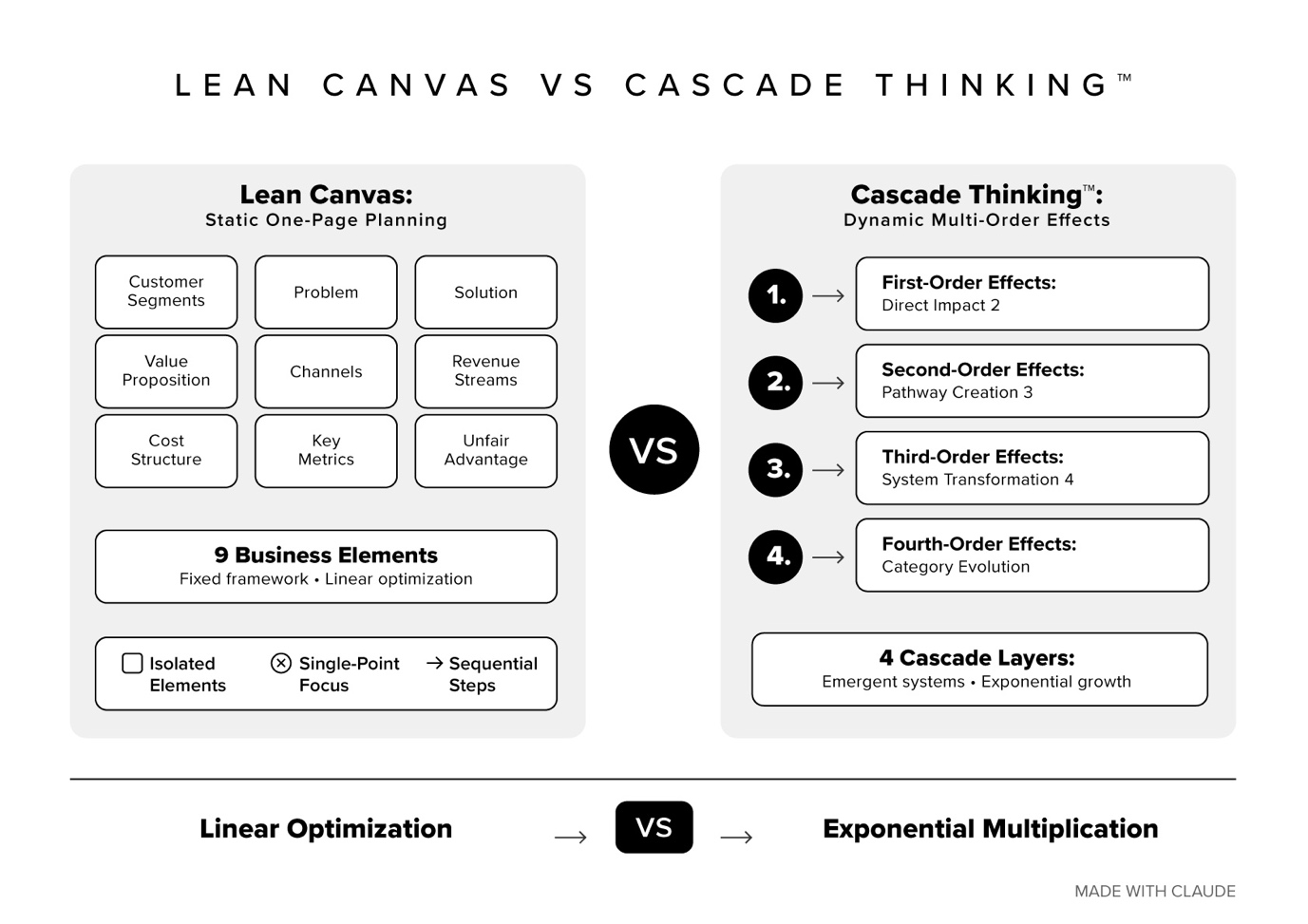
Cascade Thinking Alternative: Multi-Order Effect Design
First-Order Action: Implement comprehensive fitness tracking and nutrition app for all members
Second-Order Effects:
- Member wellness data reveals personalized coaching opportunities
- Progress tracking creates social sharing and referral mechanisms
- Nutrition insights identify supplement and meal prep partnership potential
- Health transformation stories become powerful marketing content
Third-Order Transformations:
- Wellness expertise enables corporate health consulting services
- Data-driven results attract health insurance partnerships for member discounts
- Success methodologies become licensable to other fitness businesses
- Member community evolves into wellness lifestyle platform
Fourth-Order Strategic Evolution:
- Platform ecosystem connects wellness professionals, nutritionists, and health providers
- Corporate wellness division serves enterprise clients for employee health programs
- Franchise model scales methodology with data-driven validation
- Health technology development creates new revenue streams and acquisition opportunities
Mathematical difference: Lean Canvas optimization might achieve 20-30% improvements in member retention; Cascade Thinking creates entirely new business categories and revenue streams worth 10x the original studio model.
The Emergence Blindness Problem
Tesla Lean Canvas (2003):
- Problem: Environmental pollution from gasoline vehicles
- Solution: High-performance electric vehicles
- Value Prop: Zero emissions without performance compromise
- Customer Segments: Environmentally conscious luxury car buyers
- Revenue: Vehicle sales, service revenue
What Lean Canvas missed: The multi-order effects that created energy storage empire, autonomous driving leadership, and sustainable energy ecosystem weren’t visible in initial electric car business model.
Cascade Thinking would have revealed:
- Second-order: Battery technology development enables energy storage market entry
- Third-order: Charging infrastructure creates energy services business model
- Fourth-order: Autonomous driving data creates transportation-as-a-service platform
- Fifth-order: Sustainable energy ecosystem positioning creates solar + storage + transport integration
Strategic insight: Tesla’s transformation didn’t come from optimizing their initial Lean Canvas—it came from recognizing and designing for multi-order effects that created entirely new energy and transportation categories.
Cascade Thinking™: Four-Layer Strategic Effect Mapping
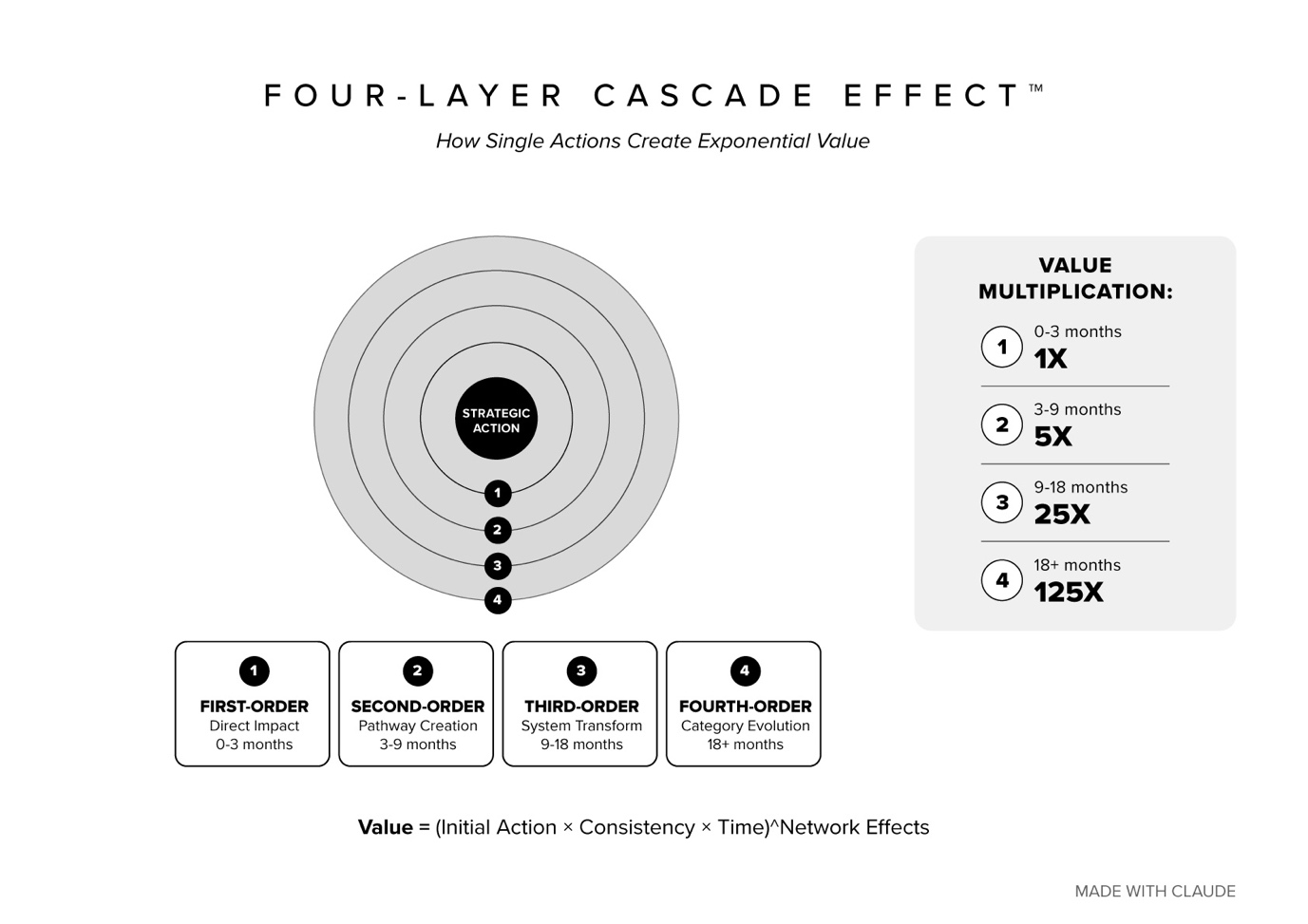
Cascade Thinking designs business actions to create multi-order effects where single strategic moves trigger beneficial changes across multiple business layers, creating exponential value through systemic interconnections.
The Four-Layer Cascade Framework
Layer 1: First-Order Effects (Direct Impact) Definition: Immediate, direct results of your strategic action Timeline: 0-3 months Measurement: Direct metrics tied to action taken
Layer 2: Second-Order Effects (Pathway Creation) Definition: New opportunities and connections enabled by first-order results Timeline: 3-9 monthsMeasurement: Emergence of new business pathways and relationships
Layer 3: Third-Order Effects (System Transformation) Definition: Fundamental changes to business model and market positioning Timeline: 9-18 months Measurement: Business architecture evolution and competitive advantage creation
Layer 4: Fourth-Order Effects (Category Evolution) Definition: Industry transformation and ecosystem creation Timeline: 18+ months Measurement: Market category creation and ecosystem leadership
Real-World Four-Layer Cascade Map: E-commerce Beauty Brand
Strategic Action: Launch personalized skincare quiz with AI-powered product recommendations
Layer 1: First-Order Effects (0-3 months)
- Direct impact: 45% increase in website conversion rates
- Immediate result: Personalized product matching reduces returns by 30%
- Data collection: Customer skin concerns and preferences database creation
Layer 2: Second-Order Effects (3-9 months)
- Custom product development: Quiz data reveals gaps in product line, enabling targeted new product launches
- Content marketing goldmine: Skin concern data creates highly targeted educational content and tutorials
- Email segmentation: Personalized customer journeys based on skin types and concerns
- Partnership opportunities: Dermatologist and aesthetician collaboration requests increase
Layer 3: Third-Order Effects (9-18 months)
- Subscription service evolution: Personalized skincare routines become monthly subscription boxes
- Professional services integration: Partner with dermatologists for virtual consultations and professional-grade treatments
- B2B expansion: License AI recommendation technology to other beauty brands and retailers
- Premium positioning: Data-driven personalization enables premium pricing and luxury market entry
Layer 4: Fourth-Order Effects (18+ months)
- Beauty tech platform creation: Become infrastructure provider for personalized beauty experiences
- Health and wellness ecosystem: Expand into nutrition, fitness, and overall wellness recommendations
- Acquisition target: Technology and data assets make company attractive to major beauty conglomerates
- Category redefinition: Shift beauty industry from generic products to personalized wellness solutions
Cascade multiplication: Single quiz implementation created 4+ distinct business evolution pathways generating compound value across technology licensing, subscription services, professional partnerships, and platform business models.
Lean Canvas vs Cascade Thinking: The Strategic Framework Comparison
| Element | Lean Canvas | Cascade Thinking |
|---|---|---|
| Planning Approach | Static snapshot at single point in time | Dynamic multi-order effect mapping over time |
| Value Creation Logic | Optimize individual business model elements | Design actions that create multi-layer systemic value |
| Opportunity Recognition | Validate known problems and solutions | Engineer emergence through interconnected effect chains |
| Success Measurement | Individual element performance metrics | Cascade effect multiplication and system transformation |
| Strategic Focus | Problem-solution fit within defined market | Multi-order effect design creating new market categories |
| Resource Allocation | Distribute effort across canvas elements | Concentrate force on high-cascade-potential actions |
| Timeline Perspective | Immediate validation and scaling | Multi-layer effect emergence over 18+ month horizons |
The Cascade Design Process: From Linear Plans to Multi-Order Strategy
Phase 1: Cascade Potential Assessment
Replace Lean Canvas problem identification with cascade opportunity mapping:
Instead of: «What problems do customers have?» Ask: «What actions could create beneficial effects across multiple business systems simultaneously?»
Cascade assessment questions:
- Which single action could improve multiple business areas at once?
- What interconnections exist between different parts of our business?
- Which strategic moves could enable entirely new business pathways?
- What would happen if this action succeeded beyond our expectations?
Phase 2: Multi-Order Effect Mapping
Replace static business model canvas with dynamic effect visualization:
Layer 1 Mapping: Direct results of proposed action within 3 months Layer 2 Mapping: New pathways and connections emerging from Layer 1 results Layer 3 Mapping: Business model and positioning transformations enabled Layer 4 Mapping: Industry and ecosystem evolution possibilities
Advanced Cascade Thinking Framework Implementation
Example: Local Restaurant Cascade Map
Layer 1: Implement farm-to-table sourcing with local producers → Improve food quality and reduce costs Layer 2: Producer relationships → Exclusive ingredient access, seasonal menu storytelling, community partnerships Layer 3: Farm-to-table expertise → Catering for corporate events, cooking classes, food tourism experiences Layer 4: Local food ecosystem leadership → Food hub creation, producer marketplace, sustainable dining category definition
Phase 3: Interconnection Analysis
Identify reinforcing loops and compound effects:
Reinforcing loop identification:
- How do second-order effects strengthen first-order results?
- Which third-order transformations enable better second-order pathway creation?
- What compound effects emerge when multiple cascades interact?
System integration:
- Connect individual cascades into integrated business architecture
- Design triggers that activate multiple cascade sequences
- Build feedback systems that amplify beneficial effects
Phase 4: Strategic Trigger Design
Convert cascade maps into executable Strategic Triggers™:
Trigger design framework:
- Binary achievement criteria: Clear success/failure measurement for cascade initiation
- Timeline specification: 3-6 month cycles for systematic cascade activation
- Resource concentration: Maximum effort on highest-cascade-potential actions
- Effect monitoring: Track multi-order effects as they emerge rather than just direct results
The Three Cascade Design Questions That Transform Strategy
When evaluating any potential strategic move, these questions transform ordinary actions into multi-order effect opportunities:
Question 1: «What immediate systems will this action directly impact?»
Purpose: Identify first-order effects and ensure they create foundation for higher-order emergence
Analysis framework:
- Map direct results across all business functions
- Identify resource and capability changes
- Document immediate metric improvements
- Assess operational impact scope
Question 2: «What new connections or pathways could emerge from these initial changes?»
Purpose: Reveal second-order effect potential and pathway creation opportunities
Discovery process:
- Analyze new relationship possibilities
- Identify data and insight generation
- Map capability expansion opportunities
- Explore partnership and collaboration potential
Question 3: «How might these changes transform our entire business system over time?»
Purpose: Uncover third and fourth-order transformation potential
Transformation mapping:
- Business model evolution possibilities
- Market positioning transformation opportunities
- Industry influence and category creation potential
- Ecosystem development and platform business emergence
Common Cascade Thinking Implementation Mistakes
Mistake 1: Confusing Multi-Step Plans with Multi-Order Effects
Wrong approach: «Step 1: Build product, Step 2: Get customers, Step 3: Scale revenue» Cascade Thinking approach: «Single product launch action creates customer data, partnership opportunities, and market positioning simultaneously»
Mistake 2: Linear Cause-and-Effect Thinking
Wrong approach: «If we improve our value proposition, we’ll get more customers» Cascade Thinking approach: «Value proposition improvement creates customer attraction, premium positioning, partnership interest, and thought leadership opportunities»
Mistake 3: Optimizing Elements Instead of Designing Systems
Wrong approach: Focus on individual lean canvas components separately Cascade Thinking approach: Design actions that improve multiple business systems through interconnected effects
Mistake 4: Short-Term Measurement of Long-Term Effects
Wrong approach: Expect all cascade effects to appear within quarterly measurement cycles Cascade Thinking approach: Monitor first-order effects immediately while tracking second, third, and fourth-order emergence over 6-18 month horizons
Lean Startup Canvas vs Multi-Order Strategic Architecture
When Lean Canvas Still Works
Lean canvas template approaches remain valuable for:
- Initial business model hypothesis formation
- Early-stage customer development and validation
- Simple business models with clear linear value creation
- Resource-constrained startups needing focus on single customer problem
When Cascade Thinking Creates Superior Results
Multi-order effect design provides exponential advantage for:
- Businesses seeking exponential growth rather than linear improvement
- Market environments where interconnections create competitive advantages
- Strategic situations where single actions can create multiple business opportunities
- Companies with sufficient resources to invest in longer-term system building
The Integration Approach
Hybrid methodology:
- Use Lean Canvas for initial business model hypothesis
- Apply Cascade Thinking™ to identify multi-order effect opportunities within canvas elements
- Design strategic actions that optimize canvas elements while creating beneficial cascade effects
- Measure both direct canvas metrics and emerging cascade effects
Ready to Replace Linear Planning with Multi-Order Strategy?
Cascade Thinking™ represents evolution beyond static business model templates toward dynamic multi-order effect design that creates exponential value through systemic interconnections and emergent opportunity capture.
Whether your business operates through traditional models or emerging categories, Cascade Thinking provides the framework for designing strategic actions that create beneficial effects across multiple business layers simultaneously rather than optimizing isolated elements.
The choice: Continue optimizing individual business model components through static planning, or design multi-order effects that transform entire business systems through interconnected Strategic Architecture™.
Get Cascade Thinking™ frameworks and complete Strategic Architecture methodology delivered weekly → Subscribe to our Substack newsletter for multi-order effect design and systemic advantage building techniques.
Join thousands of strategists learning to create exponential value through interconnected systems rather than linear business model optimization.
Prepared by the Strategic Architecture™ Editorial Team, bringing clarity to the frameworks shaping the AI era.
Here’s the FAQ section converted to WordPress FAQ block format with schema markup:
Multi-step plans are sequential actions (Step 1 → Step 2 → Step 3). Multi-order effects are simultaneous impacts where single actions create beneficial changes across multiple business systems at once (Action → Effect A + Effect B + Effect C simultaneously).
Yes—use your Lean Canvas as foundation, then identify which actions could improve multiple canvas elements simultaneously. For example, customer feedback systems might improve product development (solution), customer relationships (channels), and market validation (key metrics) through single strategic action.
Track first-order effects immediately (direct metrics), monitor second-order emergence quarterly (new pathways, partnerships, opportunities), and assess third/fourth-order transformation annually (business model evolution, market positioning changes).
Start with Lean Canvas for basic validation, but even early-stage actions can create multi-order effects. Focus on identifying 2-3 potential second-order effects from your primary customer development activities rather than mapping full four-layer cascades. [End FAQ Block] Instructions for WordPress implementation: In WordPress editor, click «Block» menu → select «FAQ» This will automatically apply structured data markup for rich results The FAQ schema will help Google display your Q&As in «People Also Ask» boxes and featured snippets
Trademark Notice
© 2025 Edward Azorbo. All rights reserved.
Strategic Inevitability, Strategic Architecture™, Power Numbers™, iPolaris, Strategic Triggers™, Clear Paths™, Mathematical Freedom Recognition, Trinity Framework™, Cascade Thinking™, and all related names, logos, and framework titles are trademarks or registered trademarks of Edward Azorbo in the United States, the European Union, and other jurisdictions.
Unauthorized use, reproduction, or modification of these marks and the proprietary methodologies they represent is strictly prohibited. All other trademarks and trade names are the property of their respective owners.