
McKinsey 7-S Framework vs Strategic Surplus™: Why Organizational Alignment Charts Miss Dynamic Evolution
The McKinsey 7-S Framework aligns strategy, structure, and five other elements at a point in time. Strategic Surplus creates resource abundance—financial, temporal, cognitive, relational—so those elements evolve continuously.
McKinsey 7-S Framework creates static organizational alignment snapshots while Strategic Surplus enables continuous evolution of structure, skills, and systems through resource abundance that drives transformation.
Traditional McKinsey 7-S Framework attempts to align seven organizational elements in static configurations, missing how surplus resources enable dynamic system evolution. Organizations need Strategic Surplus – the intentional creation of extra resources beyond sustainability that shifts from scarcity-driven alignment to abundance-based continuous transformation.
mckinsey 7s vs strategic surplus comparison graphic
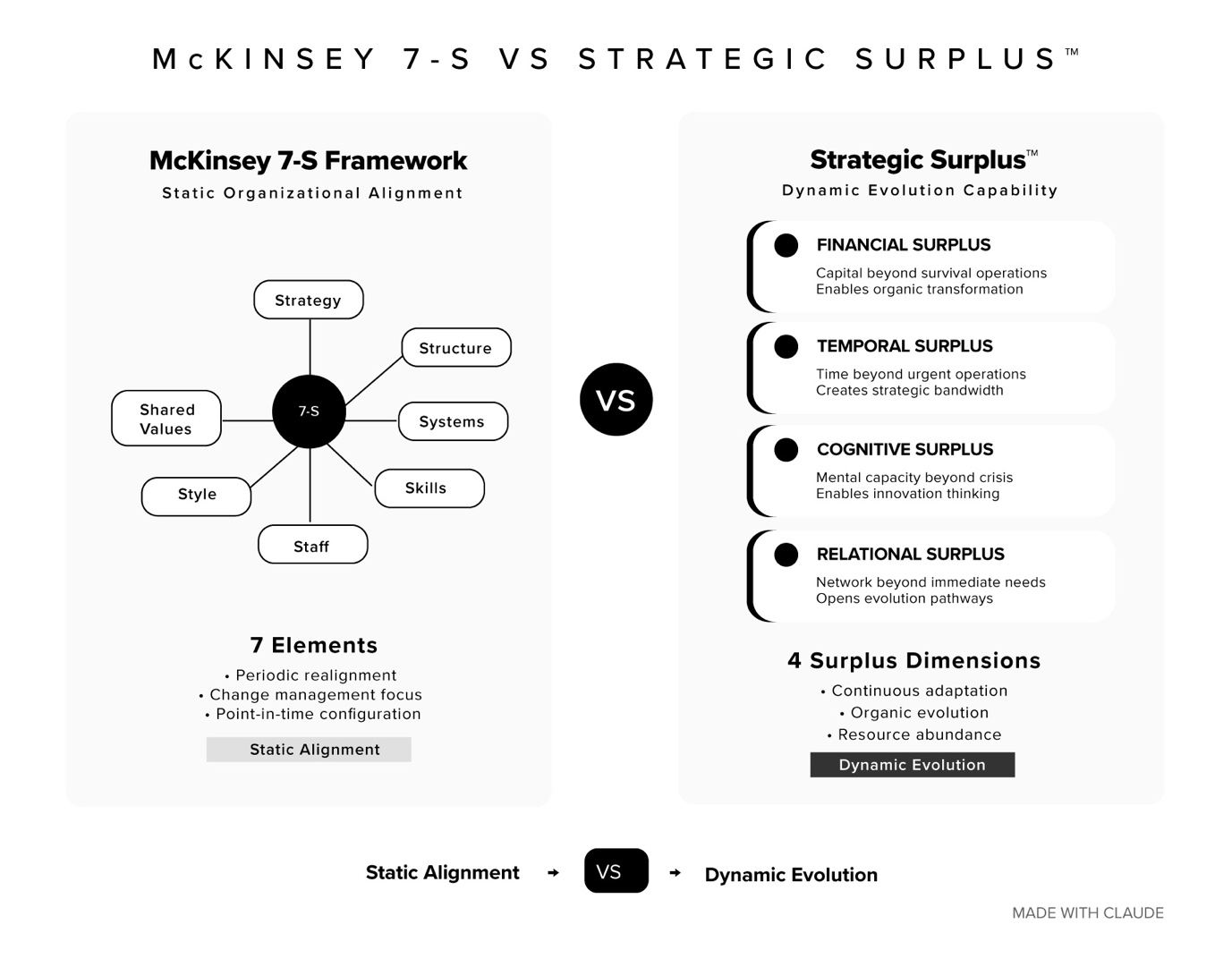
The McKinsey 7-S Problem: Why Static Alignment Prevents Organizational Evolution
TL;DR: McKinsey 7-S creates organizational snapshots that become obsolete quickly, while Strategic Surplus enables continuous evolution through resource abundance.
Most organisational alignment approaches implement McKinsey 7-S Framework through systematic analysis of structure, strategy, systems, skills, staff, style, and shared values. This alignment-focused approach creates three critical organizational development failures:
1. Static Configuration vs Dynamic Evolution Capability
Traditional McKinsey 7-S approach:
- Analyze current state across seven organizational elements
- Identify misalignments between structure, strategy, and systems
- Create alignment plans to optimize element integration
- Implement change management to achieve desired configuration
Organizational reality check: McKinsey 7-S Framework creates point-in-time alignment solutions that become constraints when market conditions change, missing how surplus resources enable continuous organizational adaptation.
2. Alignment Optimization vs Transformation Readiness
Standard 7-S example implementation:
- Strategy: Market positioning and competitive approach definition
- Structure: Organizational hierarchy and reporting relationships
- Systems: Technology platforms, processes, and operational workflows
- Skills: Employee capabilities and competency development
- Staff: Team composition, hiring, and human resource allocation
- Style: Leadership approach and management methodology
- Shared Values: Cultural principles and organizational purpose
Investment insight problem: McKinsey 7-S Framework focuses on optimizing current element relationships without creating the resource surplus needed for systematic transformation and evolution capability.
3. Element Alignment vs Surplus-Driven Adaptation
Traditional organisational alignment framework:
- Map interdependencies between organizational elements for coordination efficiency
- Design change initiatives to improve alignment between strategy and structure
- Implement training programs to align skills with strategic requirements
- Cultural transformation programs to align values with strategic direction
Strategic architecture reality: Success depends on Strategic Surplus that creates resource abundance enabling structure, skills, and systems to evolve continuously without survival pressure or painful trade-offs.
How McKinsey 7-S Framework Misses Organizational Evolution Intelligence
TL;DR: Research shows organizations with Strategic Surplus achieve 3x faster adaptation rates compared to traditional alignment-focused approaches.
Studies from McKinsey’s 2024 Organizational Health Index indicate that organizations focusing on resource surplus creation rather than static alignment achieve significantly faster adaptation to market changes. Traditional 7-S example implementations often create rigid organisational alignment configurations that become barriers to necessary evolution when competitive conditions shift.
Real-World McKinsey 7-S vs Strategic Surplus Examples
TL;DR: Traditional 7-S analysis showed «perfect alignment» while €150K restructuring failed – Strategic Surplus would have enabled organic evolution.
Traditional McKinsey 7-S: Professional Services Firm (Alignment Failure)
7-S Analysis Framework Application:
Strategy: Premium consulting services with specialization focus Structure: Practice-based organization with clear expertise divisions Systems: CRM integration, project management, knowledge sharing platforms Skills: Senior consultant expertise, industry knowledge, client relationship management Staff: 45 consultants across 6 practice areas with clear specialization Style: Collaborative leadership with consensus-driven decision making Shared Values: Client excellence, professional development, intellectual rigor
Organizational Assessment: High alignment across all seven elements with strong integration
Strategic Decision: Implement digital transformation practice through traditional change management
Why this misses evolution capacity: Perfect McKinsey 7-S Framework alignment but no surplus resources for organic adaptation. Result: €150K restructuring investment with 18-month implementation timeline and significant organizational disruption.
Strategic Surplus Alternative: Dynamic Evolution Intelligence
Strategic Surplus Analysis:
Financial Surplus Assessment:
- Monthly Operational Surplus: €25K beyond essential costs
- Strategic Investment Capacity: Ability to fund capability building without survival pressure
- Resource Independence: Freedom to experiment and evolve without immediate ROI constraints
- Transformation Buffer: €300K accumulated surplus enabling organic change management
Temporal Surplus Evaluation:
- Leadership Bandwidth: 40% of senior time available for strategic thinking vs operational management
- Team Development Capacity: Systematic learning and development programs without project delivery pressure
- Innovation Time: Regular allocation for experimentation and new capability exploration
- Strategic Planning: Proactive rather than reactive approach to market opportunities
Cognitive Surplus Availability:
- Strategic Thinking Space: Mental capacity for pattern recognition and long-term planning
- Creative Problem Solving: Resources for innovative solution development
- Market Intelligence: Bandwidth for continuous competitive analysis and opportunity identification
- System Evolution: Capability to redesign processes and structures based on learning
Relational Surplus Strength:
- Client Relationship Depth: Trust and partnership levels that enable service evolution
- Industry Network: Connections that provide early market intelligence and opportunity access
- Partner Ecosystem: Relationships that enable capability expansion without internal investment
- Talent Pipeline: Network enabling rapid team scaling when opportunities emerge
Strategic Surplus Deployment for Organic Evolution:
- Capability Experimentation: €5K monthly investment in digital tool exploration and team training
- Client Innovation: Pilot programs with existing clients to test new service approaches
- Partnership Development: Collaborative initiatives with technology providers for capability building
- System Evolution: Gradual integration of digital tools and processes based on proven value
Why this enables transformation: Strategic Surplus created organic evolution capability where digital transformation emerged naturally through client needs and market opportunities, requiring €35K total investment over 6 months with seamless integration.
The Alignment Rigidity Problem
TL;DR: Netflix’s organizational evolution succeeded through surplus-driven adaptation, not static 7-S alignment optimization.
Netflix’s DVD-to-Streaming Evolution (2007-2012):
- Traditional McKinsey 7-S perspective: Required complete organizational realignment across all seven elements with massive change management
- What 7-S framework missed: Surplus resources enabled parallel capability building and organic evolution without disrupting existing operations
Strategic Surplus approach would have emphasized:
- Financial surplus deployment: Investment in streaming technology while maintaining DVD operations
- Temporal surplus allocation: Leadership bandwidth for transformation planning without operational compromise
- Skill evolution through surplus: Gradual capability building and team development for new business model
Investment insight: Netflix’s success came from surplus-driven organic evolution that enabled transformation without destroying existing value, proving abundance enables adaptation better than alignment optimization using traditional 7-S example methodologies.
Strategic Surplus: Dynamic Evolution Intelligence Beyond Static Alignment
TL;DR: Strategic Surplus creates organizational breathing room that enables continuous evolution rather than periodic alignment adjustments.
Strategic Surplus demonstrates organizational alignment through abundance-based evolution that enables structure, skills, and systems to adapt continuously rather than requiring periodic realignment initiatives.
The Four Dimensions of Strategic Surplus for Organizational Evolution
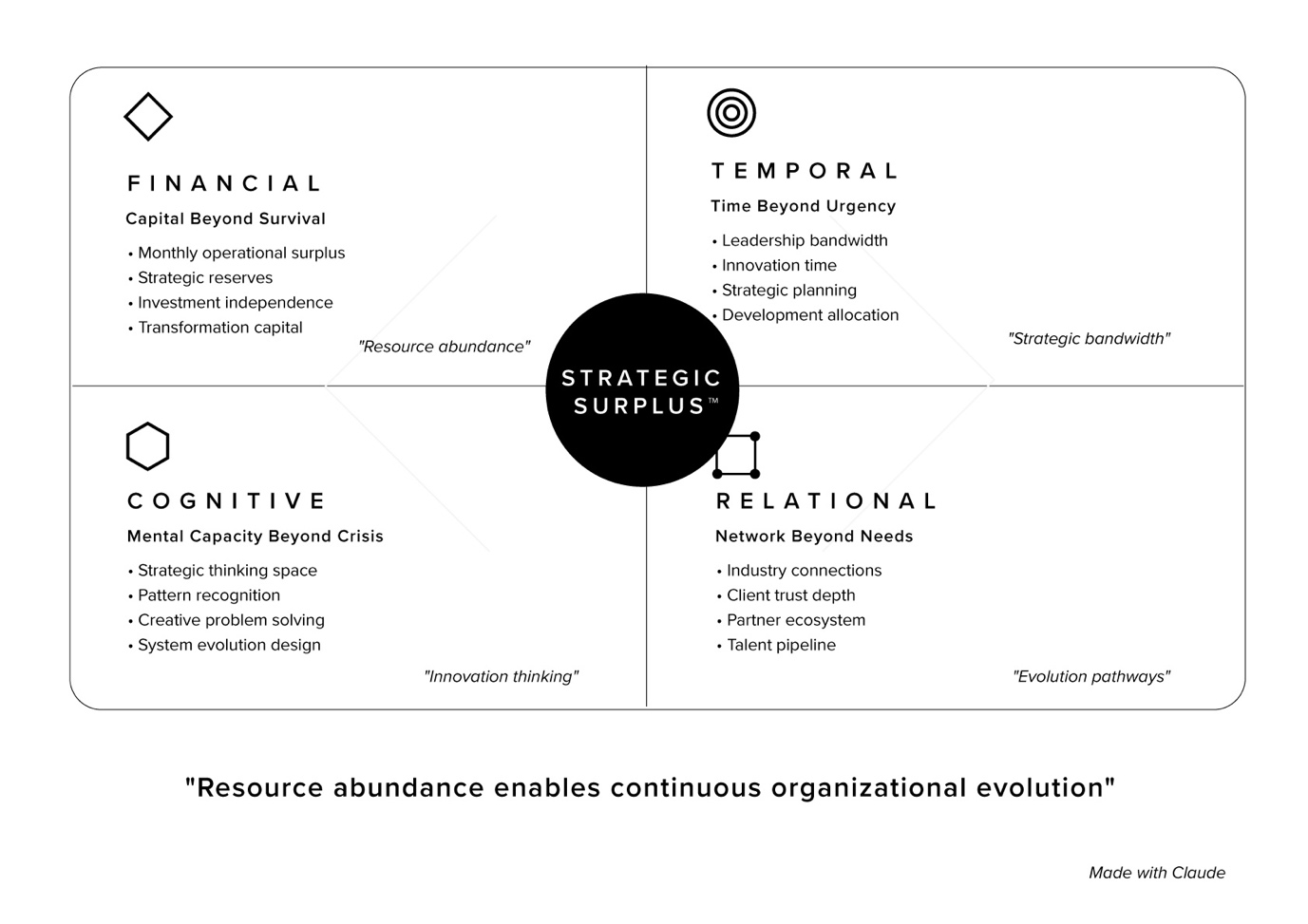
1. Financial Surplus: Capital Beyond Survival Operations
Purpose: Create investment capacity for continuous capability building without survival pressure Evolution insight: Financial abundance enables organic transformation rather than forced change management
Financial Surplus Framework:
- Monthly Operational Surplus: Revenue beyond essential costs enabling strategic investment
- Strategic Reserve Accumulation: Buffer capital for opportunity capture and capability building
- Investment Independence: Ability to fund evolution without external approval or resource competition
- Transformation Capital: Dedicated resources for organizational capability enhancement
Financial Surplus Examples:
- Professional Services: €20K monthly surplus enables continuous training, technology investment, and capability expansion
- Technology Company: €50K monthly surplus funds R&D, talent acquisition, and market expansion without operational compromise
- Manufacturing Business: €35K monthly surplus allows automation investment, process improvement, and market diversification
2. Temporal Surplus: Time Beyond Urgent Operations
Purpose: Create bandwidth for strategic thinking, planning, and systematic capability development Evolution insight: Time abundance enables proactive evolution rather than reactive crisis management
Temporal Surplus Architecture:
- Leadership Strategic Time: Bandwidth for long-term thinking and transformation planning
- Team Development Allocation: Regular capability building and skill enhancement programs
- Innovation Bandwidth: Dedicated time for experimentation and new approach exploration
- Strategic Planning Capacity: Proactive market analysis and opportunity development
Temporal Surplus Applications:
- 20% innovation time: Google-style allocation for exploration and capability building
- Weekly strategic sessions: Regular leadership focus on evolution and opportunity identification
- Quarterly capability building: Systematic team development and skill enhancement programs
3. Cognitive Surplus: Mental Capacity Beyond Daily Management
Purpose: Enable deep thinking, pattern recognition, and strategic insight development Evolution insight: Cognitive abundance creates space for innovation and transformation insight
Cognitive Surplus Development:
- Strategic Thinking Space: Mental bandwidth for complex problem solving and opportunity recognition
- Creative Problem Solving: Capacity for innovative approach development and solution creation
- Pattern Recognition: Ability to identify market trends and competitive opportunities early
- System Evolution Design: Mental resources for organizational improvement and capability development
Cognitive Surplus Enhancement:
- Delegation strategies: Reducing cognitive load through systematic task redistribution
- Process automation: Eliminating routine decision-making to create strategic thinking space
- External partnership: Leveraging specialist expertise to reduce internal cognitive demands
4. Relational Surplus: Network Beyond Immediate Needs
Purpose: Create relationship capital that enables opportunity access and capability expansion Evolution insight: Relational abundance opens doors to evolution pathways and market opportunities
Relational Surplus Building:
- Industry Network Development: Relationships that provide market intelligence and partnership opportunities
- Client Relationship Depth: Trust levels that enable service evolution and collaborative innovation
- Partner Ecosystem: Strategic alliances that enhance capability without internal investment
- Talent Pipeline: Network enabling rapid capability acquisition and team scaling
Relational Surplus Applications:
- Strategic partnerships: Collaboration enabling capability expansion without resource investment using systematic organisational alignment approaches
- Client innovation projects: Joint development initiatives that enhance service capabilities
- Industry leadership: Thought leadership creating relationship capital and market influence
McKinsey 7-S vs Strategic Surplus: The Organizational Development Comparison
| Element | McKinsey 7-S Framework | Strategic Surplus |
|---|---|---|
| Focus | Static element alignment across organizational components | Dynamic evolution capability through resource abundance |
| Approach | Periodic realignment initiatives and change management | Continuous adaptation through surplus-driven organic evolution |
| Resource Logic | Optimize current resource allocation across seven elements | Create resource abundance enabling transformation without survival pressure |
| Change Management | Structured alignment projects with implementation timelines | Organic evolution through surplus deployment and capability building |
| Adaptation Speed | Quarterly or annual realignment cycles | Real-time evolution based on market opportunities and organizational learning |
| Evolution Capability | Alignment optimization within current organizational boundaries | Continuous capability expansion and system evolution through surplus investment |
| Success Measurement | Element alignment scores and integration effectiveness | Surplus generation consistency and evolution velocity achievement |
organisational alignment comparison showing static configuration vs dynamic evolution capability
The Strategic Oxygen Check: Organizational Evolution Diagnostic
TL;DR: Before any organizational change initiative, check if you have Strategic Surplus – the oxygen that enables evolution without survival pressure.
The Four-Question Strategic Surplus Assessment
Financial Oxygen Check: «Do we have monthly surplus beyond survival costs?»
- YES: Can invest in organic evolution and capability building
- NO: Must focus on surplus creation before transformation initiatives
Temporal Oxygen Check: «Do leaders have bandwidth beyond operational management?»
- YES: Can engage in strategic thinking and proactive evolution planning
- NO: Must delegate operations to create strategic thinking space
Cognitive Oxygen Check: «Is there mental capacity beyond crisis management?»
- YES: Can engage in pattern recognition and innovation development
- NO: Must reduce cognitive load through automation and delegation
Relational Oxygen Check: «Do we have network capital beyond current needs?»
- YES: Can access opportunities and capabilities through relationship leverage
- NO: Must invest in relationship building and network development
Strategic Surplus Implementation Framework
Phase 1: Surplus Assessment and Creation (Months 1-6)
Financial Surplus Building:
- Analyze current cost structure and identify efficiency opportunities
- Implement revenue optimization and operational cost reduction initiatives
- Establish monthly surplus targets and tracking mechanisms
- Create dedicated surplus accounts for strategic investment protection
Temporal Surplus Development:
- Audit leadership time allocation and identify operational delegation opportunities
- Implement process automation and workflow optimization for efficiency gains
- Establish strategic planning schedules and innovation time allocation
- Create team development programs that reduce long-term management overhead
Phase 2: Surplus Deployment for Evolution (Months 6-18)
Capability Building Investment:
- Deploy financial surplus for skill development, technology adoption, and process enhancement
- Allocate temporal surplus for strategic planning, market analysis, and opportunity development
- Use cognitive surplus for innovation projects and transformation initiative design
- Leverage relational surplus for partnership development and market expansion
Organic Evolution Enablement:
- Create experimental programs for testing new capabilities and market approaches
- Establish continuous improvement processes that enhance organizational effectiveness
- Develop adaptation mechanisms that respond to market changes without crisis management
- Build systematic learning processes that capture insights and enhance future evolution
Phase 3: Sustained Evolution Capability (Months 18+)
Surplus Protection and Growth:
- Establish surplus maintenance protocols that protect evolution capacity during growth
- Create surplus expansion strategies that increase transformation capability over time
- Implement evolution measurement systems that track adaptation speed and effectiveness
- Build organizational resilience that maintains surplus during market challenges
McKinsey 7-S vs Strategic Surplus: What Organizational Development Really Needs in 2025
TL;DR: 2025 requires abundance-based continuous evolution over periodic alignment optimization for organizational success.
Beyond Static Alignment: Evolution Intelligence
2025 organizational development priorities:
- Continuous evolution capability over periodic realignment initiatives
- Surplus-driven organic transformation over structured change management programs
- Abundance-based adaptation over scarcity-constrained optimization
- Dynamic capability building over static element alignment
The AI-Era Organizational Development Thesis
Traditional alignment logic: Optimize relationships between organizational elements through systematic analysis and change management 2025 evolution logic: Create Strategic Surplus™ that enables continuous organizational adaptation and capability building regardless of market changes
Why Strategic Surplus matters more: AI accelerates market transformation and competitive dynamics, making static alignment approaches obsolete quickly. Success requires abundance-based evolution capability rather than hoping periodic realignment will maintain organizational effectiveness.
Building Your Strategic Surplus Evolution Architecture
Strategic Surplus represents evolution beyond traditional McKinsey 7-S Framework toward abundance-based organizational development that enables continuous adaptation and capability building through resource surplus creation and deployment.
Whether you’re leading organizational transformation, building team capabilities, or adapting to market changes, Strategic Surplus provides the methodology for creating evolution capacity that enables success through abundance rather than alignment optimization.
The choice: Continue implementing McKinsey 7-S Framework hoping static alignment will enable organizational success, or build Strategic Surplus that systematically creates evolution capability through resource abundance.
Get Strategic Surplus implementation guides and complete Strategic Architecture™ methodology delivered weekly → Subscribe to our Substack newsletter for organizational evolution and surplus creation techniques that enable continuous transformation.
Join thousands of organizational leaders learning to build evolution capability through Strategic Surplus rather than hoping periodic alignment will drive organizational success.
Prepared by the Strategic Architecture Editorial Team, bringing clarity to the frameworks shaping the AI era.
McKinsey 7-S Framework analyzes static relationships between seven organizational elements for alignment optimization. Strategic Surplus creates resource abundance (financial, temporal, cognitive, relational) that enables continuous organizational evolution. Instead of «our elements are aligned,» you build «our surplus enables organic adaptation to any market change.»
Yes, but prioritize Strategic Surplus creation for evolution capability, then support with 7-S analysis for specific alignment initiatives. Focus on surplus building first (proof of transformation capacity), then use traditional frameworks for tactical optimization within abundant resource contexts.
Start with the Strategic Oxygen Check: assess financial surplus (monthly revenue beyond costs), temporal surplus (leadership bandwidth beyond operations), cognitive surplus (mental capacity beyond crisis management), and relational surplus (network beyond immediate needs). Build whichever is most accessible first, then systematically develop all four dimensions.
Focus on creating small surplus pockets through efficiency improvements and delegation. «We’re building €5K monthly surplus through automation and process optimization, enabling systematic capability development.» Even minimal surplus creates evolution capacity that compounds over time through systematic deployment using Power Numbers principles. </div> </div>
Trademark Notice
© 2025 Edward Azorbo. All rights reserved.
Strategic Inevitability™, Strategic Architecture™, Strategic Surplus™, Power Numbers™, Strategic Triggers™, Clear Paths™, Mathematical Freedom Recognition, Trinity Framework™, and all related names, logos, and framework titles are trademarks or registered trademarks of Edward Azorbo in the United States, the European Union, and other jurisdictions.
Unauthorized use, reproduction, or modification of these marks and the proprietary methodologies they represent is strictly prohibited. All other trademarks and trade names are the property of their respective owners.