
What Is the One Multiplier Principle?
The One Multiplier Principle™ states that a single architectural element—financial, operational, psychological, social, or temporal—can anchor and multiply every other part of a business, turning retention from effort into physics and making departure structurally unacceptable rather than merely inconvenient. Introduced by Edward Azorbo in his book Leverage, this principle operates as the complementary force to the Zero Multiplier Principle in the architecture of inevitability.
Most businesses fight leakage everywhere at once.
They try to improve the product by three percent, tighten operations by three percent, polish the brand by three percent, and hope the aggregate adds up. It rarely does.
The companies that look effortless—Costco, Salesforce, CrossFit, NetJets—did something different. They installed one element strong enough to hold the whole structure in place, and let the rest of the business compound on top of it.
Why Goals and Systems Are Not Enough
Most strategic thinking evolves in the same sequence. Companies start with goals: “grow revenue by 30% this year.” When goals miss, they move to systems: “let’s build repeatable processes that work regardless of motivation.” Systems improve consistency but eventually hit a ceiling where everything still depends on constant attention. Stop pushing, and momentum leaks.
The missing layer is architecture. Goals give direction. Systems give consistency. But architecture is what creates phase change—a structural element that, once installed, changes what the business is, not just what it does. A One Multiplier is the specific kind of architecture that protects the base and makes every other move compound.
The Mathematics of Multiplication
Without a One Multiplier, the math of a business looks like this: energy spent, customer retained for a moment, energy depleted. Churn erodes what was built. Acquisition absorbs attention. Retention becomes a permanent anxiety. Margins shrink not because anyone is doing something wrong, but because the base refuses to hold. Every year starts from zero.
With a One Multiplier installed, the math reverses. Energy spent, customer stays, customer creates more customers, energy becomes surplus. Churn drops. Word of mouth strengthens. Pricing power appears. Energy does not leak out of the system—it compounds inside it. Every year begins one level higher than the year before.
The shift is not incremental. A business with no One Multiplier and a business with a strong One Multiplier can look similar on surface metrics in year one. By year three, the first company is still fighting for retention and the second has built a moat. The effort looks the same. The architecture underneath is completely different.
The Five Types of Architectural Glue
There are five kinds of architectural glue, each working through a different mechanism. The goal is not to install all five. The goal is to identify the one that fits the business by default and install it well.
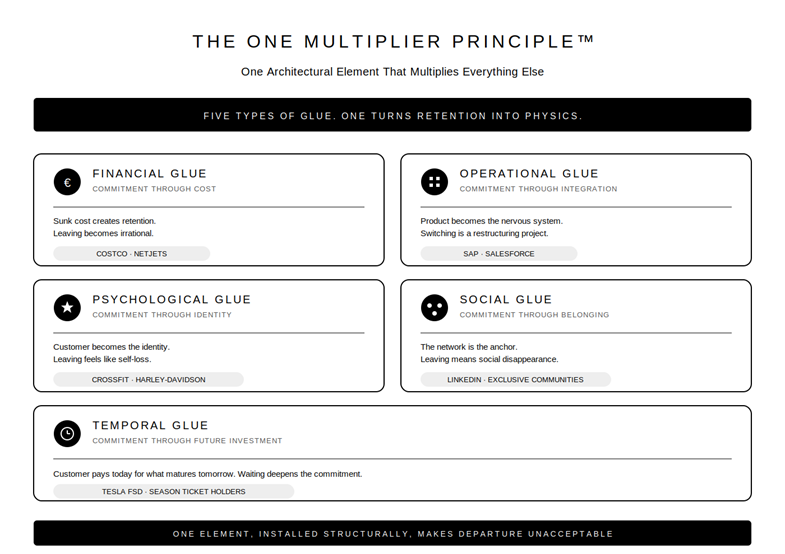
1. Financial Glue — Commitment Through Cost
Financial Glue works through money in the game. Once a customer makes a meaningful upfront investment, leaving becomes irrational.
Costco is the cleanest example. The annual membership fee looks like a barrier. It functions as an anchor. Once paid, members feel compelled to make the membership worthwhile, which means visiting more often and buying larger baskets. The fee that should have reduced demand actually increases it. NetJets uses the same physics at a different scale. A €500K fractional ownership buy-in makes charter comparison irrelevant. Once committed, the customer is a customer for decades.
Core Mechanism: sunk cost becomes commitment becomes retention.
2. Operational Glue — Commitment Through Integration
Operational Glue works through deep integration. The product becomes interwoven with how the customer actually operates. Removal requires ripping out the spine.
SAP is the textbook case. An installation takes twelve to twenty-four months, touches every department, and rebuilds how the company runs. A decade later, replacing it is not a vendor decision—it is a multi-year restructuring project. Salesforce plays the same game in a different category. Once pipelines, dashboards, and forecasts run through it, entire teams organize around it. New hires are trained into it. Partners build services on top of it. What began as “a CRM” becomes the company’s nervous system.
Core Mechanism: deep integration makes switching structurally impossible.
3. Psychological Glue — Commitment Through Identity
Psychological Glue works through identity adoption. The customer does not just use the product—they become the product’s identity.
CrossFit does not sell workouts. It sells “I am a CrossFitter.” The gym, the WOD, the language, the community are all delivery mechanisms for an identity the member then defends socially. Harley-Davidson riders get the logo tattooed. Apple users organize their work and aesthetic around the ecosystem. Once the product is part of who someone is, leaving feels like self-loss, not a purchasing decision.
Core Mechanism: identity adoption produces emotional lock-in that rational comparison cannot dissolve.
4. Social Glue — Commitment Through Belonging
Social Glue works through the network, the status, the reputation graph. The product is not the anchor. The social position is.
LinkedIn is the structural example. Nobody keeps using it because the product is delightful. They keep using it because their professional graph lives there. Leaving means disappearing from the network. Exclusive clubs, invitation-only communities, professional associations all work the same way—the belonging itself is the asset, and walking away means walking out of a social position that took years to earn.
Core Mechanism: belonging creates status creates fear of exclusion.
5. Temporal Glue — Commitment Through Future Investment
Temporal Glue works through time plus expectation. The customer pays today for something that fully matures tomorrow, and the longer they wait, the more invested they become.
Tesla’s Full Self-Driving pre-purchase is the model case. Customers pay thousands of euros for a capability that is still evolving. Every month of waiting deepens the psychological investment in the future delivery. The customer defends the timeline publicly because they are now invested in its arrival. Season ticket holders in sports work the same way—the compounding history makes leaving feel like abandoning a long arc, not cancelling a product.
Core Mechanism: time plus expectation creates compounding commitment that strengthens the longer it runs.
Industry Architecture: How Different Sectors Install Glue
Different sectors have different natural glues. Forcing the wrong glue onto the wrong business produces brittleness. Installing the right one produces inevitability.
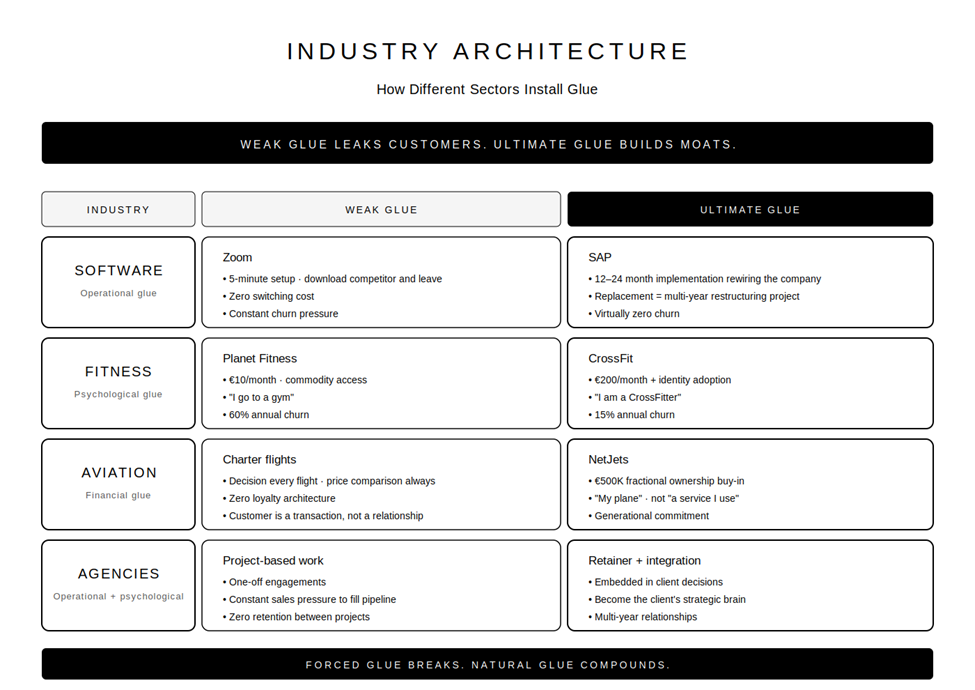
The pattern is consistent. In software, the natural glue is operational—becoming so integrated that removal is a restructuring project. In fitness, the natural glue is psychological—identity adoption. In aviation, financial—a commitment large enough to remove the decision. In agencies, a combination of operational and psychological—being the trusted brain inside the client’s workflow.
The Cascade Effect: From Retention to Exponential Growth
One Multipliers do not just prevent churn. They cascade, and the cascade is where exponential value appears.
Level 1: Direct Protection. The financial glue reduces churn. The operational glue makes switching expensive. The psychological glue produces defensiveness.
Level 2: Identity Transformation. The customer stops being a customer and starts being an investor. Costco members defend the membership to friends. Salesforce power users become evangelists inside their own companies. CrossFit members recruit new members because every new recruit validates their own identity choice.
Level 3: Exponential Multiplication. The investor mindset creates community. Community creates word of mouth. Word of mouth attracts premium customers. Premium customers raise pricing power. Higher prices fund better product. Better product reinforces identity. The loop closes and starts accelerating.
Each level does not add. It multiplies. A business at Level 1 has lower churn. A business at Level 3 has a different economic structure entirely—where acquisition cost drops, retention becomes passive, and growth compounds without proportional marketing spend.
The Surplus Energy Paradox
Here is the counterintuitive insight: a true One Multiplier is not defense. It is offense.
It is tempting to think of glue as a way to stop customers from leaving. True One Multipliers do something more powerful. They generate surplus energy that fuels expansion.
Costco’s membership fee does not just prevent people from cancelling. It compels them to shop more often and buy more per visit to make the fee worthwhile. The payment that should have been a barrier becomes the engine of higher frequency, larger baskets, and organic advocacy. CrossFit’s identity glue does not just reduce churn. It turns members into recruiters, because every new CrossFitter is proof that their own identity choice was correct. Salesforce’s operational glue does not just lock customers in. It produces an entire ecosystem of agencies, consultants, and app developers who build on top of it—expanding Salesforce’s surface area through other people’s work.
Retention converts into expansion. Defense converts into offense. That is the architectural magic.
How to Identify Your Natural One Multiplier
The question is not “how do I design a One Multiplier.” The better question is “given this business, what kind of glue wants to live here by default?”
Every business creates value in a specific way, and each way has a natural architectural glue. For B2B SaaS platforms and infrastructure products, the natural glue is operational—becoming the nervous system of the customer’s company.
For consumer apps and prosumer tools, the natural glue is also operational, expressed as workflow ownership: “this is where my work lives.”
For education, cohorts, and high-ticket programs, the natural glue is financial and psychological combined—a meaningful upfront investment paired with the identity of someone who joins this specific kind of thing.
For communities and clubs, the natural glue is social—status, belonging, curation. For agencies and consulting, the natural glue is operational plus psychological—becoming the trusted brain inside the client’s decisions.
For marketplaces, the natural glue is social—reputation graphs that accumulate over time and are expensive to lose.
For luxury and identity brands, the natural glue is psychological and social—rituals, language, and visible markers of belonging.
The practical move is simple. Identify the archetype. Find the natural primary glue for that archetype. Add a secondary glue only if it strengthens the primary. Do not force a glue the business does not want. Forced glue always feels forced, and customers recognize it instantly.
Zero Multipliers vs One Multipliers: The Two Sides of Architecture
The Zero Multiplier Principle™ identifies what to remove. A Zero Multiplier is any element weak enough to cancel everything around it—a broken onboarding flow that nullifies the product, a founder behavior that undermines culture, a pricing model that contradicts positioning. Without removing Zero Multipliers, nothing downstream matters.
The One Multiplier Principle™ identifies what to install. A One Multiplier is any element strong enough to protect and amplify everything around it. Without installing One Multipliers, everything leaks.
The two principles are complements, not opposites. Subtraction reveals what matters. Installation protects what is revealed. Together they form the multiplication physics of strategic architecture: remove the zeros, install the ones, and let physics do the rest.
Most businesses have neither. They add features hoping for traction. They lower prices hoping for loyalty. They polish the brand hoping for retention. Hope is not architecture. Strategic architects remove what destroys and install what multiplies, and the business transforms underneath.
The One Multiplier in Your Strategic Architecture
The One Multiplier Principle™ integrates directly into The Three Games™ framework. In Game 1, the One Multiplier changes the economics of immediate transactions—Costco members buy more per visit, SAP contracts include multi-year commitments by default.
In Game 2, the One Multiplier stabilizes cadence by removing retention anxiety—when churn is structurally low, system-building can proceed without survival pressure.
In Game 3, the One Multiplier becomes one of the most durable Illegible Compounding Assets™—trust, identity, and switching-cost moats that cannot be copied at any speed.
The sequence matters. First, audit for Zero Multipliers and remove them. Second, identify the natural One Multiplier for the business archetype. Third, install it structurally—not as a tactic, but as a foundation the rest of the business can compound on. Fourth, let time do its work. The moat builds itself once the architecture is right.
The question to sit with: what one element, if installed in this business, would make customer departure feel unacceptable, not merely inconvenient? Find that element. Build it into the foundation. While competitors spend their time plugging a thousand leaks, you will have designed the element that makes leakage structurally unlikely.
FAQ
What is the difference between a One Multiplier and a switching cost?
A switching cost is one type of One Multiplier—specifically the operational variety. The One Multiplier Principle™ is broader. It includes financial commitment (Costco membership), psychological identity (CrossFit), social belonging (LinkedIn), and temporal investment (Tesla FSD pre-purchase). All five types create stickiness, but through different mechanisms. Focusing only on switching costs misses four of the five available forms of architectural glue.
Can a business have more than one type of glue at the same time?
Yes, and the strongest businesses do. Apple combines psychological glue (identity), operational glue (ecosystem integration), and financial glue (upfront device costs). Salesforce combines operational glue (deep integration) with social glue (a certified consultant ecosystem). The key is to identify the primary glue that fits the business archetype and strengthen it first. Secondary glues compound on top of a strong primary. Trying to install all five at once usually produces none.
How long does it take to install a One Multiplier?
Installation is fast. Compounding takes longer. A financial commitment can be added to a business model in weeks. An identity community takes months to seed and years to mature. An operational integration typically takes six to twelve months before the switching cost becomes prohibitive. The One Multiplier starts working immediately, but its full protective power appears once enough cycles have accumulated. The sooner it is installed, the sooner the compounding curve begins.
Is the One Multiplier Principle manipulative?
It is structural, not manipulative. A One Multiplier works because it aligns the economic and psychological interests of the customer with the business. Costco members benefit from shopping more—lower unit prices, better product curation. CrossFit members benefit from identity adoption—fitness, community, self-concept. SAP customers benefit from integration—unified operations across the enterprise. Manipulation extracts value against the customer’s interest. Architecture creates value because the customer’s interest is the lock itself.
What happens if the wrong type of glue is installed?
The business feels brittle. A SaaS company forcing identity glue when its natural glue is operational will fail to produce either lock-in or community. A fitness business using operational glue—long contracts, complex onboarding—when its natural glue is psychological will produce higher churn than competitors using simple memberships with strong identity. Forced glue breaks. Natural glue compounds. The audit question is always the same: given this business, which glue type is the physics already pointing toward?
Ready to install your business’s One Multiplier? Get the complete Strategic Architecture™ methodology delivered weekly → Subscribe to our Substack newsletter for frameworks that turn architectural decisions into compounding moats.
Prepared by the Strategic Architecture™ Editorial Team, bringing clarity to the frameworks shaping the AI era.
Trademark Notice
© 2025 Edward Azorbo. All rights reserved.
Strategic Inevitability™, Strategic Architecture™, Power Numbers™, iPolaris™, Strategic Triggers™, Clear Paths™, Mathematical Freedom Recognition™, Trinity Framework™, The Three Games™, The One Multiplier Principle™, The Zero Multiplier Principle™, Illegible Compounding Assets™, Trust Architecture™, and all related names, logos, and framework titles are trademarks or registered trademarks of Edward Azorbo in the United States, the European Union, and other jurisdictions.
Unauthorized use, reproduction, or modification of these marks and the proprietary methodologies they represent is strictly prohibited. All other trademarks and trade names are the property of their respective owners.
“The canonical definitions of all frameworks are maintained in the Strategic Architecture™ Glossary. The complete methodology is documented across two books: Leverage and The Opportunity Advantage by Edward Azorbo.”