
Evolving Porter’s Five Forces for the AI Era: When Traditional Analysis Meets Real-Time Strategy
Porter’s Five Forces is a five-part model (suppliers, buyers, competitors, substitutes, new entrants) for gauging industry profitability and competitive dynamics within any given market.
How AI-driven markets are pushing competitive analysis beyond quarterly planning cycles
Michael Porter’s Five Forces framework revolutionized strategic thinking for a generation of business leaders. When Porter introduced competitive analysis in 1979, industries transformed every decade, competitive advantages lasted years, and strategic planning could comfortably operate on five-year horizons.
The framework’s logic remains sound: understand suppliers, buyers, competitors, substitutes, and new entrants to make better strategic decisions. For manufacturing companies, traditional retail chains, and established service businesses, Porter’s Five Forces in the AI era still provides excellent foundational thinking.
But something fundamental has shifted in the speed of business transformation—and it’s making traditional competitive analysis mathematically impossible.
Porter’s Five Forces in the AI Era: The Speed Problem That’s Killing Strategy
Here’s the brutal mathematical reality destroying traditional strategy:
ChatGPT launched in November 2022. By January 2023—just two months later—it had restructured competitive landscapes across education, content creation, customer service, and strategy consulting. Consulting teams that spent six weeks completing Porter’s Five Forces analyses were presenting insights about markets that no longer existed.
The Speed Problem:
- Porter’s Five Forces analysis: 3-8 weeks to complete
- AI-driven industry analysis: Major transformations every 6-12 months
- Mathematical conclusion: Your analysis becomes obsolete before you finish it
It’s like trying to navigate using maps that update slower than roads change. Not just useless—actively dangerous for real-time competitive analysis.
| Era | Market Change Speed | Analysis Relevance | Strategic Reality |
|---|---|---|---|
| Porter’s Era (1979-2010) | Decades between shifts | 2-5 years | Analysis worked perfectly |
| Internet Era (2010-2020) | 2-3 years between disruptions | 6-18 months | Analysis increasingly risky |
| AI Era (2020-present) | 6-12 months between category changes | Weeks to months | Analysis becomes dangerous |
The Emergence Catastrophes: When Perfect Five Forces Strategy Kills Companies
The business graveyard overflows with companies that had excellent Five Forces analysis but died when emergence hit:
BlackBerry: Perfect Enterprise Strategy, Fatal Emergence Blindness
Perfect enterprise mobile strategy. Dominated business phones for years with superior Porter’s Five Forces positioning—strong supplier relationships, high switching costs, clear competitive moats.
Emergence blindness: Missed consumer smartphone revolution completely. Result: Lost 95% of smartphone market share (2009-2016).
Borders: Flawless Retail Analysis, Digital Disruption Death
Flawless traditional retail strategy. Optimized physical experience, excellent supplier negotiations, strong local competitive positions according to evolving Porter’s model principles.
Emergence blindness: Digital book ecosystem emerged while they analyzed physical competition. Result: Total extinction.
Yahoo: Dominant Portal Position, Search Engine Miss
Perfect web portal strategy. Dominant market position, excellent competitive analysis, strong advertiser relationships.
Emergence blindness: Search engine revolution (Google) created entirely new category. Result: Sold for fraction of peak value.
The consistent pattern: The better their traditional Five Forces strategy, the bigger their failure when emergence struck.
Recent Emergence Speed: Why Traditional Analysis Can’t Keep Up
TikTok Transformation (2018-2021):
- Traditional analysts: Studying «Facebook vs Instagram competition»
- Emergence reality: Vertical video created entirely new attention economy
- Speed: Reorganized global social media in 36 months
Shopify Explosion (2020-2021):
- Traditional analysts: Mapping «e-commerce platform competition»
- Emergence reality: COVID accelerated digital retail by 5+ years
- Speed: Stock multiplied 5x in 20 months, became retail infrastructure backbone
ChatGPT Revolution (November 2022-June 2023):
- Traditional analysts: Still conducting standard competitive analysis
- Emergence reality: Conversational AI made strategy consulting accessible to everyone
- Speed: Entire industries restructured in 6 months
Mathematical impossibility: When industry transformations happen every 6-12 months but competitive analysis takes 6-8 weeks, you’re always analyzing yesterday’s reality.
The Strategic Architecture™ Alternative: Real-Time Competitive Evolution
Traditional strategy tries to predict and control. Strategic Architecture captures and amplifies emergence through dynamic strategy frameworks that evolve continuously rather than relying on periodic analysis.
The core breakthrough: Strategic Triggers™—binary transformation points achieved within 3-6 month cycles that recalibrate competitive position as markets shift in real-time.
Think of it as competitive analysis with continuous adaptation capability built in—the natural evolution of Porter’s Five Forces for markets where AI-driven industry analysis reveals constant category transformation.
Traditional Strategy vs Strategic Architecture: The Mathematical Advantage
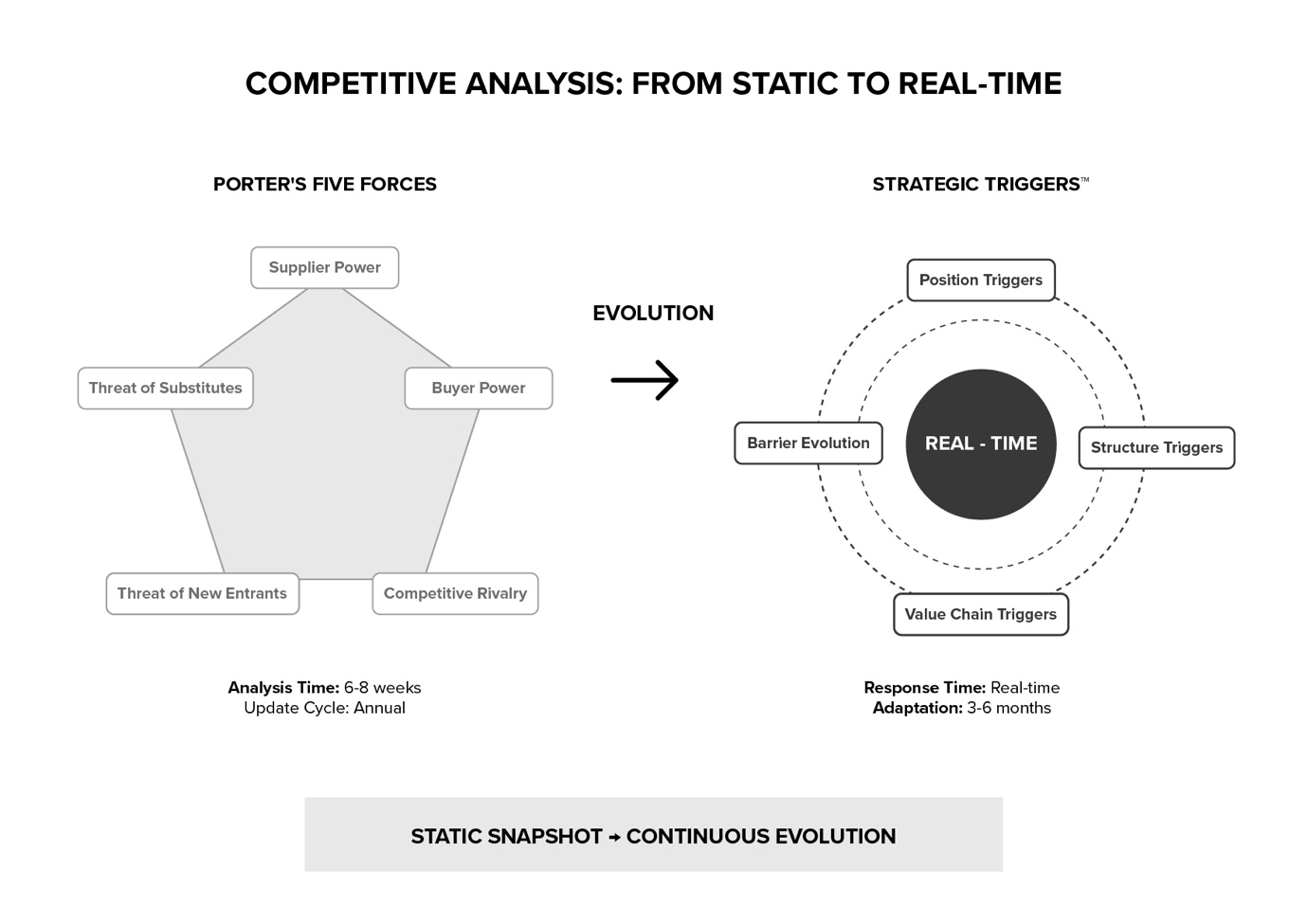
| Element | Porter’s Five Forces | Strategic Triggers |
|---|---|---|
| Analysis Speed | 6-8 weeks | Continuous execution |
| Response Time | Annual planning cycles | 3-6 month adaptation |
| Market Focus | Static competitive snapshot | Dynamic competitive evolution |
| Change Response | Reactive analysis | Proactive architecture |
| Advantage Source | Resource positioning | Emergence capture |
| Success Metric | Market share defense | System evolution speed |
The Four Strategic Trigger™ Categories That Replace Static Analysis
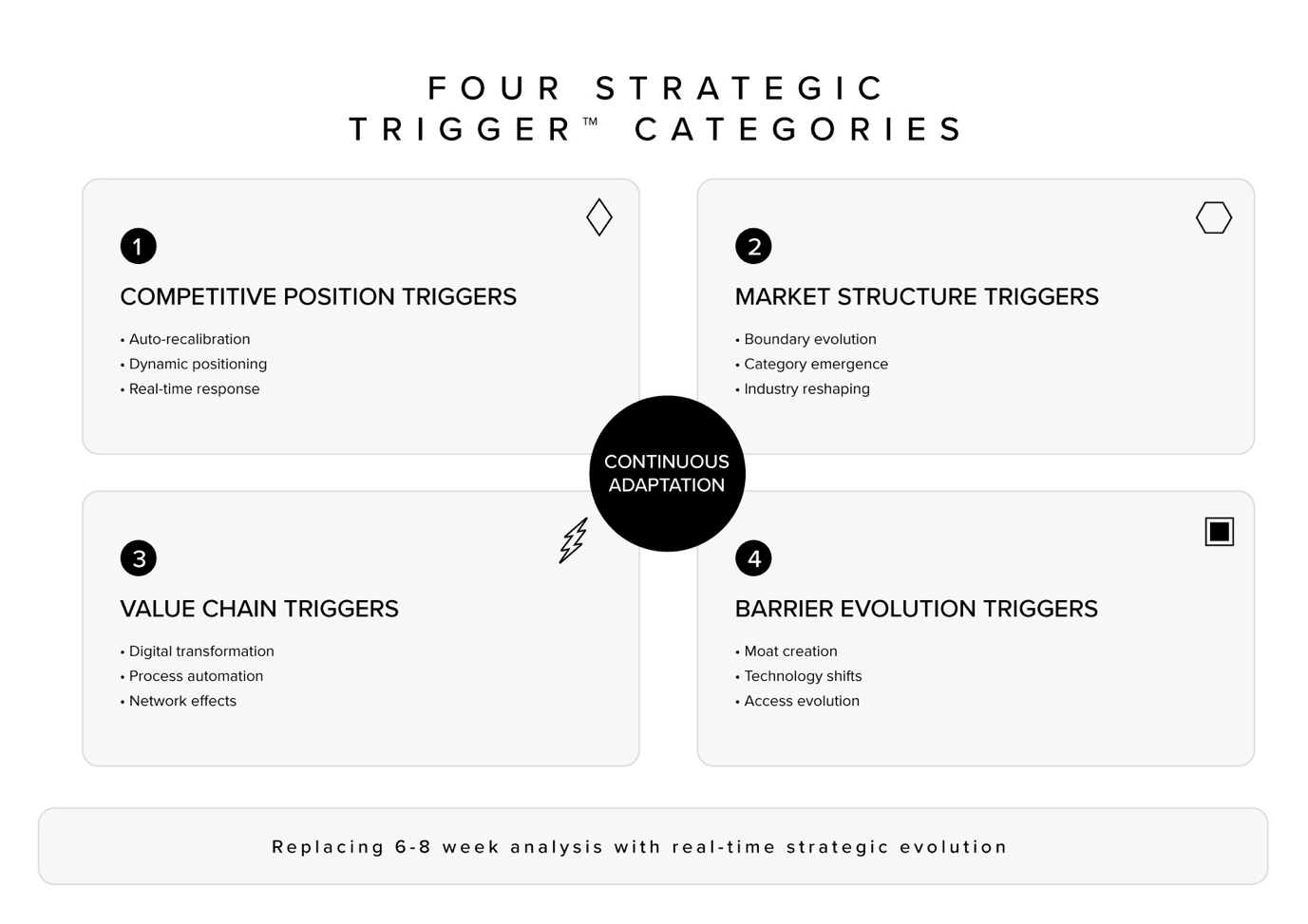
1. Competitive Position Triggers: Beyond Traditional Five Forces Mapping
Problem with Five Forces: Analyzes current competitors while new categories emerge Strategic Triggers Solution: Automatic recalibration when competitive dynamics shift
Example: SaaS companies create triggers for «when three AI-powered competitors enter our space» → immediately activate differentiation and capability enhancement strategies, rather than waiting for quarterly competitive reviews.
2. Market Structure Triggers: Dynamic Industry Boundary Evolution
Problem with Five Forces: Industry structure analysis becomes obsolete as boundaries dissolve Strategic Triggers™ Solution: Capture emerging market structures in real-time competitive analysis
Example: Traditional consultancies establish triggers for «when AI tools replicate 60% of our analysis work» → immediate transition from implementation to strategic advisory positioning, rather than defending obsolete value propositions.
3. Value Chain Triggers: Continuous Reconfiguration Capability
Problem with Five Forces: Value chain mapping misses digital transformation opportunities Strategic Triggers Solution: Dynamic value chain reconfiguration using evolving Porter’s model principles
Example: Manufacturing companies build triggers for «when automation reaches specific cost thresholds» → immediate value chain evolution toward customization and speed, rather than protecting legacy operations.
4. Barrier Evolution Triggers: Creating New Moats as Technology Eliminates Old Ones
Problem with Five Forces: Entry barriers analysis fails as technology eliminates traditional moats Strategic Triggers Solution: Create new barriers as old ones erode
Example: Media companies design triggers for «when content creation costs drop below threshold levels» → immediate shift competitive barriers from production resources to audience relationships and distribution networks.
Mathematical Advantage: Emergence Capture vs Analysis Paralysis
Netflix Evolution Model: Strategic Triggers in Action
- Used competitive analysis for DVD-by-mail foundation
- Built Strategic Triggers for streaming emergence capture
- Triggered content creation when subscriber thresholds hit
- Triggered global expansion when content library reached critical mass
- Result: Continuous competitive evolution rather than single static position
Amazon Emergence Engine: Platform Architecture for Category Capture
- Applied competitive analysis to books
- Created Strategic Triggers for e-commerce expansion
- Triggered cloud services when internal infrastructure reached surplus
- Triggered AI services when machine learning capabilities matured
- Result: Platform architecture that captures any emerging category
Tesla Disruption System: Vertical Integration for Technological Emergence
- Started with automotive competitive analysis
- Built Strategic Triggers for energy storage emergence
- Triggered autonomous driving when AI capabilities aligned
- Triggering robotics as manufacturing and AI converge
- Result: Vertical integration that captures technological emergence
Pattern recognition: Winners don’t abandon competitive thinking—they evolve it to work at emergence speed.
The Future Mathematical Impossibility of Traditional Planning
Acceleration Projection:
- 2025+: Major emergence events every 3-6 months
- Traditional planning: Still operates on 12-24 month cycles
- Analysis validity: Days to weeks maximum
- Mathematical conclusion: Traditional competitive strategy becomes literally impossible
The Antifragile Choice:
- Fragile Strategy: Static analysis that breaks under emergence pressure
- Antifragile Strategy: Strategic Architecture that gets stronger from chaos
Building Your Emergence Capture System: Integration Framework
Step 1: Use Porter’s Five Forces for competitive foundation (still valuable for market entry understanding)
Step 2: Identify which competitive dynamics change fastest in your industry
Step 3: Design Strategic Triggers for those dynamic elements
Step 4: Create continuous evolution capability rather than periodic planning
Step 5: Build emergence capture into your Strategic Architecture
Key insight: It’s not either/or—it’s both/and evolution. Strong competitive analysis provides foundation for strong competitive evolution through real-time competitive analysis.
The Strategic Choice That Changes Everything
Porter’s Five Forces worked brilliantly for its era and continues providing value in stable markets. But in AI-accelerated industries, traditional competitive analysis has become strategically dangerous.
Strategic Architecture offers systematic emergence capture designed specifically for markets where competitive dynamics shift continuously. Whether this evolution fits your business depends entirely on your industry’s actual speed of change.
The companies that will dominate the next decade aren’t those with better competitive analysis—they’re those with better competitive evolution systems.
The mathematical trend is clear: As AI accelerates everything, competitive analysis must accelerate with it, or become irrelevant.
Ready to Master Emergence-Based Strategy?
If your industry changes faster than your planning cycles, you need frameworks designed for continuous competitive evolution rather than periodic analysis.
Get Strategic Architecture insights delivered weekly → Subscribe to our Substack newsletter for frameworks on real-time competitive analysis and Strategic Triggers™ that help you capture emergence rather than just analyze competitors.
Join thousands of strategists learning to build antifragile businesses that get stronger from market chaos.
Prepared by the Strategic Architecture Editorial Team, bringing clarity to the frameworks shaping the AI era.
No—Porter’s Five Forces remains valuable for foundational competitive understanding, but it works best when paired with 3-6-month Strategic Trigger™ cycles in fast-moving industries.
Every quarter in tech sectors; monthly monitoring if AI is core to your business model; annually may still work for stable traditional industries.
Porter’s Five Forces provides competitive snapshots; Strategic Triggers™ create continuous competitive evolution systems that adapt positioning as markets shift in real-time.
Trademark Notice
© 2025 Edward Azorbo. All rights reserved.
Strategic Inevitability, Strategic Architecture™, Power Numbers™, iPolaris, Strategic Triggers™, Clear Paths™, Mathematical Freedom Recognition, Trinity Framework™, and all related names, logos, and framework titles are trademarks or registered trademarks of Edward Azorbo in the United States, the European Union, and other jurisdictions.
Unauthorized use, reproduction, or modification of these marks and the proprietary methodologies they represent is strictly prohibited. All other trademarks and trade names are the property of their respective owners.