
Trinity Framework™: The Three-Layer System for Strategic Inevitability
Trinity Framework™: How Three Strategic Constraints Create Mathematical Inevitability
What Is Trinity Framework?
Trinity Framework™ is a three-layer constraint system that transforms infinite strategic possibilities into closed probability spaces where success becomes mathematically inevitable through Strategic Linchpin identification, systematic enablement, and consistent cadence execution. Unlike traditional strategic planning that drowns in endless options, Trinity Framework creates focused execution through three precise constraints that compound over time.
Think of it as strategic blinders—like racehorses that can only look forward, eliminating distractions and creating singular focus. But instead of limiting vision, these constraints create freedom by transforming hope into mathematical certainty.
The Chaos of Infinite Possibilities
Why Traditional Strategy Fails
Most businesses drown in options. Every path seems viable. Every opportunity looks promising. Every strategy could work. This creates what physicists call «maximum entropy»—a state of complete disorder where no progress is possible.
Traditional strategic planning makes this worse by:
- Adding more analysis (creating more options)
- Seeking perfect information (delaying execution)
- Optimizing everything (diluting focus)
- Chasing trends (breaking consistency)
The result? Strategic paralysis. Businesses spend months planning, analyzing, optimizing—and achieving nothing. They’re trying to optimize infinity.
The Mathematical Problem
When you have infinite possibilities, the probability of choosing the optimal path approaches zero. It’s a mathematical certainty: more options create worse outcomes.
The solution isn’t better planning. It’s systematic constraint.
The Trinity Framework Architecture
The Three-Layer Constraint System
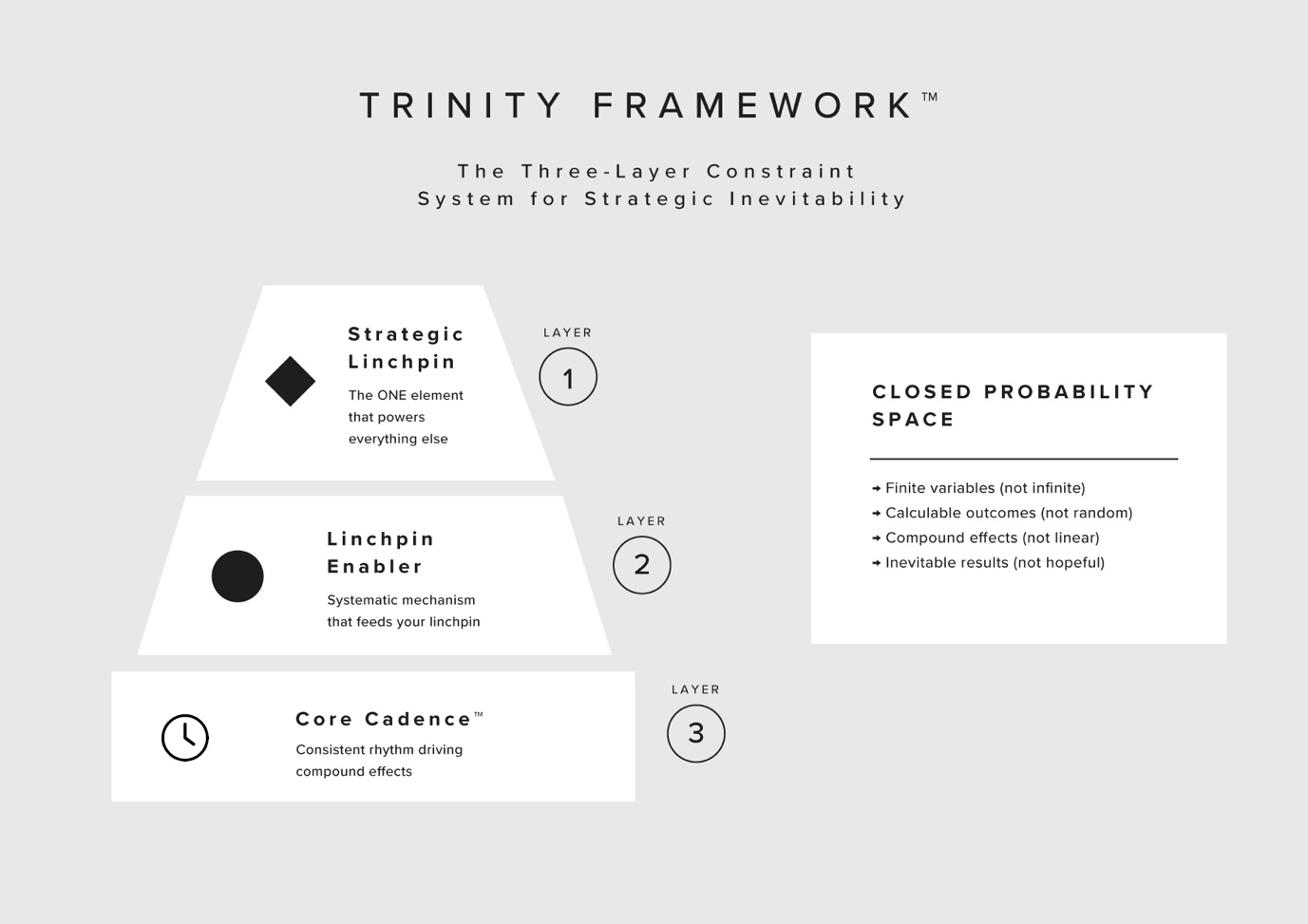
Trinity Framework solves strategic chaos through three interconnected constraints:
- Layer 1: Strategic Linchpin The ONE element that powers everything else. Your point of maximum leverage where small improvements create exponential results.
- Layer 2: Linchpin Enabler The systematic mechanism that feeds and optimizes your linchpin. Your repeatable process for creating linchpin growth.
- Layer 3: Core Cadence The consistent rhythm that drives your enabler. Your inevitability engine that ensures progress regardless of external chaos.
The Closed Probability Space
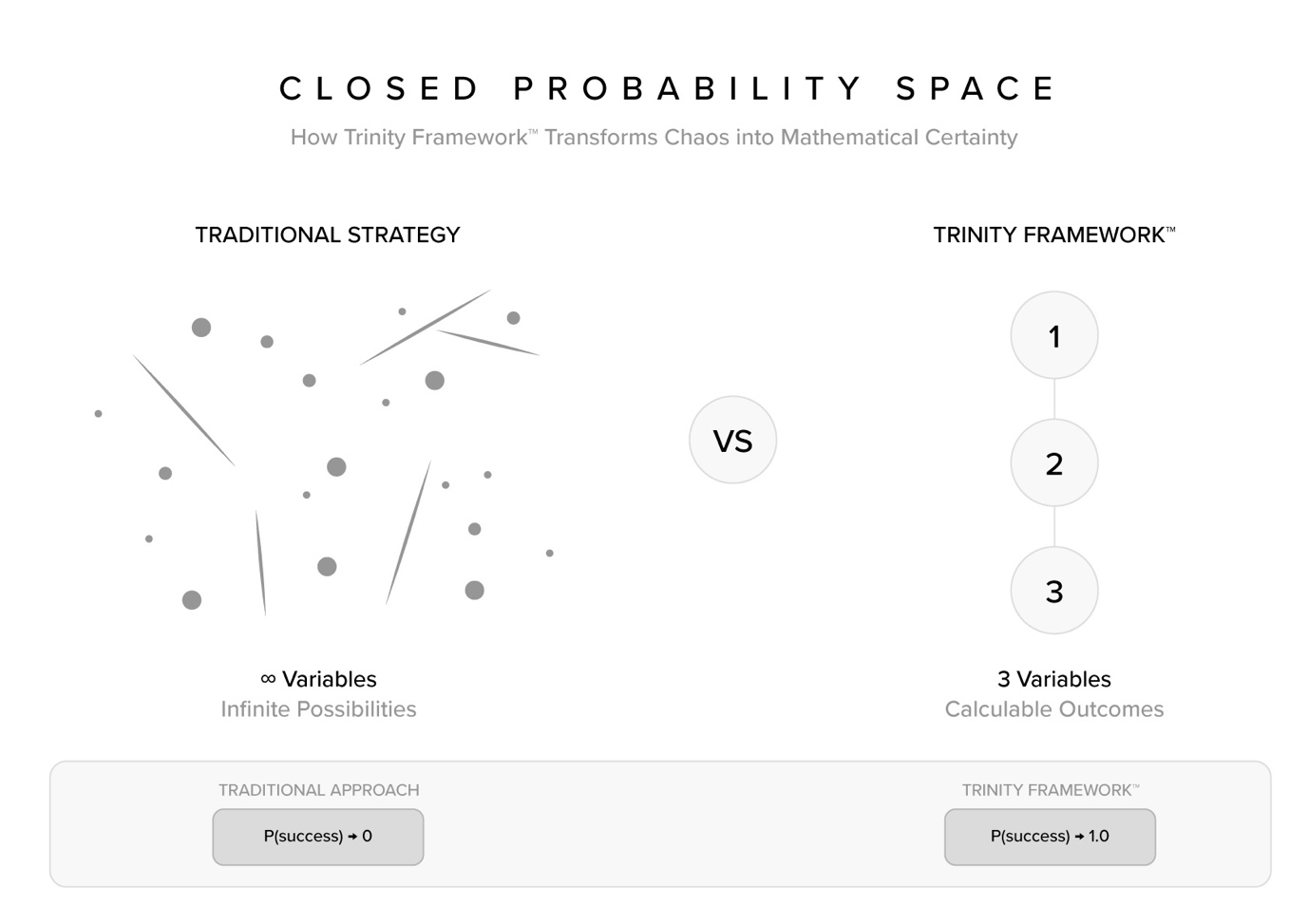
By constraining strategy to three elements, Trinity Framework creates what mathematicians call a «closed probability space»:
- Finite variables (not infinite)
- Calculable outcomes (not random)
- Compound effects (not linear)
- Inevitability results (not hopeful)
This transforms strategy from gambling to engineering.
Layer 1: Strategic Linchpin – The Power Concentration
Definition and Recognition
Your Strategic Linchpin is the single element that, when optimized, makes everything else easier or unnecessary. It’s not just important—it’s the mathematical center of gravity for your entire business.
Recognition Questions:
- «What single metric, if dramatically improved, would transform everything?»
- «What creates exponential rather than linear results?»
- «What generates mathematical freedom for all other decisions?»
- «What would make our biggest constraints irrelevant?»
Common Strategic Linchpins
SaaS Businesses: Monthly Recurring Revenue (MRR)
- Powers hiring decisions
- Enables product development
- Creates investor interest
- Funds growth experiments
Thought Leaders: Audience Growth
- Drives revenue opportunities
- Creates speaking invitations
- Attracts premium clients
- Builds category authority
Marketplaces: Network Effects
- Accelerates both sides
- Creates competitive moats
- Drives valuation
- Enables platform expansion
Service Businesses: Recurring Revenue
- Stabilizes cash flow
- Enables team building
- Allows strategic investment
- Creates predictability
The Linchpin Test
A true Strategic Linchpin must:
- Power the entire system
- Create freedom when optimized
- Enable compound effects
- Protect against volatility
If it doesn’t meet ALL criteria, it’s not your linchpin.
Layer 2: Linchpin Enabler – The Optimization Engine
Definition and Design
Your Linchpin Enabler is the systematic process that directly feeds and strengthens your Strategic Linchpin. It’s not random improvement—it’s engineered optimization.
Design Requirements:
- Directly impacts linchpin growth
- Completely systematic and repeatable
- Creates compound improvement
- Works regardless of market conditions
Enabler Examples
For MRR Growth:
- Systematic growth experiments
- A/B testing frameworks
- Conversion optimization processes
- Retention improvement systems
For Audience Building:
- Daily content creation systems
- Distribution channel optimization
- Engagement amplification processes
- Community building mechanisms
For Network Effects:
- User acquisition funnels
- Referral system optimization
- Platform feature development
- Engagement loop design
The Enabler Test
Ask: «Can I execute this exact process next week without thinking?»
If the answer is no, you don’t have an enabler—you have hope.
Layer 3: Core Cadence – The Inevitability Rhythm
Definition and Power
Core Cadence is the systematic rhythm that ensures your Linchpin Enabler operates consistently. It’s the heartbeat of inevitability—the predictable pattern that transforms strategy into compound results.
Cadence Mathematics:
- Daily = 365 compound cycles/year
- Weekly = 52 compound cycles/year
- Monthly = 12 compound cycles/year
More cycles = faster compound effects.
The Compound Effect
Each cadence cycle creates three simultaneous benefits:
- 1. Emergent Opportunity Capture Regular rhythm ensures you’re «in position» when unexpected opportunities appear
- 2. Optimization Stacking Consistent execution generates data and improvements that compound
- 3. Position Strengthening Each cycle builds advantages that make future cycles easier
The Cadence Test
«If you keep breaking your rhythm, you don’t have a cadence—you have hope.»
True cadence is unbreakable. Market chaos, team changes, personal challenges—nothing breaks the rhythm.
Real-World Trinity Implementation
Case Study 1: SaaS Revenue Acceleration
Context: B2B SaaS struggling with unpredictable growth
Trinity Implementation:
- Strategic Linchpin: Monthly Recurring Revenue (MRR)
- Linchpin Enabler: Weekly growth experiments (paid ads focus)
- Core Cadence: Every Monday, new experiment launched
Execution Reality:
- Week 1-4: Learning phase, minimal results
- Week 5-12: Patterns emerge, optimization begins
- Week 13-26: Compound effects accelerate
- Week 27-52: Mathematical inevitability achieved
Result: €100K to €1M ARR in 9 months through 180+ systematic experiments
Case Study 2: Thought Leadership Building
Context: Business strategist building category authority
Trinity Implementation:
- Strategic Linchpin: Email list growth
- Linchpin Enabler: «Inside the trenches» content sharing
- Core Cadence: Daily publishing without exception
Cascade Effects:
- List growth → Revenue opportunities
- Consistency → Trust building
- Authority → Premium positioning
- Compound → Exponential results
Result: Unknown to category leader in 18 months
The Mathematical Certainty
Why Trinity Creates Inevitability
Traditional strategy operates in open probability spaces:
- Infinite variables
- Random outcomes
- Unpredictable results
- Hope-based projections
Trinity Framework creates closed probability spaces:
- Three variables only
- Calculable outcomes
- Compound results
- Math-based projections
The Probability Calculation
Within Trinity’s closed space:
- Success probability = (Linchpin Clarity × Enabler Systematization × Cadence Consistency)^Time
- As time increases, probability approaches 1.0
- Compound effects accelerate over time
- Inevitability becomes mathematical
Common Trinity Mistakes
Mistake 1: Multiple Linchpins
Wrong: «We optimize MRR AND user experience AND team culture…» Right: ONE linchpin. Everything else is secondary.
Mistake 2: Unsystematic Enabler
Wrong: «We try different things to grow MRR» Right: Systematic, repeatable process executed identically
Mistake 3: Broken Cadence
Wrong: «We usually do weekly, but sometimes…» Right: Unbreakable rhythm. No exceptions. Ever.
Mistake 4: Impatience
Wrong: «It’s been 3 months and results are slow» Right: Trust the compound curve. Math doesn’t lie.
Trinity Evolution and Review
Linchpin Evolution Triggers
Your Strategic Linchpin may evolve when:
- Major strategic trigger achieved (like €1M ARR)
- Market conditions fundamentally shift
- Higher-leverage linchpin discovered
- Current linchpin becomes saturated
Review Schedule: Quarterly assessment, annual deep review
Evolution Process
When changing your Trinity:
- Validate new linchpin thoroughly
- Redesign enabler completely
- Adjust cadence if needed
- Commit fully to new system
Never run multiple Trinities simultaneously—it breaks the closed probability space.
Implementation Blueprint
Phase 1: Trinity Design (Week 1)
Step 1: Identify Strategic Linchpin
- List all important metrics
- Apply recognition questions
- Validate with linchpin test
- Commit to single choice
Step 2: Design Linchpin Enabler
- Map systematic process
- Ensure direct impact
- Validate repeatability
- Document completely
Step 3: Establish Core Cadence
- Choose sustainable rhythm
- Design specific process
- Set unbreakable rules
- Begin immediately
Phase 2: Trinity Execution (Week 2-Forever)
- Daily Question: «Am I in cadence?»
- Weekly Review: «Is my enabler optimizing?»
- Monthly Check: «Is my linchpin growing exponentially?»
- Quarterly Assessment: «Is evolution needed?»
The Strategic Freedom Paradox
Trinity Framework proves a counterintuitive truth: Constraints create freedom.
By limiting strategy to three elements, you gain:
- Mental Freedom: No decision fatigue
- Execution Freedom: Clear daily actions
- Strategic Freedom: Compound results
- Mathematical Freedom: Calculable outcomes
The framework doesn’t limit possibilities—it makes them inevitable.
From Chaos to Compound Certainty
Trinity Framework represents a fundamental shift in strategic thinking. Instead of trying to optimize everything, you constrain everything except what matters. Instead of hoping for results, you engineer inevitability.
The businesses that dominate their markets aren’t working on more things—they’re working on the right thing, systematically, consistently. They’ve discovered that three constraints create more progress than infinite possibilities.
The math is clear. The framework is proven. The only question: Will you continue drowning in strategic options, or will you create your Trinity and transform chaos into compound certainty?
Ready to engineer your strategic inevitability? Get the complete Strategic Architecture™ methodology delivered weekly → Subscribe to our Substack newsletter for frameworks that transform strategic chaos into mathematical certainty.
Prepared by the Strategic Architecture™ Editorial Team, bringing clarity to the frameworks shaping the AI era.
FAQ
Trinity Framework is a three-layer constraint system using Strategic Linchpin, Linchpin Enabler, and Core Cadence to transform infinite possibilities into mathematical certainty for business growth.
Traditional planning creates infinite options and analysis paralysis. Trinity Framework constrains strategy to three elements, creating a closed probability space where success becomes calculable.
A Strategic Linchpin is the single element that powers everything else in your business—the one metric that, when optimized, creates exponential results and mathematical freedom.
Results compound over time. Initial patterns emerge in 4-12 weeks, optimization gains appear in 3-6 months, and mathematical inevitability typically manifests within 12-18 months of consistent execution.
No. Multiple linchpins break the closed probability space. Choose ONE linchpin that powers everything else. Review quarterly, but never run multiple Trinities simultaneously.
Trademark Notice
© 2025 Edward Azorbo. All rights reserved.
Strategic Inevitability™, Strategic Architecture™, Power Numbers™, iPolaris™, Strategic Triggers™, Clear Paths™, Mathematical Freedom Recognition™, Trinity Framework™, Strategic Linchpin™, Linchpin Enabler™, Core Cadence™, and all related names, logos, and framework titles are trademarks or registered trademarks of Edward Azorbo in the United States, the European Union, and other jurisdictions.
Unauthorized use, reproduction, or modification of these marks and the proprietary methodologies they represent is strictly prohibited. All other trademarks and trade names are the property of their respective owners.