
VRIO Framework vs Illegible Compounding Assets: Why Resource Analysis Misses Hidden Strategic Moats
The VRIO Framework evaluates visible resources for value, rarity, imitability and organization. Illegible Compounding Assets build hidden multi-layer systems that competitors can’t see, copy or substitute, creating moats that grow over time.
VRIO Framework analyzes visible resources for sustainable advantage that erode quickly in AI-accelerated markets. Illegible Compounding Assets create hidden systems with multiple value layers that competitors cannot see, understand, or replicate.
Why traditional resource analysis fails to identify compound value creation and how Illegible Compounding Assets build unassailable strategic positions
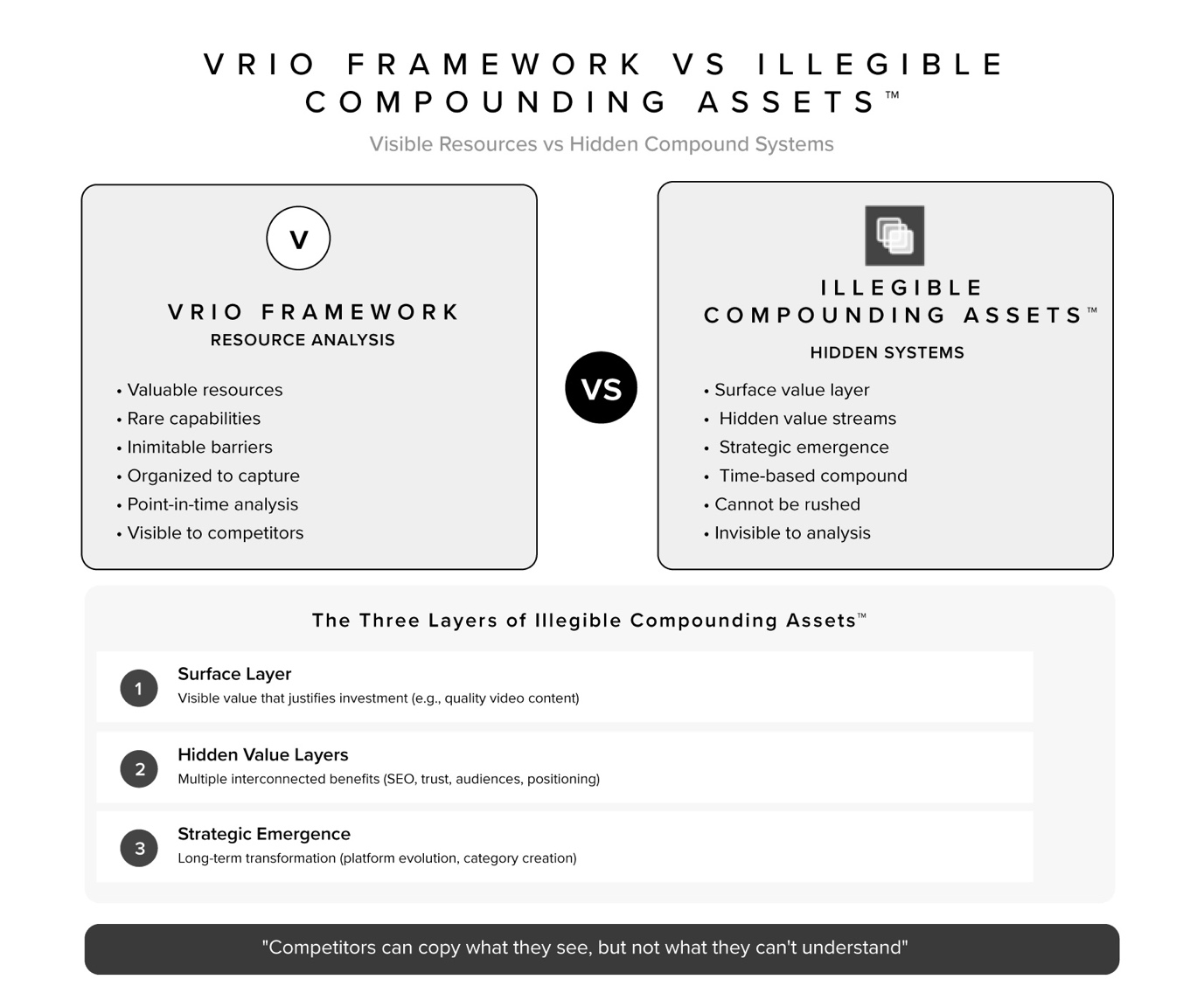
Traditional VRIO Framework conducts resource analysis through Value, Rarity, Imitability, and Organization assessment, but visible resources lose competitive advantage quickly in AI-accelerated markets. Modern sustainable advantage requires Illegible Compounding Assets™ – hidden systems that create exponential value through multiple layers of complexity that competitors cannot see or replicate.
Illegible Compounding Assets replace static resource evaluation with dynamic compound value creation: strategic assets that appear simple on the surface but generate exponential advantages through hidden layers that compound over time.
vrio framework vs illegible compounding assets comparison graphic
The VRIO Problem: Why Visible Resource Analysis Creates Temporary Advantage
TL;DR: VRIO Framework evaluates visible resources that AI-acceleration makes imitable quickly, missing hidden compound systems that create lasting competitive moats.
Most organizations implement VRIO Framework through systematic resource analysis: assessing resources for Value creation, Rarity in markets, Imitability barriers, and Organizational capability to exploit advantages. This visibility-focused approach creates three critical strategic failures in dynamic environments:
- Visible Resource Focus vs Hidden System Architecture
Traditional VRIO approach:
- Identify valuable resources that create customer benefits and competitive advantages
- Assess resource rarity to determine scarcity and uniqueness in marketplace
- Analyze imitability barriers including causal ambiguity and social complexity
- Evaluate organizational capability to implement and exploit identified resources
AI-era reality check: VRIO Framework analyzes surface-level resources that become visible to competitors, enabling AI-assisted reverse engineering and rapid competitive imitation.
2. Static Resource Assessment vs Dynamic Compound Value Creation
Standard resource analysis methodology:
- Value Assessment: Does the resource create customer value and competitive advantage?
- Rarity Evaluation: Is the resource scarce and difficult for competitors to obtain?
- Imitability Analysis: Can competitors copy or substitute the resource easily?
- Organization Capability: Can the firm organize to capture resource value effectively?
Investment insight problem: VRIO Framework evaluates resources at single points in time without recognizing how hidden systems create compound value that multiplies exponentially through interconnected layers.
3. Resource Optimization vs System Illegibility Building
Traditional sustainable advantage logic:
- Build competitive advantage through valuable, rare, inimitable, and organizationally supported resources
- Protect resource advantages through barriers to imitation and strategic positioning
- Optimize resource allocation for maximum competitive advantage and value capture
- Sustain advantages through continuous resource development and protection
Strategic architecture reality: Success depends on Illegible Compounding Assets that create sustainable advantage through hidden complexity that competitors cannot recognize, understand, or replicate systematically.
How VRIO Framework Misses Compound Value Intelligence
TL;DR: Research shows AI reduces resource imitation time by 75%, making traditional VRIO advantages temporary rather than sustainable.
Studies indicate that AI-enabled competitive analysis, reverse engineering, and rapid development cycles eliminate traditional resource advantages within 12-18 months. VRIO Framework assumptions about imitability barriers break down when AI accelerates competitive learning and resource replication processes.
Real-World VRIO vs Illegible Compounding Assets™ Examples
TL;DR: Amazon’s success came from illegible compound systems, not visible resources that VRIO analysis would identify and competitors could replicate.
Traditional VRIO: Technology Consulting Firm (Advantage Erosion)
VRIO Analysis Implementation:
Value Assessment:
- AI Implementation Expertise: Creates customer value through digital transformation capability
- Industry Knowledge: Deep understanding of client business processes and technology needs
- Team Capability: Experienced consultants with proven track record in AI deployment
Rarity Evaluation:
- Specialized Skills: Limited pool of consultants with AI implementation experience
- Client Relationships: Established trust and repeat business relationships
- Methodology Framework: Proprietary implementation process and best practices
Imitability Analysis:
- Knowledge Barriers: Complex expertise requiring years of experience development
- Relationship Assets: Client trust and history difficult to replicate quickly
- Process Complexity: Implementation methodology with institutional knowledge
Organization Assessment:
- Team Structure: Organized to deliver consistent AI implementation services
- Knowledge Management: Systems for capturing and transferring implementation expertise
- Client Delivery: Processes ensuring reliable service quality and customer satisfaction
VRIO Conclusion: Sustainable competitive advantage through valuable, rare, difficult-to-imitate resources with strong organizational support
Why this advantage erodes: Visible expertise becomes replicable through AI training, methodology documentation, and talent acquisition. Competitors reverse-engineer approaches and build similar capabilities within 12 months.
Illegible Compounding Assets Alternative: Hidden System Architecture
Illegible Compounding Assets Analysis:
The Video Production Paradox:
What Competitors See: «Just expensive video content instead of standard presentations»
Actual Compound System:
Surface Layer:
- High production quality video content for client presentations
- More expensive than traditional PowerPoint or PDF deliverables
- Seemingly «just better content marketing»
Hidden Value Layers:
- Brand Position Compounding: Premium positioning through production quality associations
- Retargeting Audience Building: Video engagement creates valuable remarketing audiences
- Market Education Assets: Content that educates prospects while building authority
- Premium Position Strength: Quality signaling that justifies higher pricing
- Category Ownership Signals: Video leadership suggesting market sophistication
Strategic Emergence Effects:
- Platform Evolution Potential: Video content enables multiple channel distribution
- Category Creation Power: Visual storytelling becomes market differentiator
- Trust Acceleration: High production values increase credibility and client confidence
- Position Transformation: Evolution from service provider to thought leader
Result After Time: Market perception of «owning video» creates competitive moat impossible to replicate through surface imitation
The Trust Architecture Compound System:
What Competitors See: «Just collecting more client testimonials and reviews»
Actual Compound System:
Surface Layer:
- 1000+ client testimonials across multiple platforms
- Video case studies and success stories
- Basic social proof and credibility indicators
Hidden Value Layers:
- Category Trust Transfer: Established credibility enabling expansion into new service areas
- Implementation Proof Library: Evidence database supporting sales process efficiency
- Market Confidence Asset: Trust foundation enabling premium pricing and faster sales cycles
- Position Acceleration: Credibility momentum that compounds through referrals and word-of-mouth
- Transformation Validation: Proof points supporting innovative service offerings
Strategic Evolution Effects:
- New Category Enablement: Trust assets enable expansion into adjacent markets
- Trust-Based Transformation: Credibility foundation supporting business model evolution
- Position Strength: Market authority that creates sustainable competitive advantages
- Value Multiplication: Trust assets generating multiple revenue streams and opportunities
Why this creates lasting advantage: Illegible Compounding Assets build hidden systems that competitors cannot replicate by copying surface elements, creating time-based advantages that strengthen through consistency and compound through multiple value layers.
The Resource Visibility Problem
TL;DR: Tesla’s competitive advantage came from illegible compound systems, not visible resources that traditional VRIO analysis would identify.
Tesla’s Hidden System Architecture (2008-2025):
- Traditional VRIO perspective: Electric vehicle technology, battery expertise, and software integration as valuable, rare resources
- What VRIO analysis missed: Illegible compound systems creating multiple simultaneous advantages through hidden interconnections
Illegible Compounding Assets approach would have emphasized:
- Manufacturing Innovation Compound System: Production methods creating cost advantages while building expertise platform
- Software-Hardware Integration: Development processes creating seamless integration impossible to replicate through component copying
- Brand-Mission Alignment: Mission-driven positioning creating customer loyalty that transcends product features
Strategic insight: Tesla’s dominance came from illegible compound systems that created multiple reinforcing advantages rather than single valuable resources that competitors could analyze and replicate.
Illegible Compounding Assets: Hidden Systems for Sustainable Advantage
TL;DR: Illegible Compounding Assets create sustainable advantage through hidden complexity that strengthens over time rather than eroding through competitive imitation.
Illegible Compounding Assets demonstrate sustainable advantage through strategic assets that appear simple but create exponential value through hidden layers of complexity and time-based compound effects.
The Three Layers of Illegible Compounding Architecture
1. Surface Layer: Visible Value Creation
Purpose: Provide immediate, tangible value that justifies investment while masking deeper system complexity Strategic insight: Surface benefits attract attention while hiding compound advantage sources
Surface Layer Design Principles:
- Immediate Value Delivery: Clear benefits that stakeholders can understand and appreciate
- Resource Justification: Visible returns that support continued investment and development
- Competitive Misdirection: Apparent simplicity that obscures underlying system sophistication
- Market Positioning: Surface benefits that create premium positioning and customer preference
Surface Layer Examples:
- High-quality video content: Visible production value and professional presentation
- Comprehensive client testimonials: Social proof and credibility demonstration
- Systematic frameworks and processes: Organized methodology and implementation guides
- Premium service delivery: Enhanced customer experience and satisfaction
2. Hidden Value Layers: Compound Advantage Creation
Purpose: Generate multiple streams of strategic value that interconnect and reinforce each other Strategic insight: Hidden layers create competitive advantages that compound exponentially through system integration
Hidden Value Architecture:
- Cross-Functional Benefits: Single assets generating value across multiple business functions
- Data and Intelligence Generation: Systems that create information advantages and market insights
- Process and Efficiency Improvements: Operational benefits that reduce costs while increasing capability
- Relationship and Trust Building: Social capital development that opens new opportunities
Hidden Layer Examples:
Video Content Hidden Layers:
- SEO Authority Building: Content optimization creating search ranking advantages
- Retargeting Audience Development: Video engagement generating valuable marketing audiences
- Brand Position Compounding: Quality associations improving market perception over time
- Educational Asset Creation: Content that builds market understanding while establishing expertise
Trust System Hidden Layers:
- Sales Process Acceleration: Credibility reducing sales cycle time and increasing conversion rates
- Premium Pricing Justification: Trust enabling higher pricing through risk reduction perception
- Referral Network Activation: Satisfied clients becoming active business development assets
- Market Expansion Enablement: Trust assets facilitating entry into new service areas
3. Strategic Emergence Effects: Long-Term Transformation
Purpose: Enable business model evolution and market position transformation through compound system effects Strategic insight: Time-based development creates strategic possibilities impossible through direct planning
Emergence Architecture:
- Platform Evolution Potential: Assets becoming foundations for new business models and revenue streams
- Category Creation Power: System sophistication enabling market definition and competitive standard setting
- Position Transformation: Evolution from service provider to market leader through systematic advantage building
- Value Multiplication: Compound effects generating exponential returns on initial asset investment
Strategic Emergence Examples:
Content System Emergence:
- Thought Leadership Platform: Content assets evolving into industry authority and speaking opportunities
- Educational Market Control: Information advantage enabling market conversation leadership
- Product Development Foundation: Content insights driving service innovation and market expansion
- Strategic Partnership Attraction: Authority position drawing collaboration and joint venture opportunities
Trust System Emergence:
- Market Making Capability: Credibility enabling new category creation and standard setting
- Ecosystem Orchestration: Trust platform supporting partner network development and management
- Investment Attraction: Proven track record drawing capital and growth partnership opportunities
- Succession and Exit Value: Trust assets becoming transferable business value for succession or sale
VRIO Framework vs Illegible Compounding Assets: The Competitive Advantage Comparison
| Element | VRIO Framework | Illegible Compounding Assets™ |
|---|---|---|
| Analysis Focus | Visible resource evaluation for competitive advantage | Hidden system architecture creating compound strategic value |
| Advantage Duration | Temporary protection through imitability barriers | Permanent advantage through time-based compound complexity |
| Competitive Protection | Resource scarcity and imitation difficulty | System illegibility and multi-layer interdependence |
| Value Creation | Resource optimization for maximum competitive advantage | Exponential value multiplication through hidden system integration |
| Strategic Assessment | Point-in-time resource analysis and capability evaluation | Dynamic compound effect tracking and system evolution measurement |
| Sustainability Method | Barrier maintenance and resource protection | Continuous system development and complexity deepening |
| Competitive Intelligence | Resource visibility enabling competitive analysis | System invisibility preventing competitive understanding and replication |
resource analysis comparison showing visible evaluation vs hidden system architecture
The Time-Based Advantage Principle
TL;DR: Illegible Compounding Assets cannot be rushed, copied, or substituted because they require time-based development and consistent execution.
The Three Strategic Powers of Illegible Assets
1. Cannot Be Rushed: Time-Based Advantage Protection
Why Speed Cannot Overcome Time Requirements:
- Consistency Building: Trust and authority require sustained performance over extended periods
- System Integration: Multiple value layers develop through interconnected experience and learning
- Market Perception: Premium positioning emerges through consistent quality demonstration over time
- Compound Effects: Exponential value creation requires sufficient time for compound multiplication
Strategic Protection Through Time:
- Competitive Frustration: Rivals cannot match advantages through increased investment or effort
- Resource Independence: Time-based assets resist competitive pressure and market disruption
- Strategic Patience Reward: Long-term thinking creates insurmountable advantages over short-term optimization
- Compound Acceleration: Time-based development creates exponentially increasing competitive gaps
2. Cannot Be Copied: Surface Visibility Deception
Why Imitation Fails to Create Equivalent Value:
- Surface Copying Misses System: Competitors replicate visible elements while missing hidden value creation
- Depth Invisibility: Multiple value layers remain unrecognized by external analysis
- Integration Complexity: System interconnections resist reverse engineering and replication
- Context Dependency: Assets derive value from specific organizational and market contexts
Strategic Protection Through Illegibility:
- Competitive Misdirection: Surface simplicity obscures underlying system sophistication
- Analysis Resistance: Hidden complexity prevents accurate competitive intelligence gathering
- Replication Impossibility: System illegibility makes complete copying impossible
- Resource Waste: Competitor attempts at imitation waste resources on incomplete understanding
3. Cannot Be Substituted: Unique Value Architecture
Why Alternative Approaches Cannot Match Strategic Value:
- Multiple Value Streams: Single assets generating diverse benefits resist substitution approaches
- System Independence: Integrated value creation reduces dependence on external resources or capabilities
- Compound Uniqueness: Time-based development creates unreplicable combinations of advantages
- Evolution Capability: Dynamic systems adapt and strengthen in response to competitive pressure
Strategic Protection Through Integration:
- Holistic Advantage: Complete system benefits exceed sum of individual component values
- Substitution Resistance: Alternative approaches cannot match integrated system performance
- Competitive Immunity: System strength increases rather than decreases under competitive pressure
- Strategic Freedom: Compound advantages enable multiple strategic options and market opportunities
Building Your Illegible Compounding Assets Architecture
TL;DR: Transform visible resources into hidden compound systems that create exponential strategic advantages through time-based development.
The Four-Phase Illegible Asset Development Process
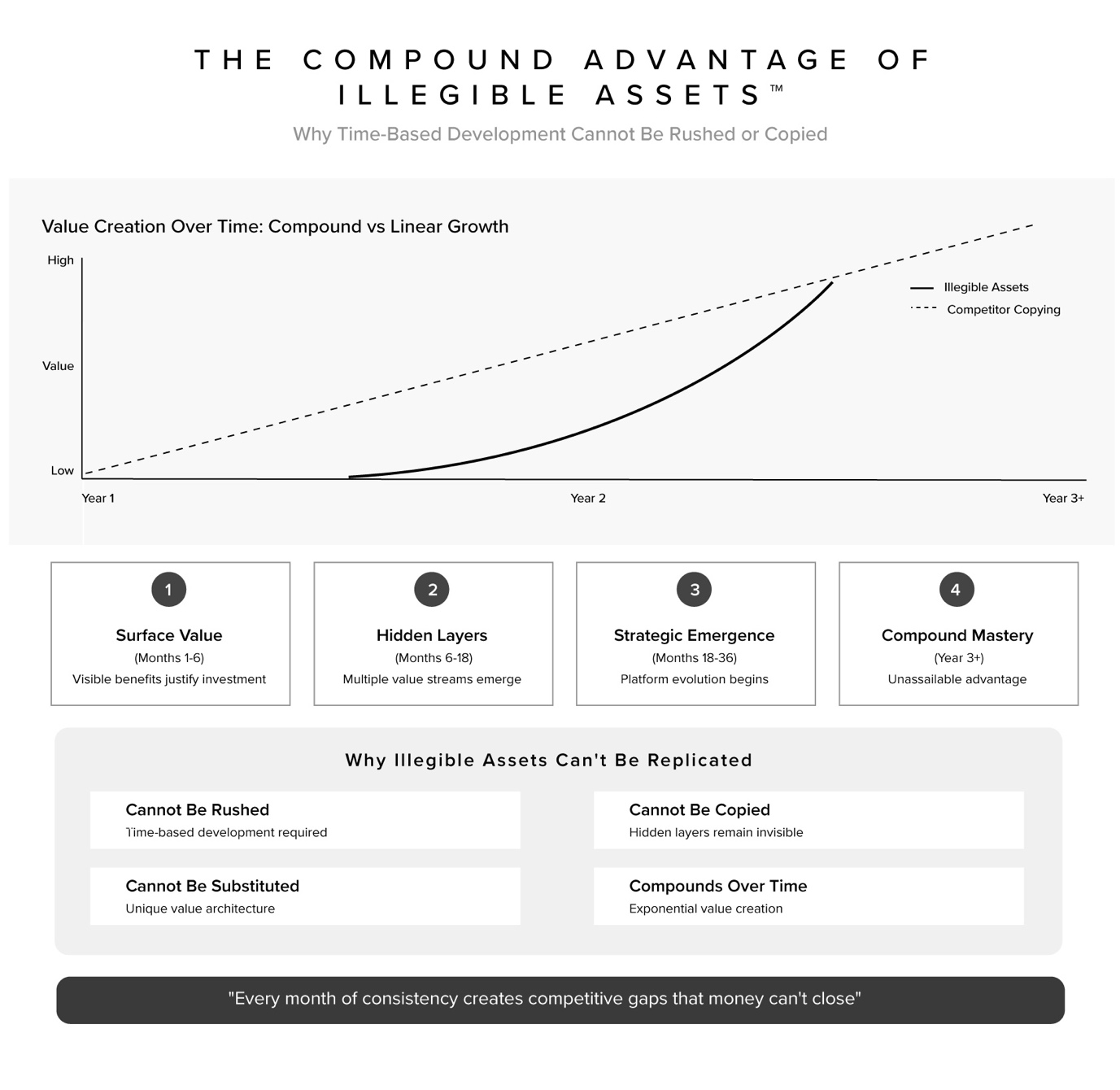
Phase 1: Surface Value Creation (Months 1-6)
Objective: Establish visible value that justifies investment while beginning hidden system development
Strategic Actions:
- Identify Initial Value Layer: Choose assets that provide immediate, tangible value to stakeholders
- Design Hidden Integration: Plan how surface assets will connect to multiple value streams
- Begin Consistency Building: Establish sustainable execution rhythms for compound development
- Document Learning Systems: Create processes for capturing insights and optimizing asset development
Success Criteria: Visible value delivery with hidden system foundation established
Phase 2: Hidden Layer Development (Months 6-18)
Objective: Build multiple value streams and system interconnections that compound strategic advantage
Strategic Actions:
- Expand Value Streams: Develop cross-functional benefits from single asset investments
- Create Data Systems: Build intelligence gathering and competitive advantage generation
- Strengthen Integration: Connect assets across business functions for compound effect creation
- Develop Protection Mechanisms: Increase system complexity and competitive analysis resistance
Success Criteria: Multiple hidden value streams operating with measurable compound effects
Phase 3: Strategic Emergence Enablement (Months 18-36)
Objective: Enable business model evolution and market position transformation through compound systems
Strategic Actions:
- Platform Evolution: Transform assets into foundations for new business models and revenue streams
- Market Position Building: Use compound advantages for category creation and competitive standard setting
- Partnership Attraction: Leverage system strength for strategic collaboration and ecosystem development
- Investment Preparation: Build transferable value for growth capital, partnerships, or exit opportunities
Success Criteria: Business model evolution capabilities with market position transformation evidence
Phase 4: Compound Advantage Mastery (Months 36+)
Objective: Achieve sustainable competitive advantage through mature illegible compounding systems
Strategic Actions:
- System Evolution: Continuously develop and strengthen compound advantage architecture
- Competitive Moat Deepening: Increase system complexity and competitive replication difficulty
- Value Multiplication: Optimize compound effects for exponential strategic advantage creation
- Market Leadership: Use compound advantages for industry leadership and standard setting
Success Criteria: Unassailable competitive position with self-reinforcing advantage systems
VRIO Framework vs Illegible Compounding Assets: What Sustainable Advantage Really Needs in 2025
TL;DR: 2025 requires hidden compound systems over visible resource analysis for sustainable competitive advantage.
Beyond Visible Resources: Hidden System Intelligence
2025 sustainable advantage priorities:
- Hidden compound system building over visible resource optimization
- Time-based advantage creation over barrier-dependent protection
- Multi-layer value integration over single resource development
- Strategic illegibility design over competitive analysis resistance
The AI-Era Competitive Advantage Thesis
Traditional advantage logic: Build sustainable advantage through valuable, rare, inimitable resources with organizational support 2025 advantage logic: Create Illegible Compounding Assetsthat generate exponential value through hidden systems that cannot be seen, understood, or replicated
Why Illegible Compounding Assets matter more: AI accelerates competitive analysis and resource replication, making traditional VRIO advantages temporary. Success requires hidden compound systems that create advantages through time-based development and multi-layer complexity.
Engineering Your Hidden Competitive Advantage Architecture
Illegible Compounding Assets represent evolution beyond traditional VRIO Framework toward sustainable competitive advantage through hidden system architecture that creates exponential value through time-based compound development.
Whether you’re building service businesses, developing technology platforms, or creating market leadership positions, Illegible Compounding Assets provide the methodology for creating sustainable advantages that strengthen rather than erode through competitive pressure.
The choice: Continue conducting VRIO Framework resource analysis hoping visible advantages will remain sustainable, or build Illegible Compounding Assets that create hidden competitive moats through systematic compound development.
Get Illegible Compounding Assets implementation guides and complete Strategic Architecture™ methodology delivered weekly → Subscribe to our Substack newsletter for hidden system building and compound advantage creation techniques that build unassailable competitive positions.
Join thousands of strategic leaders learning to build illegible compound advantages rather than hoping visible resource analysis will create sustainable competitive protection.
Prepared by the Strategic Architecture™ Editorial Team, bringing clarity to the frameworks shaping the AI era.
VRIO Framework analyzes visible resources for competitive advantage that erodes through AI-accelerated imitation. Illegible Compounding Assets create hidden systems with multiple value layers that compound over time and cannot be replicated through surface copying. Instead of «our resources are valuable and rare,» you build «our hidden systems create exponential advantages competitors cannot see or understand.»
Yes, but prioritize Illegible Compounding Assets for sustainable advantage creation, then support with VRIO for visible resource optimization. Focus on hidden system building first (proof of compound advantage), then use traditional analysis for tactical resource management within illegible asset contexts.
Look for assets that appear simple but could generate multiple value streams through hidden layers. Ask: «What seemingly basic investment could create benefits across multiple business functions over time?» Focus on assets requiring consistency and time for full value realization, like content systems, trust building, or expertise development.
Surface copying actually strengthens your position by validating the approach while missing the hidden value creation. «Competitors copied our video content but missed the trust compounding, audience building, and market positioning systems underneath.» Surface imitation without system understanding wastes competitor resources while deepening your compound advantages.
Trademark Notice
© 2025 Edward Azorbo. All rights reserved.
Strategic Inevitability™, Strategic Architecture, Illegible Compounding Assets, Power Numbers™, Strategic Triggers™, Clear Paths™, Mathematical Freedom Recognition, Trinity Framework™, and all related names, logos, and framework titles are trademarks or registered trademarks of Edward Azorbo in the United States, the European Union, and other jurisdictions.
Unauthorized use, reproduction, or modification of these marks and the proprietary methodologies they represent is strictly prohibited. All other trademarks and trade names are the property of their respective owners.