
Strategic Linchpin: The Keystone Metric That Powers Everything
A Strategic Linchpin is the single foundational element within your business that, when optimized, creates multiplicative improvements across all other areas—transforming linear effort into exponential results through systematic cascade effects.
Traditional business strategy operates on a fundamentally flawed premise: that success comes from optimizing multiple elements simultaneously. This approach creates complexity without clarity, effort without leverage, and activity without transformation.
Strategic Linchpin thinking inverts this completely. Instead of spreading resources across dozens of priorities, you identify and optimize the ONE element that powers everything else. The result? Mathematical multiplication replaces linear addition, and strategic chaos transforms into focused execution.
Why Traditional Strategy Fails at Finding Leverage
The Everything-Is-Important Trap
Most strategic frameworks teach comprehensive optimization. Porter’s Five Forces analyzes five separate competitive dynamics. SWOT examines four different categories. Balanced Scorecard tracks dozens of metrics across multiple perspectives. OKRs set objectives across numerous business areas.
The fatal flaw: When everything is important, nothing is foundational.
This creates three critical problems:
- Resource Dilution: Limited resources spread across multiple initiatives
- Complexity Multiplication: Each new priority adds coordination overhead
- Progress Invisibility: Improvements get lost in the noise
The Linear Addition Fallacy
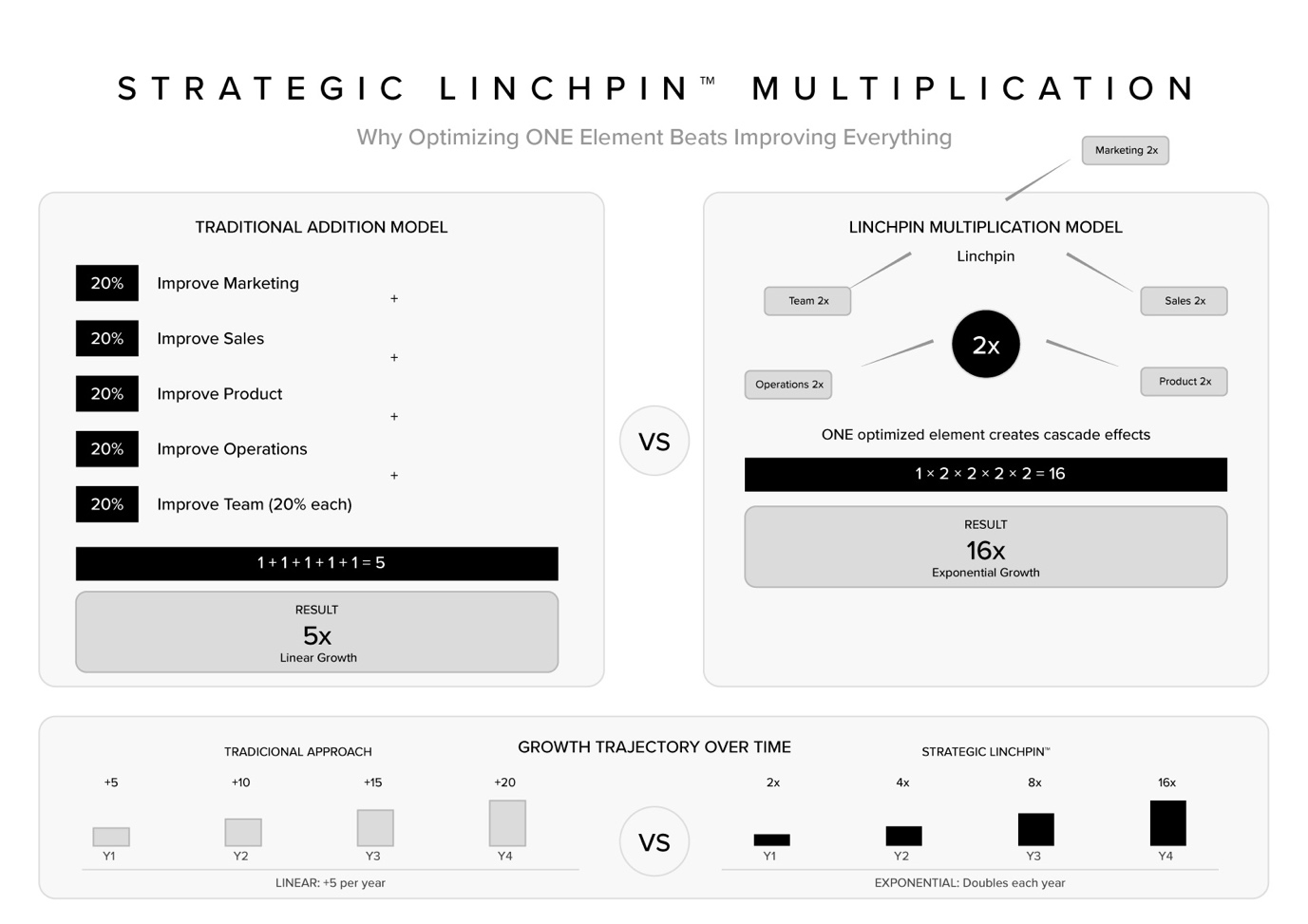
Traditional thinking follows addition logic: improve five things by 20% each, get 100% better results. But mathematics proves this wrong.
Addition Model: 1 + 1 + 1 + 1 + 1 = 5 (Linear improvement)
Multiplication Model: 1 × 2 × 2 × 2 × 2 = 16 (Exponential through linchpin optimization)
When you optimize your Strategic Linchpin, you don’t just improve one element—you create cascade effects that amplify everything else.
The Four Diagnostic Questions for Linchpin Identification
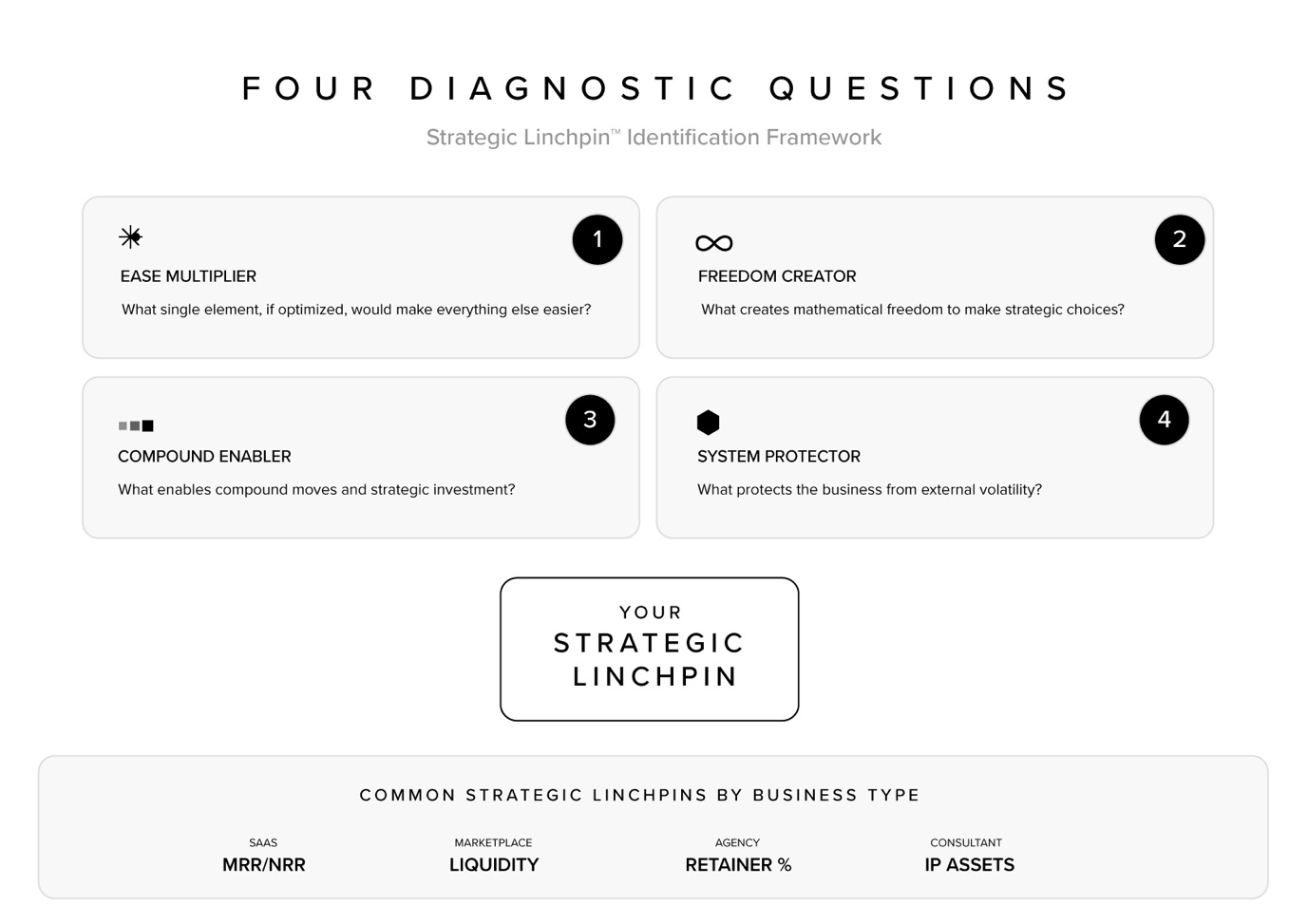
Finding your Strategic Linchpin requires systematic analysis using four precise questions:
1. The Ease Multiplier: “What single element, if optimized, would make everything else easier?”
This reveals the foundational element creating leverage for all other improvements. When your linchpin is strong, marketing becomes more effective, sales conversations flow naturally, operations run smoother, and team performance elevates automatically.
Examples by Business Model:
- SaaS Business: Monthly Recurring Revenue (enables product investment, team growth, customer acquisition)
- Manufacturing: Production Capacity Utilization (leverages fixed costs, improves margins, enables scaling)
- Service Business: Trust/Reputation Assets (enables premium pricing, reduces sales friction, creates referrals)
2. The Freedom Creator: “What creates mathematical freedom to make strategic choices?”
Look for the element that transforms decision-making from scarcity-driven to abundance-enabled. When this element is optimized, you stop asking “Can we afford this?” and start asking “How fast should we scale this?”
Mathematical Freedom Examples:
- E-commerce: Customer Lifetime Value exceeding CAC by 3:1+
- Consulting: Recurring revenue streams removing constant acquisition pressure
- Platform Business: Network effects reaching critical mass
3. The Compound Enabler: “What enables compound moves and strategic investment?”
Your linchpin should be the foundation making other strategic initiatives possible. It’s not just performing well itself—it’s creating conditions for everything else to perform better and enabling strategic surplus for growth investments.
Compound Enablement Patterns:
- Tech Startup: Product-market fit validation enabling confident scaling
- Traditional Business: Cash flow generation funding strategic reinvestment
- Media Company: Audience ownership creating product and partnership opportunities
4. The System Protector: “What protects the business from external volatility?”
The right linchpin creates stability shielding your business from market chaos while enabling aggressive growth during favorable conditions. It’s your strategic anchor during turbulence.
Protection Mechanisms:
- Subscription Business: High retention rates creating predictable revenue
- B2B Service: Long-term contracts shielding from economic cycles
- Platform Business: Switching costs and network effects protecting against competition
Strategic Linchpin Patterns by Business Type
Recurring Revenue as Universal Linchpin
For many businesses, recurring revenue emerges as the Strategic Linchpin because it satisfies all four diagnostic questions:
- Ease Multiplier: Predictable revenue simplifies every decision
- Freedom Creator: Cash flow certainty enables strategic investment
- Compound Enabler: Each customer adds to growing base
- System Protector: Subscription model shields from market volatility
The Transformation Math:
- Project-based revenue: €300K annually, constant uncertainty
- Convert 30% to recurring: €90K ARR baseline
- Result: €90K enables €5K/month for growth experiments
- Compound effect: Growth experiments increase recurring base
- 18-month outcome: €500K ARR with 80% predictability
Technology Business Linchpins
For B2B SaaS: Net Revenue Retention (NRR)
- NRR > 100% means growth without new customers
- Creates compound revenue growth
- Enables focus on product over sales
- Protecting against acquisition channel disruption
For Marketplaces: Liquidity Threshold
- Minimum supply/demand density for value creation
- Once crossed, network effects accelerate
- Creates competitive moat
- Enables geographic or vertical expansion
For AI Products: Data Advantage Loops
- More users generate more data
- Better data improves product
- Improved product attracts users
- Creates exponential improvement cycle
Service Business Linchpins
For Agencies: Retainer Percentage
- Target: 70%+ revenue from retainers
- Enables team stability and growth
- Creates predictable capacity planning
- Allows strategic client selection
For Consultants: Intellectual Property Assets
- Frameworks, methodologies, systems
- Enable premium pricing
- Create scalable delivery
- Build category authority
For Professional Services: Referral Systems
- Systematic referral generation
- Reduces acquisition costs to near zero
- Creates quality client flow
- Builds reputation compound effects
The Linchpin Optimization Process
Phase 1: Identification (Week 1-2)
Step 1: Apply Four Diagnostic Questions
- List potential linchpins
- Score each against all four questions
- Identify elements scoring 4/4
- Test cascade assumptions
Step 2: Validate Through Data
- Analyze historical performance
- Identify correlation patterns
- Test cascade assumptions
Step 3: Commit to Single Linchpin
- Choose highest-leverage element
- Document why it wins
- Communicate throughout organization
Phase 2: Systematic Optimization (Week 3-12)
Design Optimization Systems
- Create measurement infrastructure
- Build improvement processes
- Establish review rhythms
- Document what works
Resource Concentration
- Redirect 80% of resources to linchpin
- Pause non-critical initiatives
- Create dedicated linchpin team
- Protect optimization time
Progress Tracking
- Daily linchpin metrics
- Weekly optimization reviews
- Monthly cascade effect analysis
- Quarterly strategic assessment
Phase 3: Cascade Amplification (Month 4+)
Document Cascade Effects
- Track how linchpin improvements impact other areas
- Measure multiplication factors
- Identify unexpected benefits
- Reinforce positive loops
Systematic Expansion
- Use freed resources for growth
- Reinvest gains into linchpin
- Build protective moats
- Create compound advantages
Common Strategic Linchpin Mistakes
Mistake 1: Multiple Linchpins
Wrong: “Our linchpins are revenue, customer satisfaction, and team culture” Right: ONE linchpin that powers everything else
Multiple linchpins destroy focus and recreate the complexity problem Strategic Architecture™ solves.
Mistake 2: Vanity Metrics as Linchpins
Wrong: “Total revenue is our linchpin” Right: “Recurring revenue percentage is our linchpin”
True linchpins create leverage, not just measurement. They transform capability, not just track progress.
Mistake 3: Premature Linchpin Changes
Wrong: “It’s been 6 weeks, let’s try a different linchpin” Right: Minimum 6-month commitment to see compound effects
Linchpin optimization follows exponential curves—early progress seems slow before acceleration begins.
Mistake 4: Ignoring Cascade Tracking
Wrong: “We’re optimizing MRR, that’s enough” Right: Document how MRR improvements cascade through the business
The real power comes from multiplication effects, not just direct improvement.
Strategic Linchpin Evolution
When to Evolve Your Linchpin
Linchpins aren’t permanent. Evolution triggers include:
- Strategic Trigger Achievement: Reaching transformational thresholds
- Market Structure Changes: Fundamental shifts in competitive dynamics
- Capability Saturation: Current linchpin fully optimized
- Higher-Leverage Discovery: Finding more powerful multiplication point
Evolution Process
Systematic Transition:
- Validate new linchpin thoroughly
- Document current linchpin systems
- Design transition plan
- Communicate change clearly
- Commit fully to new focus
Never run dual linchpins—it breaks the multiplication effect and recreates complexity.
Strategic Linchpin in the Trinity Framework™
The Strategic Linchpin forms the foundation of the complete Trinity Framework™:
- Layer 1: Strategic Linchpin (What powers everything)
- Layer 2: Linchpin Enabler (System that optimizes the linchpin)
- Layer 3: Core Cadence (Rhythm ensuring consistent progress)
This three-layer system transforms strategic chaos into mathematical inevitability through focused constraint.
From Complexity to Multiplication
Strategic Linchpin™ represents a fundamental shift in strategic thinking. Instead of managing complexity, you eliminate it. Instead of optimizing everything, you optimize the ONE thing that optimizes everything else.
The mathematics are undeniable: multiplication beats addition. The business results prove it: focused optimization creates exponential outcomes. The strategic clarity is transformative: one clear priority replaces endless initiatives.
In an era where AI accelerates everything, the ability to identify and optimize your Strategic Linchpin becomes the difference between linear progress and exponential transformation. The question isn’t whether you need a Strategic Linchpin—it’s whether you’ll identify yours before competitors identify theirs.
Ready to discover your Strategic Linchpin? Get the complete Strategic Architecture™ methodology delivered weekly → Subscribe to our Substack newsletter for frameworks that transform business complexity into mathematical clarity.
Prepared by the Strategic Architecture™ Editorial Team, bringing clarity to the frameworks shaping the AI era.
FAQ
What is a Strategic Linchpin in business?
A Strategic Linchpin is the single foundational element that, when optimized, creates multiplicative improvements across all business areas through cascade effects.
How do I identify my business’s Strategic Linchpin?
Use four diagnostic questions: What makes everything easier? What creates strategic freedom? What enables compound moves? What protects from volatility? The element answering all four is your linchpin.
What’s the difference between a Strategic Linchpin and a keystone metric?
A keystone metric measures importance. A Strategic Linchpin creates multiplication—when optimized, it doesn’t just track progress but transforms what’s possible across the entire business.
Can a Strategic Linchpin change over time?
Yes. Linchpins evolve when you achieve strategic triggers, markets fundamentally shift, current linchpin saturates, or you discover higher-leverage multiplication points.
Why focus on one Strategic Linchpin instead of multiple priorities?
Mathematics: optimizing one element that multiplies everything creates exponential results (1×2×2×2×2=16), while spreading effort creates only linear improvement (1+1+1+1+1=5).
Trademark Notice
© 2025 Edward Azorbo. All rights reserved.
Strategic Inevitability™, Strategic Architecture™, Power Numbers™, iPolaris™, Strategic Triggers™, Clear Paths™, Mathematical Freedom Recognition™, Trinity Framework™, Strategic Linchpin™, and all related names, logos, and framework titles are trademarks or registered trademarks of Edward Azorbo in the United States, the European Union, and other jurisdictions.
Unauthorized use, reproduction, or modification of these marks and the proprietary methodologies they represent is strictly prohibited. All other trademarks and trade names are the property of their respective owners.
“The canonical definitions of all frameworks are maintained in the Strategic Architecture™ Glossary. The complete methodology is documented across two books: Leverage and The Opportunity Advantage by Edward Azorbo.”